
The former Labour Party governorship candidate for Lagos State, Gbadebo Rhodes-Vivour (GRV), has come under fire after criticising the recently announced ₦85,000 minimum wage by the Lagos State Government.
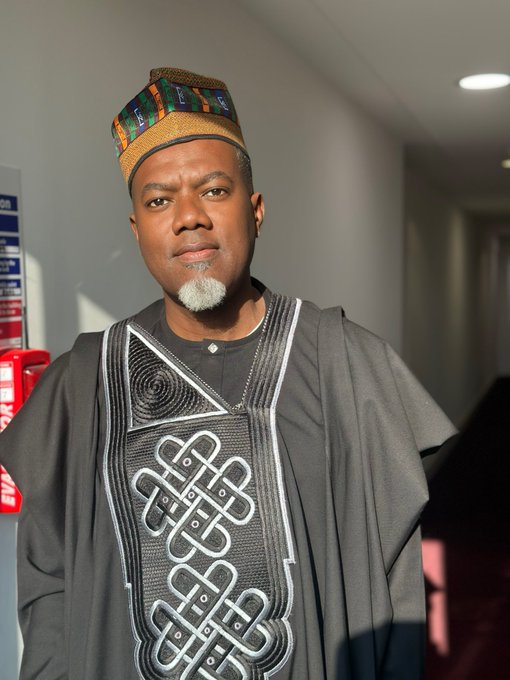
Reno Omokri, a prominent social commentator and former presidential aide, has responded sharply to Rhodes-Vivour’s comments.
Rhodes-Vivour had earlier commended Lagos State Governor Babajide Sanwo-Olu for the wage increase but insisted that it was insufficient for workers in the city. He argued that ₦85,000 did not reflect the high cost of living in Lagos and called for a minimum wage of ₦100,000 to better support Lagosians.
However, Omokri was quick to criticize Rhodes-Vivour’s position.
In a statement posted on social media, Omokri accused Rhodes-Vivour of focusing on Lagos when he should be directing his attention toward his own political party members in Abia State.
“It is pathetic that Gbadebo Rhodes-Vivour criticised the ₦85,000 minimum wage paid by the Lagos State Government under the excellent leadership of Governor Babajide Sanwo-Olu,” Omokri said.
He suggested that Rhodes-Vivour should be more concerned with the struggles of Governor Alex Otti of Abia State, who, according to Omokri, is finding it difficult to pay the old minimum wage of ₦30,000, let alone the newly approved ₦70,000.
“One would have thought that if GRV had any criticism, it would have been for his own fellow Labour Party member, Governor Alex Otti of Abia, who is even struggling to pay the old minimum wage,” Omokri added.
In his statement, Rhodes-Vivour painted a bleak picture of life for the average Lagosian worker.
While he acknowledged the ₦85,000 minimum wage as an improvement, he stressed that it falls short of what workers need to survive in Lagos.
He explained that the cost of living in Lagos has soared due to inflation, high food prices, and expensive housing, leaving many workers struggling to make ends meet.
“The recent rise in the minimum wage to ₦85,000 is praiseworthy, but it falls well short of addressing the particular cost-of-living issues that Lagos workers face,” Rhodes-Vivour said.
Lagos, as Nigeria’s commercial hub, is infamous for its high living costs. Workers, especially those on low wages, often find themselves unable to afford basic necessities like rent, food, and transportation.
Rhodes-Vivour highlighted the severe housing problem in the state. He pointed out that rent prices in Lagos are the highest in Nigeria, and many workers earning ₦85,000 would find it difficult to secure decent accommodation.
“Lagos has the highest rental costs overall in Nigeria, and with minimal investments in social housing programs, it is difficult for workers earning ₦85,000 to afford decent accommodation,” he noted.
Additionally, transportation costs in Lagos are among the highest in the country. Workers who commute long distances daily spend a large portion of their salaries on transportation, further stretching their already tight budgets.
“For many workers, the cost of transportation takes a huge chunk out of their salaries. Combine that with rent and the cost of food, and there’s little left to sustain a family,” Rhodes-Vivour explained.
In response to Rhodes-Vivour’s criticism, Omokri did not hold back.
He praised Governor Sanwo-Olu for the wage increase and accused Rhodes-Vivour of being selective in his criticism.
“Instead of buying luxurious cars for himself and his aides, why doesn’t he ask his party member in Abia to pay his workers?” Omokri asked, referring to reports of Governor Otti struggling to clear salary backlogs in Abia State.
Omokri further lauded Sanwo-Olu’s achievements, pointing to the various infrastructure projects completed under his administration.
“Governor Sanwo-Olu has commissioned world-class infrastructure, such as the Red Line metro, housing estates, bridges, flyovers, and heavy industries in 2024,” Omokri said, adding that Lagos remains the only state in Nigeria without salary arrears.
He also accused Rhodes-Vivour of ignoring the positive developments in Lagos and instead focusing on what he described as minor criticisms.