
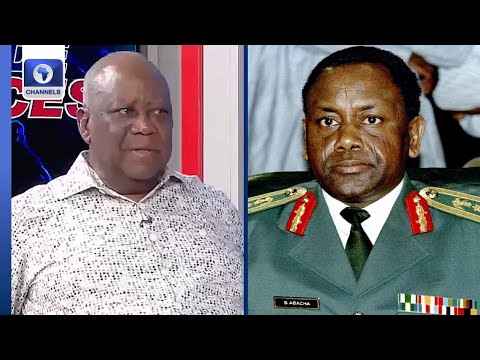
A retired Nigerian Army colonel, Babatunde Bello-Fadile, has claimed that if he had been allowed to resume his post as the aide-de-camp (ADC) to Interim President Ernest Shonekan, General Sani Abacha’s coup in 1993 would not have occurred.
Bello-Fadile, speaking on the Friday edition of Inside Sources with Laolu Akande, aired on Channels Television, explained how he was initially posted to the role of ADC to Shonekan but was never allowed to assume the position.
“I was posted ADC to Shonekan. I don’t know why I was not allowed to resume. Still, if I had been ADC, it (the takeover) probably wouldn’t have happened,” Bello-Fadile said.
He recalled how he was ordered by the Chief of Army Staff to wait until Shonekan returned from Malta, where he had gone for a Commonwealth Heads of State meeting. By the time Shonekan came back, Abacha had already carried out the coup.
Bello-Fadile’s account adds a new layer of intrigue to the story of Nigeria’s political upheaval in the 1990s. The country was in the midst of a transition, with an interim government formed after General Ibrahim Babangida annulled the 1993 election that was supposed to bring MKO Abiola to power.
Sonekan, a businessman, was appointed interim president, and Abacha was serving as the Chief of Defence Staff and Minister of Defence.
On November 18, 1993, only three months after the interim government was formed, Abacha executed a palace coup and removed Sonekan from power.
Bello-Fadile believes that Shonekan’s removal was not only an extraordinary event but also an avoidable one.
A History of Tension
The events of 1993 were the climax of a turbulent period in Nigeria’s history. In 1993, General Babangida’s regime, which had ruled since 1985, annulled the results of a presidential election that would have seen Abiola, a prominent businessman and politician, become Nigeria’s president. This led to widespread unrest and protests.
In response to the pressure, Babangida resigned and set up an interim government, with Shonekan at the helm. Abacha, despite his position in the interim government, harbored ambitions of his own.
“The military decided to leave after June 12 and an interim government was set up and it was agreed that we would midwife an elected government,” Bello-Fadile explained, referring to the supposed understanding that the military would allow a return to civilian rule.
But this plan was disrupted by Abacha, who had other ideas.
Confronting Abacha
Bello-Fadile’s recollections don’t end with his non-resumption as ADC. He also spoke about his later confrontations with Abacha after the coup.
He explained that Abacha had no intention of returning power to civilians, despite the agreement that the military would step aside after June 12.
Bello-Fadile revealed that Abacha had dismissed those in the military who supported the return to democracy.
“My friend (Abacha) decided to say no,” he said. “The second in command to Shonekan (Abacha) organised a resignation and threw away the agreement that the military had had enough, and should set a path for democratic government.”
He continued, “Then Abacha said these are IBB boys behind the insistence for a return to democracy. And all of a sudden, he announced their retirement.”
Bello-Fadile explained how he survived a purge in which 17 of his colleagues in the military were retired by Abacha.
“I was still in the military at the time and he retired all my friends, 17 of them. I don’t know how I survived that,” Bello-Fadile said.
The retired colonel went on to describe the panels Abacha set up after taking power. These panels were intended to review Nigeria’s legal and police systems but were seen as attempts to buy time.
He recalled that during the review of the judiciary, he was the only military officer present, with the others being judges and lawyers. He said that Abacha ignored the recommendations, which included calls for the military to return to the barracks.
A Lasting Impact
Bello-Fadile’s reflections also highlight the broader context of military politics in Nigeria. At the time, there was a significant push for military leaders to step aside and allow a return to civilian rule.
But Abacha’s coup in 1993 set Nigeria on a different path, one that would see him rule as a military dictator for nearly five years before his sudden death in 1998.
Bello-Fadile, however, did not want to see another military leader rise to power. “I didn’t want to overthrow the government. We wanted an interim government back,” he said. “I was the one doing all the running around.”
Despite his efforts, the military’s grip on power remained strong under Abacha, and Nigeria’s transition to democracy was delayed until the late 1990s.
A Reflection on History
Now, over 30 years after the coup, Bello-Fadile looks back on those turbulent days with a sense of regret. He believes that if his role as ADC had been allowed to go forward, history might have played out differently.
“It probably wouldn’t have happened,” he said, referring to the coup. “If I had been ADC, I would have ensured the agreement to return to democracy was followed.”