
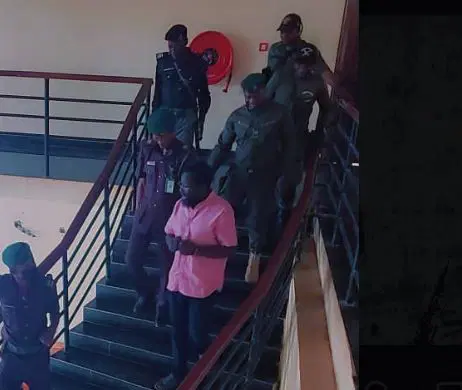
Nigerians have erupted in anger after human rights activist and lawyer, Dele Farotimi, appeared at the Ekiti State High Court in handcuffs on Monday.
Farotimi’s dramatic court appearance came after his arrest last week in Lagos by officers of the Ekiti State Police Command. The arrest was linked to a defamation lawsuit filed by legal icon Chief Afe Babalola, SAN, over allegations in Farotimi’s book, Nigeria and its Criminal Justice System.
The sight of the activist in handcuffs has sparked outrage across social media and among prominent voices in the human rights community, with many describing the incident as a stain on Nigeria’s legal profession.
“An Embarrassment to the Legal Profession”
Farotimi was escorted to court by armed police officers, his hands restrained as if he were a violent criminal. This display has been widely condemned as excessive and unnecessary.
Deji Adeyanju, a vocal human rights lawyer, took to X (formerly Twitter) to express his disgust.
“A lawyer in handcuffs over defamation, not armed robbery, kidnapping, or any crime. Shame on everyone involved in this embarrassment to the legal profession,” Adeyanju wrote.
Adeyanju also accused the police of abducting Farotimi and taking him to Ekiti, a state he claimed is dominated by Babalola’s influence.
Political Prisoner or Defamed Victim?
Chief Afe Babalola, a 95-year-old legal luminary, alleged that Farotimi’s book tarnished his reputation by accusing him of misconduct in Nigeria’s justice system. The high-profile defamation case has stirred debates about the limits of free speech and the use of state resources to settle personal grievances.
Inibehe Effiong, another rights activist and lawyer, decried Farotimi’s treatment as unjustified.
“Can the Nigerian Correctional Service explain why they handcuffed Dele Farotimi for a defamation case? This is preposterous,” Effiong wrote.
He argued that Farotimi posed no security threat and labeled him a “political prisoner” being unfairly targeted.
Public Outcry Over Draconian Measures
Many Nigerians have questioned the use of handcuffs in a case that is civil in nature. Defamation, as critics point out, is not a violent crime, yet Farotimi was treated like a dangerous felon.
Rinu Oduala, a youth activist and prominent voice in Nigeria’s #EndSARS protests, joined the chorus of disapproval.
“Dele Farotimi is put in handcuffs for an offence that doesn’t even exist in the laws. Is he a criminal or a political prisoner?” she asked.
Social media has been ablaze with hashtags like #FreeDeleFarotimiNow, as users accuse the justice system of bias and intimidation.
Bail Comes at a Cost
During Monday’s proceedings, the court granted Farotimi bail under strict conditions. He was required to provide a surety and a sum of N50 million—a condition many believe was deliberately harsh.
Legal experts have described the bail conditions as excessive, raising concerns about access to justice for ordinary Nigerians.
One user, Darey, summarized public sentiment with a scathing post:
“Afe Babalola put Dele Farotimi in handcuffs for defamation, which is a CIVIL MATTER. Nigeria and its CRIMINAL JUSTICE SYSTEM.”
Contextualizing the Lawsuit
Chief Afe Babalola is no stranger to controversy. Widely respected for his contributions to Nigerian law, the senior advocate has also faced criticism for using his considerable influence to protect his image.
This defamation case stems from allegations Farotimi made in his book, which reportedly criticized Babalola’s role in Nigeria’s judiciary. Farotimi has previously accused the legal elite of perpetuating systemic injustices, a claim that has made him both celebrated and controversial.
Farotimi’s case has exposed deep divisions within Nigeria’s legal community. Some believe that Babalola’s action was necessary to defend his reputation. Others argue that dragging a fellow lawyer to court—and in handcuffs, no less—sets a dangerous precedent.
“The legal profession is supposed to protect the rights of individuals, not suppress them,” Effiong stated.
A Warning to Police Officers Nationwide
This case has served as a stark reminder of the consequences of police misconduct.
It underscores the need for more robust training and accountability measures for officers in Nigeria.
“This could have been anyone,” @Mr_Robmichael1 remarked in his update.
“It’s not just about my brother. It’s about holding people accountable for their actions and ensuring this doesn’t happen again.”
The incident also raises questions about the effectiveness of internal police checks and balances.
“This is why we need real reform,” said a local human rights advocate.
“The police cannot continue to behave as if they are above the law.”