
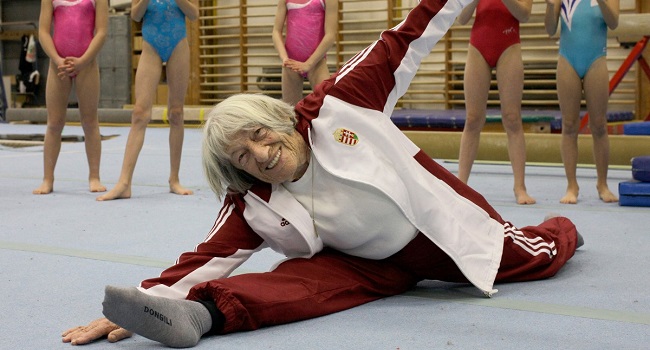
Agnes Keleti, the world’s oldest Olympic gold medalist and a survivor of the Holocaust, has passed away at the age of 103, just days before celebrating her 104th birthday. The Hungarian icon, whose life story captivated the world, died on Thursday in a Budapest hospital after being admitted with pneumonia, her family confirmed.
Keleti’s remarkable journey—from surviving one of history’s darkest chapters to becoming a gymnastics legend—left an indelible mark on the world. Known as Hungary’s most decorated gymnast, she won ten Olympic medals, including five golds, making her one of the greatest sports figures in history. But her story was more than just athletic achievement. It was one of resilience, hope, and the determination to defy the odds.
“We pray for her, and are grateful for the vitality she showed throughout her life,” her son, Rafael Biro-Keleti, said in a statement. “We had hoped to celebrate her 104th birthday with her, but we will remember her for her courage and the extraordinary legacy she leaves behind.”
A Survivor of Adversity: From the Holocaust to the Gymnastics Floor
Keleti was born as Agnes Klein on January 9, 1921, in Budapest. As a young girl, she showed promise in various sports, but it was gymnastics where she truly excelled. However, her promising career was interrupted by the outbreak of World War II. Like many Jews in Europe during the Holocaust, Keleti was forced to confront unimaginable horrors. She survived the brutalities of Nazi occupation, which claimed the lives of many of her family members. But despite the trauma, she rebuilt her life with an unyielding resolve.
“I was competing not because I liked it, but I did it because I wanted to see the world,” Keleti famously said in an interview with AFP in 2016. Her desire to escape Hungary’s communist regime and explore the world beyond the Iron Curtain became a driving force behind her athletic pursuits.
Olympic Glory After 30: A Late Bloomer in a Young Athlete’s World
Keleti’s Olympic journey began when she was already in her 30s, an age considered advanced for a gymnast at the time. Nonetheless, she proved that age was no barrier to success. At the 1952 Helsinki Olympics, Keleti won four gold medals, solidifying her place in history. But it was at the 1956 Melbourne Olympics that she truly made her mark, claiming a total of six medals—two of them gold.
Her tenacity and skill on the gymnastics floor earned her the moniker “the queen of gymnastics.” Yet, her motivation was not rooted in fame or glory. Instead, Keleti viewed sports as a ticket to freedom, a means to break away from Hungary’s oppressive political climate.
At the time, Hungary was under communist rule, and the 1956 Olympic Games came in the wake of the Hungarian Revolution, a failed attempt to break free from Soviet influence. Many Hungarian athletes, including Keleti, were reluctant to return home after the competition, fearing for their safety. Keleti, like many others, chose not to return to Hungary and instead sought refuge in Israel.
A New Life in Israel and a Family
After the Melbourne Olympics, Keleti moved to Israel, where she built a new life. In 1959, she married Robert Biro, a Hungarian sports teacher, and the couple had two children. Keleti also found a new calling as a physical education teacher and coach, helping to shape the future of gymnastics in Israel.
While her competitive days were behind her, Keleti continued to influence the sport. She became the coach of the Israeli national gymnastics team, leaving a lasting legacy on young athletes. She also continued to contribute to her community and was an admired figure in both her adopted homeland and in Hungary.
Her connection to her homeland, however, remained strong. In 1983, after many years of separation, Keleti was able to return to Hungary to participate in the World Gymnastics Championships. The trip was a symbolic homecoming, as it marked the first time she had returned to the communist country since her departure in 1956. In 2015, after the collapse of the Soviet bloc, Keleti moved back to Hungary permanently.
An Unforgettable Legacy
In recent years, Keleti’s life was celebrated globally as a testament to perseverance and the power of the human spirit. In 2020, she reflected on her extraordinary journey just weeks before her 100th birthday.
“It was worth doing something well in life, considering the attention I have received. I get the shivers when I see all the articles written about me,” she said in an interview. “I never imagined that my story would become so big.”
Keleti’s contributions to the sport of gymnastics and her survival of unimaginable challenges have made her an inspiration to generations of athletes and ordinary people alike. Her longevity and vitality in her later years further elevated her status as a symbol of endurance and strength. The world will remember her not just as an Olympic champion, but as a beacon of resilience, determination, and hope.
A Tribute to a Champion
Tributes have poured in from all corners of the world, from former athletes to international organizations. The International Olympic Committee (IOC) expressed its sorrow at her passing, calling her a “true pioneer” in gymnastics. “Her courage and passion for life have inspired countless people,” said IOC President Thomas Bach in a statement.
In Hungary, Keleti’s death is mourned as the loss of a national treasure. The Hungarian Olympic Committee praised her not only for her athletic achievements but for her indomitable spirit in the face of adversity.
“She was a symbol of hope, and her life story will continue to inspire generations of Hungarians and people all over the world,” said the Committee’s president, Krisztian Kulcsar.
As the world remembers Agnes Keleti, it is clear that her legacy is more than just the ten Olympic medals she won. Her life, marked by survival, sacrifice, and triumph, will endure as a shining example of what it means to persevere against all odds.
For those who knew her, Keleti’s story was more than the remarkable feats she achieved in the gym; it was the story of a woman who never gave up, no matter how difficult the journey.