
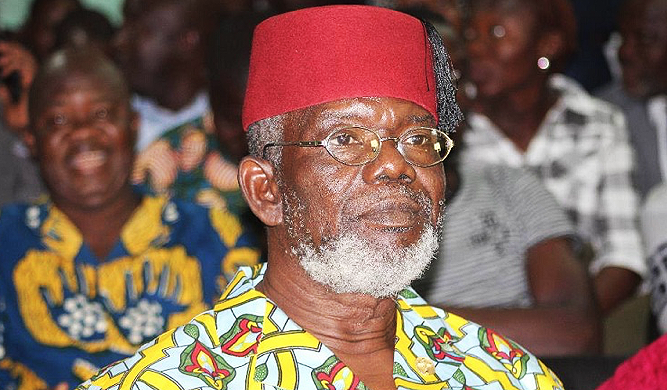
In an extraordinary display of mourning, thousands of Liberians gathered in Nimba County on Saturday to honor the life of Prince Johnson, a man whose name is etched in both fear and reverence in the nation’s turbulent history. Johnson, a former warlord notorious for his role in Liberia’s brutal civil wars, later transitioned into a polarizing political figure who wielded significant influence until his death in November 2024 at the age of 72.
The five-day state funeral culminated in Ganta City, where his body was interred at the PYJ Polytechnic University, an institution he founded and named after himself. Supporters from his home county of Nimba, including farmers, politicians, and traditional leaders, flooded the grounds to pay their respects. Many donned traditional attire, some painting their faces with red and white chalk, while others carried sticks fashioned into guns to symbolize Johnson’s warrior-like spirit.
A Legacy of Blood and Power
Prince Johnson rose to infamy in 1990 during the first Liberian civil war, when he appeared in a gruesome video calmly sipping beer while his fighters tortured and killed then-President Samuel Doe. That shocking scene became a defining image of the conflict, which lasted from 1989 to 2003, claiming an estimated 250,000 lives and leaving countless survivors scarred.
Johnson’s notoriety extended beyond that single event. A 2009 Truth and Reconciliation Commission report named him the individual responsible for the highest number of violations during the war. His alleged crimes included massacres, extortion, forced recruitment of child soldiers, torture, and rape. Despite these accusations, Johnson never faced prosecution, as Liberia failed to implement the commission’s recommendations to establish a war crimes court.
“He was both a hero and a villain, depending on who you ask,” said Professor Gbengai Matthews, a political analyst at the University of Liberia. “To some, he was a defender of Nimba County. To others, he was the face of Liberia’s darkest days.”
Supporters Celebrate His Legacy
In death, as in life, Johnson remained a divisive figure. During Saturday’s funeral, President Joseph Boakai, Vice President Jeremiah Koung, and other prominent officials joined throngs of mourners who hailed Johnson as a protector of his people.
“The biggest tree that we all depended on has fallen,” said Charles G. Wondor, a 65-year-old farmer from Nimba. “We don’t think we can ever get anyone like him again.”
Johnson’s family, clad in white, stood solemnly by as another group of supporters—dressed in black with red hats—beat drums, clapped, and sang traditional songs. The funeral reflected the cultural and political complexities of Liberia, a nation still grappling with the ghosts of its past.
The Political Kingmaker
After the war, Johnson sought to reinvent himself, returning to Liberia in 2004 following 12 years of exile in Nigeria. He adopted the role of a preacher, delivering sermons of peace and reconciliation in an evangelical church. In 2005, he was elected as a senator for Nimba County, a position he held for nearly two decades.
Despite his violent past, Johnson enjoyed unwavering support from his constituents, who viewed him as a defender of their interests. His political influence extended far beyond his county. He acted as a kingmaker in Liberia’s last three presidential elections, a role that earned him respect among some and condemnation from others.
“He played the game of politics masterfully,” noted Matthews. “His ability to remain relevant, despite the shadow of his past, is a testament to his charisma and understanding of Liberian politics.”
A Controversial Advocate Against Justice
While Johnson’s supporters celebrated his contributions, his critics decried his consistent opposition to the establishment of a war crimes court. He argued that prosecuting former warlords could destabilize Liberia, a claim that human rights advocates have dismissed as self-serving.
“I have done nothing criminal,” Johnson declared during his 2011 presidential campaign, in which he secured 11.4 percent of the vote. “I fought to defend my people who were led to the slaughterhouse like chickens and goats by the Doe regime.”
This steadfast refusal to acknowledge wrongdoing only deepened the divide between those who viewed him as a hero and those who saw him as an unrepentant war criminal.
A Nation’s Struggle with Accountability
Johnson’s funeral serves as a stark reminder of Liberia’s unresolved struggle with justice and reconciliation. Many of the warlords responsible for atrocities during the civil wars have avoided prosecution, leaving victims and their families without closure.
Human rights activist Siafa George expressed frustration over Liberia’s failure to hold figures like Johnson accountable. “How do we move forward as a nation when those responsible for so much pain are celebrated instead of facing justice?” he asked.
Despite such criticisms, Johnson’s supporters remain steadfast in their admiration. “He was not perfect, but he loved Nimba and Liberia,” said Wondor. “He gave us hope when no one else did.”
A Polarizing Figure, Even in Death
As Liberia reflects on Johnson’s life and legacy, his death has reopened old wounds and sparked renewed calls for accountability. His burial at the university he founded symbolizes his lasting imprint on Nimba County, while the absence of a war crimes court underscores Liberia’s ongoing challenges in confronting its past.
For now, Johnson’s supporters mourn the loss of what they see as a pillar of their community, while his critics lament what they view as the perpetuation of impunity. In the words of Professor Matthews, “Prince Johnson’s story is Liberia’s story: one of pain, resilience, and a complicated quest for justice.”