
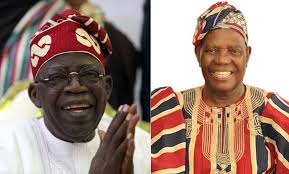
In an exclusive revelation, former Governor of Osun State and pioneer national chairman of the All Progressives Congress (APC), Chief Bisi Akande, has opened up about former President Muhammadu Buhari’s discontent with his vice president, Yemi Osinbajo, contesting against Bola Tinubu for the party’s presidential ticket in the 2023 elections.
Speaking candidly on a podcast hosted by Edmund Obilo, Akande, who has been a key figure in Nigerian politics for decades, provided an intriguing insight into the internal dynamics of the APC during the run-up to the 2023 general elections. According to Akande, Buhari was not entirely pleased with Osinbajo’s decision to challenge Tinubu for the presidential slot, which led to a bitter contest during the party’s primaries in 2022.
Akande recalled that, despite several attempts to prevent friction within the party’s Yoruba faction, Osinbajo refused to step down in favor of Tinubu, who had long been seen as the presumptive candidate. “There were efforts to ensure unity among the Yoruba contenders, but Osinbajo stood firm in his bid,” Akande said. “Buhari was not happy with this, but he never directly told me so.”
The admission is significant as it sheds light on a sensitive moment in the APC’s history, one that threatened to unravel the delicate balance of power among its key figures. Akande’s remarks underline the deep complexities of loyalty, ambition, and party politics within the APC, as well as the growing tensions between Buhari and his vice president during their tenure.
Akande went on to explain that, during his discussions with Buhari, he probed the former president on whether he had actively influenced Osinbajo’s decision to contest against Tinubu. In response, Buhari denied any involvement in the decision, explaining that, in his view, a loyal protégé would not go up against their mentor for the top position.
“I asked him many questions, including whether he had instigated Osinbajo to contest against Tinubu,” Akande recalled. “He said no, and he added that in his culture, when your mentor is interested in a position, you don’t contest with him. That was the kind of relationship he had with Tinubu.”
The comments are particularly poignant given the fact that Buhari’s endorsement carried significant weight within the party. Many had expected that the support of Buhari, a revered figure within APC and the broader Nigerian political landscape, would have resulted in a more unified approach among the party’s key figures. However, Osinbajo’s determination to stake his own claim to the presidency created a schism that threatened to spill over into public view.
In the heat of the 2023 primaries, Tinubu emerged victorious, securing 1,271 votes to clinch the party’s ticket. He defeated 13 other aspirants, including Osinbajo, in a dramatic contest that left the political world on edge. Osinbajo’s participation in the race was widely seen as an internal challenge to Tinubu’s aspirations, especially considering the longstanding political relationship between the two men.
For many in the APC, the contest between Tinubu and Osinbajo was a sign of the changing tides within the party. Both men are influential figures, with their own loyal bases of support, but the competition between them was more than just a political rivalry. It was also a contest of ideologies and visions for the future of the country.
Although Buhari refrained from publicly opposing Osinbajo’s bid, Akande’s comments indicate that there was an underlying tension within the corridors of power, with Buhari himself not entirely at ease with the situation. The idea of a vice president challenging his superior for the top position in a party, particularly one as powerful as the APC, was viewed as unconventional and fraught with potential consequences for party unity.
The interview also highlighted Akande’s perspective on loyalty and tradition within the APC. As a founding member of the party, Akande emphasized the importance of maintaining harmony, especially among the party’s key players. His comments suggest that he was uncomfortable with the fracturing of the party that occurred when Osinbajo chose to run against Tinubu, even though the former vice president had every right to pursue his own political ambitions.
Despite the tension, Tinubu’s victory in the primaries marked a decisive moment for the APC, solidifying his position as the party’s flag-bearer for the 2023 elections. In the end, Osinbajo’s challenge did not derail Tinubu’s ambitions, but it did serve as a reminder of the complexities and challenges that come with navigating Nigeria’s political landscape.
Osinbajo, in contrast, was left to reflect on his political future following his loss in the primaries. While he did not win the ticket, his campaign gave him a platform to demonstrate his political strength and his vision for the country. His bid also underscored the growing influence of the Yoruba faction within the APC, a significant demographic that remains a key constituency in Nigerian politics.
The events leading up to the 2023 primaries also raised questions about the nature of mentorship and loyalty in Nigerian politics. The idea that a vice president, who had served under Buhari for eight years, would challenge his own political ally for the presidency speaks to the deeply competitive nature of Nigerian politics, where ambition often overrides traditional bonds of loyalty.
Akande’s revelations provide a window into the internal power struggles and political calculations that shaped the APC’s decision-making process in the lead-up to the 2023 elections. His reflections offer valuable insight into the personalities and dynamics that have driven the party’s recent political trajectory.