
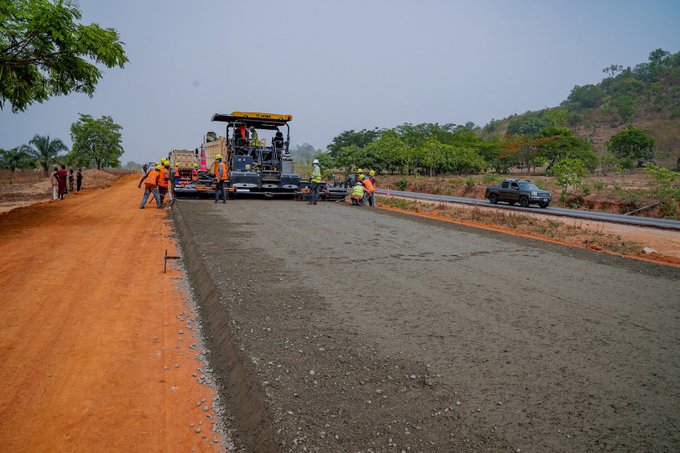
The Federal Government of Nigeria has raised serious concerns over the prolonged delays in the N202 billion Enugu-Onitsha Expressway project, a key infrastructure development under the Federal Government’s Tax Credit Scheme. The Ministry of Works has now given telecommunications giant MTN a strict ultimatum to speed up payment to contractors or face the imminent revocation of its contract.
The Enugu-Onitsha road project, initiated to ease transportation between the southeastern states of Nigeria, has become embroiled in controversy due to what officials are describing as significant financial delays and slow progress. In a bold move, the Federal Ministry of Works, led by Engr. David Umahi, issued a stern warning to MTN, instructing the company to pay a minimum of N15 billion to contractors each month for the next 10 months to ensure the project moves forward. Failure to do so, officials have stated, will trigger the termination process of MTN’s contract.
“The Federal Government will not tolerate further delays in the completion of the Enugu-Onitsha Expressway,” said Hon. Orji Uchenna Orji, Special Adviser to the Minister of Works, in a statement released after a critical meeting held in Abuja. “We are demanding an irrevocable commitment from MTN to ensure at least N15 billion is paid to contractors monthly, starting immediately. This is crucial to avoid the revocation of their involvement in the project.”
The announcement came after a high-level meeting that included key stakeholders, including members of the National Assembly representing Anambra and Enugu States, as well as MTN representatives, who are responsible for overseeing the financial and logistical execution of the project through their partnership with RCC Ltd., the main construction company involved.
MTN has been under scrutiny for its failure to adhere to the agreed-upon timelines and financial commitments that were initially outlined when the project began under the Tax Credit Scheme. The Ministry of Works has made it clear that delays, coupled with financial hold-ups, have led to a troubling cost escalation that could push the final budget for the 79-kilometer stretch of road over 200% higher than expected.
“The slow pace of work and failure to fulfill financial obligations have caused a significant increase in costs, undermining the initial budget,” said Engr. Umahi. “If MTN cannot meet the demands set forth in this ultimatum, the government will be forced to take drastic action, including engaging alternative contractors to complete the project.”
Financial Pressures Mount as MTN Faces Heavy Scrutiny
MTN, which has been involved in the road development project as part of the government’s Tax Credit Scheme, has faced mounting pressure from both the public and government officials for not meeting the stipulated requirements. The Tax Credit Scheme allows companies to contribute to national infrastructure projects by paying a portion of their taxes directly towards specific projects, rather than paying the funds to the government. MTN had initially committed to completing its portion of the contract for the Enugu-Onitsha Expressway, but delays in contractor payments have put its involvement in jeopardy.
The latest warning from the Ministry comes after MTN’s failure to meet previous deadlines and fulfill financial obligations to RCC Ltd. The delays have not only delayed construction but also increased the cost of the project, raising concerns that additional contractors will need to be engaged to complete the road, a situation which would further inflate the project’s budget.
Speaking on the matter, Ikechukwu Uchendu, MTN’s General Manager, acknowledged the delays but emphasized that the company was committed to fulfilling its obligations. “MTN is fully aware of the challenges surrounding this project and we are actively working to resolve them,” Uchendu said. “We are committed to ensuring that the road is completed and that the financial demands outlined by the Ministry are met.”
However, government officials have expressed skepticism over MTN’s ability to meet the strict financial terms laid out during the meeting. Engr. Umahi pointed out that the pace of work had not met the targets expected from such a high-value partnership, and the Federal Government could not afford further delays. “The Federal Government is resolute in ensuring the timely completion of this critical infrastructure, and we will take all necessary steps to hold parties accountable,” he added.
Government’s Renewed Resolve for Accountability
This move marks the Federal Government’s renewed focus on ensuring that infrastructure projects are completed on time, as the country grapples with severe transportation challenges in key regions. The Enugu-Onitsha Expressway, once completed, will provide a vital transport link between the southeastern states and the rest of the country, promoting economic growth and easing the movement of goods and people.
The Ministry of Works also announced a contingency plan to address the escalating costs and delays. “The remaining portion of the road, stretching 72 kilometers, will now be awarded to other contractors through a competitive bidding process,” Engr. Umahi confirmed. “MTN and RCC Ltd. are free to participate in the bidding process, but it is imperative that the project moves forward without further financial setbacks.”
MTN’s involvement in the project has sparked a broader conversation about corporate responsibility in national infrastructure development. Some critics argue that the delays and financial difficulties reflect a wider issue of corporate mismanagement, while others have questioned the effectiveness of the Tax Credit Scheme in ensuring timely project completion.
A Broader Impact on National Infrastructure
The Enugu-Onitsha road is part of a broader initiative to modernize Nigeria’s road networks and improve the country’s overall infrastructure. The Federal Government has been keen to leverage private sector involvement through tax credit schemes, but recent setbacks have raised concerns about the effectiveness of such partnerships.
“It is becoming increasingly clear that the government needs to be more rigorous in holding corporate partners accountable,” said Engr. C.A. Ogbuagu, Director of Highways Construction and Rehabilitation at the Ministry of Works. “If we are to make significant progress on road infrastructure in Nigeria, we must ensure that projects are completed on time and within budget.”
As the ultimatum for MTN looms, all eyes will be on how the telecommunications giant responds to the Ministry’s demands. Failure to meet the financial commitment could mean the end of its involvement in one of Nigeria’s most critical infrastructure projects, which would have far-reaching consequences for both the company and the people of the southeastern region.