
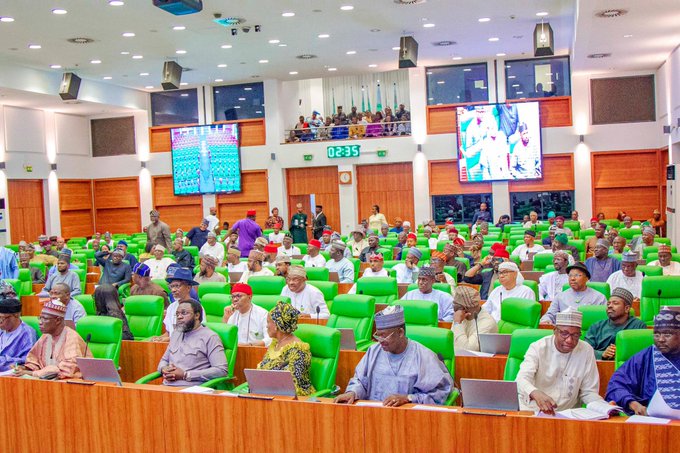
The House of Representatives Public Accounts Committee has issued a 72-hour ultimatum to the federal information and communication technology firm, Galaxy Backbone, demanding a comprehensive explanation over a series of financial irregularities, including unremitted taxes and questionable contract payments amounting to billions of naira.
The ultimatum was delivered on Wednesday during a public hearing at the National Assembly Complex in Abuja. The session, presided over by the committee chairman, Hon. Bamidele Salam, focused on queries raised by the Auditor-General for the Federation in his 2021 financial report, exposing multiple breaches of financial regulations by the government-owned ICT service provider.
Tax Evasion and Dubious Contracts
The committee raised alarm over Galaxy Backbone’s failure to remit taxes worth approximately N329.85 million within the legally stipulated 21-day period. Lawmakers deemed this a grave violation of Nigeria’s financial laws and ordered immediate compliance.
Beyond tax infractions, the committee scrutinized the company’s financial dealings and flagged a questionable payment of N66.80 million made for a contractual obligation that lacked supporting documentation. The lawmakers demanded full disclosure of the transaction, including all relevant documents, within three days.
“We cannot continue to overlook these reckless financial transactions that undermine transparency in public administration,” Hon. Salam declared. “Galaxy Backbone must provide detailed explanations and relevant documents within 72 hours or face further consequences.”
Dubious Foreign Transactions Under Scrutiny
Another startling revelation involved a payment made to a U.S.-based firm, ST Engineering, which was listed under two different state addresses in the United States. The lawmakers found no evidence that the contract was ever executed, raising concerns of potential fraud or mismanagement of funds.
“The discrepancies in these transactions are troubling,” Salam stated. “We need clarity on the legitimacy of this contractor, proof of work done, and all necessary approvals from regulatory agencies such as the Bureau of Public Procurement.”
The committee further directed the ICT company to furnish records regarding other financial violations, including an e-payment infraction of N12.66 million and a procurement contract valued at $164,403. Lawmakers stressed that failure to comply would result in further legislative actions against the company.
Executive’s Absence Raises Eyebrows
The session also drew attention to the absence of Galaxy Backbone’s Managing Director and Chief Executive Officer, Prof. Ibrahim Adeyanju, who was expected to personally answer for the audit queries. Instead, the company was represented by its Executive Director of Finance and Corporate Services, Mr. Sani Ibrahim. Lawmakers expressed disappointment over Adeyanju’s failure to appear, viewing it as a lack of seriousness in addressing the allegations.
“We are dealing with billions of naira in financial discrepancies, yet the CEO himself is absent,” Hon. Salam fumed. “This does not show a commitment to accountability. We expect to see full cooperation and responsiveness in matters of national interest.”
The committee directed that the management of Galaxy Backbone must reappear before lawmakers on February 27 with all requested documents and explanations for the audit concerns.
Peace and Conflict Resolution Institute Also in Hot Water
Galaxy Backbone was not the only entity under scrutiny. The committee also summoned the Institute for Peace and Conflict Resolution over financial irregularities linked to project monitoring and evaluation allowances, amounting to N25.80 million.
The Director-General of the institute, Joseph Ochogwu, attempted to distance himself from the infractions, claiming they were inherited from the previous administration. However, lawmakers rejected this defense, emphasizing that accountability must be upheld regardless of leadership changes.
“The excuse of inheriting past misdeeds does not absolve an institution from responsibility,” Hon. Salam noted. “We need to see exact project locations, justification for travel expenses, and the list of personnel involved in the transactions.”
Further financial anomalies uncovered included a dubious training expense of N21.38 million, which lawmakers described as ‘highly suspicious.’ An ad hoc committee, led by Hon. Billy Osawaru of Edo State, was set up to investigate the matter and report back within a week.
A Pattern of Financial Mismanagement
These revelations add to the growing concerns over financial mismanagement and accountability within government agencies. Over the years, several government institutions have come under fire for failing to properly account for public funds, prompting calls for stricter oversight and enforcement of financial regulations.
Analysts note that Galaxy Backbone’s case is particularly alarming, given its central role in Nigeria’s digital transformation agenda. The firm, which provides ICT services for federal agencies, is expected to uphold the highest standards of financial discipline. Instead, its involvement in tax breaches and opaque contract dealings raises serious concerns about governance in Nigeria’s digital sector.
“This case is yet another example of the lack of financial discipline among government agencies,” said financial analyst Dr. Emmanuel Uche. “It sends the wrong signal about Nigeria’s commitment to accountability and could discourage potential investors in the country’s digital infrastructure sector.”
What Comes Next?
With the committee’s February 27 deadline looming, all eyes are on Galaxy Backbone to see whether it will comply with the summons or risk potential legislative sanctions. Lawmakers have warned that continued failure to provide satisfactory responses could lead to severe consequences, including the possibility of further investigations by anti-corruption agencies such as the Economic and Financial Crimes Commission (EFCC) and the Independent Corrupt Practices and Other Related Offences Commission (ICPC).
The controversy also highlights broader issues surrounding fiscal responsibility in Nigeria’s public sector, with experts calling for more stringent audits, enhanced transparency measures, and possible legal reforms to curb financial malpractice in government institutions.