
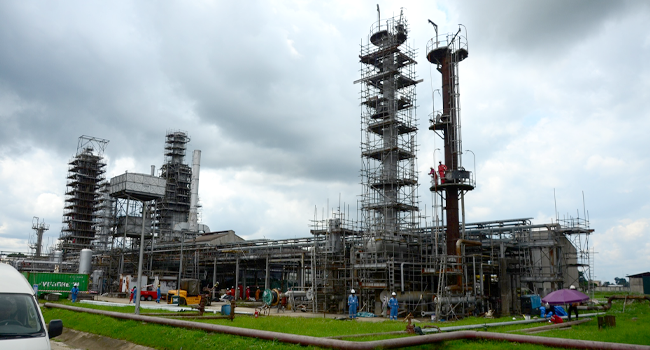
Africa’s richest man, Aliko Dangote, has cast serious doubt on the future of Nigeria’s government-owned refineries, saying they may never work again despite over \$18 billion reportedly spent on them.
Dangote made the statement on Thursday while addressing a delegation from the Global CEO Africa group of Lagos Business School who visited his 650,000 barrels-per-day Dangote Refinery in Lekki, Lagos.
He said the Port Harcourt, Warri, and Kaduna refineries, owned by the Nigerian National Petroleum Company Limited (NNPC), had become outdated and unproductive despite years of turnaround maintenance efforts.
“We bought the refineries in January 2007, but had to return them when the late President Yar’Adua came into office. Since then, about \$18bn has been spent on them, yet they are not working. I doubt they will ever work again,” Dangote said.
He added that reviving the refineries was like trying to modernize a 40-year-old car. “Even if you change the engine, the body will not take the shock of the new engine,” he explained.
Dangote’s remarks follow recent revelations that the Port Harcourt and Warri refineries, which were declared operational late last year, have been shut down again.
His comments align with former President Olusegun Obasanjo’s long-standing position that NNPC lacks the capacity to run the refineries. Obasanjo revealed that international oil companies like Shell once refused to manage them, while the \$750m sale of the refineries to Dangote and partners was cancelled by Yar’Adua.
According to Obasanjo, “The refineries won’t work. And when the government wants to sell them, they won’t even get \$200m for scrap.”
Recent reports show that Nigeria has spent billions of dollars maintaining these moribund refineries. The Federal Government approved \$1.4bn for Port Harcourt in 2021, \$897m for Warri, and \$586m for Kaduna. Still, they remain idle.
Industry experts and the Manufacturers Association of Nigeria have called for their outright sale, saying they are a heavy burden on the economy. Some crude refiners even suggest selling the refineries as scrap and using the money to support modular refineries.
As of the time of filing this report, NNPC had not responded to enquiries. Its contact lines and emails listed on its website were unreachable.