
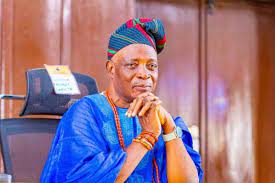
The Olubadan of Ibadanland, Oba Rasidi Adewolu Ladoja, has called on Nigerians to unite in the fight against terrorism, saying that terrorists do not know the difference between Muslims and Christians.
The respected traditional ruler made the statement while receiving the President of the Pentecostal Fellowship of Nigeria (PFN), Bishop Francis Wale Oke, at his palace in Ibadan over the weekend.
Oba Ladoja was reacting to a recent comment attributed to United States President Donald Trump, who reportedly alleged that Christians were being subjected to genocide in Nigeria.
In a statement issued on Sunday by his Media Aide, Mr. Adeola Oloko, the Olubadan dismissed such claims, saying that the violence caused by terrorists and bandits in Nigeria affects everyone, regardless of religion or ethnicity.
The Olubadan said it was misleading to portray the country’s security challenges as a religious war. He explained that terrorist groups operating in Nigeria have targeted both Christians and Muslims, with ordinary citizens bearing the brunt of their attacks.
“I want to caution that terrorists don’t know the difference between Muslims and Christians,” he said. “They see everybody as a prey, while they are the predator.”
Oba Ladoja stressed that the violence and insecurity across the country had destroyed countless lives and properties, displacing thousands of families and leaving women and children in hardship.
According to him, “Many people have been killed and valuable properties lost. Multitudes of families, especially women and children, have been displaced as a result of terrorism. These are not attacks targeted at one religion, but at humanity itself.”
He urged all Nigerians, regardless of faith or background, to unite and confront terrorism together. “This is not a time to divide ourselves along religious lines,” he said. “We must stand up and jointly fight terrorism to a standstill.”
U.S. President Donald Trump has repeatedly made statements accusing the Nigerian government of failing to protect Christians from persecution. His comments have generated controversy both locally and internationally.
While some Christian groups in Nigeria have echoed concerns about attacks on churches and communities in the northern region, others have argued that the violence stems largely from criminality, banditry, and terrorism that affect all citizens.
Nigeria has faced years of insecurity, especially from terrorist organizations such as Boko Haram and the Islamic State in West Africa Province (ISWAP), as well as violent herder-farmer conflicts and bandit attacks in various parts of the country.
During the meeting, Oba Ladoja appealed to Bishop Francis Wale Oke to help calm the anger among Christian communities who may feel unfairly targeted by the wave of insecurity.
“As the President of the Pentecostal Fellowship of Nigeria, a constituent part of the Christian Association of Nigeria (CAN), we appeal to you to please help us to placate our Christian brethren who are understandably aggrieved,” the monarch said. “These times will pass.”
He praised the PFN for its continued role in promoting peace, unity, and moral guidance in Nigeria, urging religious leaders to preach messages that strengthen national cohesion rather than deepen divisions.
The Olubadan also used the opportunity to highlight the need for a collective response to insecurity, saying that no community or religious group can solve the problem alone.
He called on traditional rulers, clerics, political leaders, and civil society organizations to work together to rebuild trust and restore peace in communities affected by terrorism.
“We must all see terrorism as a common enemy,” he said. “If we continue to see it as a Christian or Muslim problem, we will never overcome it.”
Oba Ladoja’s remarks reflect a growing call from traditional and religious leaders for unity in confronting Nigeria’s complex security challenges. Many of them have warned that religious tensions could worsen national divisions if not properly managed.
Traditional rulers like the Olubadan play a crucial role in maintaining peace at the grassroots level. In recent years, several monarchs across Nigeria have been involved in peace dialogues, community sensitization, and mediation between conflicting groups.
In Oyo State, Oba Ladoja — a former governor of the state and now a first-class monarch has often used his position to advocate for peace, development, and interfaith understanding. His latest comments add to efforts by leaders who insist that terrorism and banditry should not be viewed through a religious lens.
Some noted that his intervention was timely, as misinformation about the nature of Nigeria’s insecurity could fuel mistrust among citizens and strain relationships between Christians and Muslims.
Others called for stronger collaboration between religious organizations like the PFN, CAN, and Muslim groups such as the Nigerian Supreme Council for Islamic Affairs (NSCIA) to promote mutual understanding and counter hate speech.
Concluding his remarks, Oba Ladoja expressed optimism that Nigeria would overcome its current security challenges if citizens remained united. He encouraged Nigerians to continue praying for peace and supporting efforts to restore stability in all parts of the country.
“These difficult times will pass,” he said. “With unity, faith, and collective action, we can defeat terrorism and rebuild a country where everyone can live in peace, regardless of religion.”