
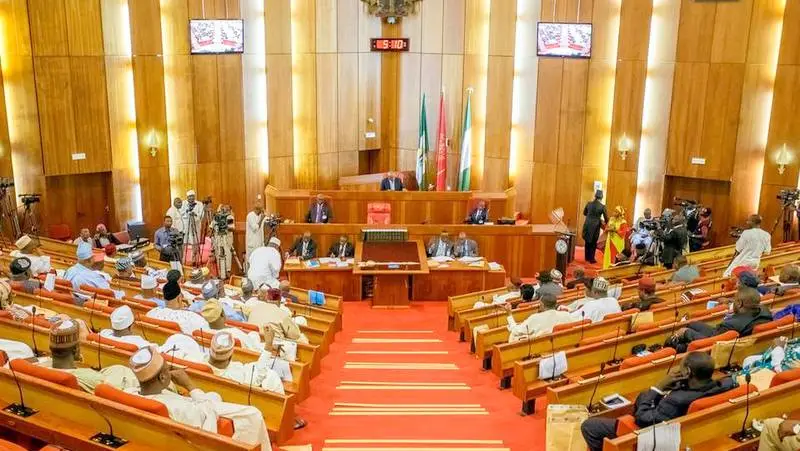
Senate President Godswill Akpabio on Wednesday said the Nigerian Senate is firmly opposed to negotiating with terrorists or paying ransom to kidnappers. He stated this during the ministerial screening of former Chief of Defence Staff and Defence Minister nominee, General Christopher Musa (rtd.), at the National Assembly in Abuja.
Akpabio’s comments come at a time when Nigerians across many states are grappling with rising cases of kidnapping, banditry, and terrorism. In recent years, the payment of ransom has become a major issue, with many families forced to gather huge sums to secure the release of their loved ones. Security experts and government officials have repeatedly warned that ransom payments strengthen criminal groups by giving them access to more weapons and resources.
Speaking during the plenary, Akpabio stressed that the Senate would not support any form of negotiation with kidnappers. According to him, ransom payments only encourage more violence.
“This Senate is against negotiations with terrorists; we are against the idea of paying ransom to terrorists,” he said. “They would use the money to buy more arms and kidnap again.”
Akpabio explained that criminals often take advantage of negotiations because they know desperate families or government officials may be willing to pay. He added that kidnappers do not approach negotiations with genuine intentions and mostly seek more time to plan fresh attacks.
“Most of the people you are negotiating with are living with drugs. They don’t go into negotiations with their normal eyes, they don’t intend to keep to whatever agreement. They only want to buy time to come back and strike,” Akpabio said.
The Senate President also shared his experience while serving as the governor of Akwa Ibom State. He explained that he adopted a tough approach that made kidnappers fear entering the state.
“Even when I was a governor, I never negotiated with terrorists. I made my state so hot that each time we arrested a kidnapper, he would say, ‘Please sir, forgive me. I didn’t know it was in your state when they said we have a job,’” Akpabio recalled.
He said his administration maintained strong security policies that discouraged criminal activities. According to him, the strict measures created an environment where even kidnappers traveling from neighbouring countries became scared of operating in the state.
“We can make Nigeria so hot that anyone that crosses in from Sahel states—Niger or Mali—when arrested, the person will be pleading with you, ‘Minister of Defence, forgive me, I didn’t know it was part of Nigeria,’ because of the policies we have put in place,” he said.
Akpabio also used the opportunity to call for a review of Nigeria’s security framework, especially the balance between kinetic (military force) and non-kinetic (dialogue and negotiation) strategies. While he said he was not against peaceful approaches in general, he insisted that kidnapping must be treated as a very serious crime.
“A kidnapper is a kidnapper. This Senate is of the opinion that once we arrest any kidnapper, he should face capital punishment so that the society can be kept safe. Many countries have done that,” the Senate President said.
His comments indicate that the Senate may push for tougher laws, including the possibility of the death penalty for convicted kidnappers. Several lawmakers have previously proposed such measures, arguing that the rising wave of kidnappings poses a threat to national security.
Nigeria has battled kidnapping for ransom for more than a decade, but the crisis has worsened in recent years. Initially concentrated in the Niger Delta during the era of militant activities, kidnapping has now spread to nearly every region of the country.
In the North-West and North-Central, heavily armed bandits have attacked villages, schools, and highways, abducting students, commuters, and residents. Incidents such as the abduction of students from Kankara in Katsina State (2020), Greenfield University in Kaduna State (2021), and many others have drawn global attention.
In the South-East and South-West, kidnapping has been linked to criminal gangs and, in some cases, separatist groups. Meanwhile, in the North-East, Boko Haram and the Islamic State West Africa Province (ISWAP) continue to use abduction as a tool to raise funds and spread fear.
The issue of whether governments should negotiate with kidnappers remains controversial. Some state governments have been accused of paying ransom, although many of them deny it. Families often negotiate privately because of fear that their relatives may be killed.
However, the federal government and military authorities have often discouraged ransom payments, warning that it fuels the criminal economy. International organisations, including the United Nations, have also advised against negotiation with terrorists because it legitimises criminal groups.
Akpabio’s statement further reinforces the federal government’s position, suggesting that the National Assembly may soon consider stronger legislation to block ransom payments and punish offenders.
During the screening, Defence Minister nominee Christopher Musa assured the Senate that he would adopt strong and coordinated measures to reduce kidnapping and terrorism if confirmed. Musa, who previously served as Chief of Defence Staff, said he believes Nigeria can overcome insecurity with the right strategies, better intelligence, and improved collaboration among security agencies.
He thanked the Senate for its confidence and promised to prioritize the safety of citizens across the country.
With the Senate’s strong position, lawmakers may introduce bills aimed at banning ransom payments, enhancing intelligence gathering, and strengthening border security to prevent criminals from entering the country. Akpabio’s call for capital punishment may also reopen national debate about the death penalty, which some human-rights groups oppose.