
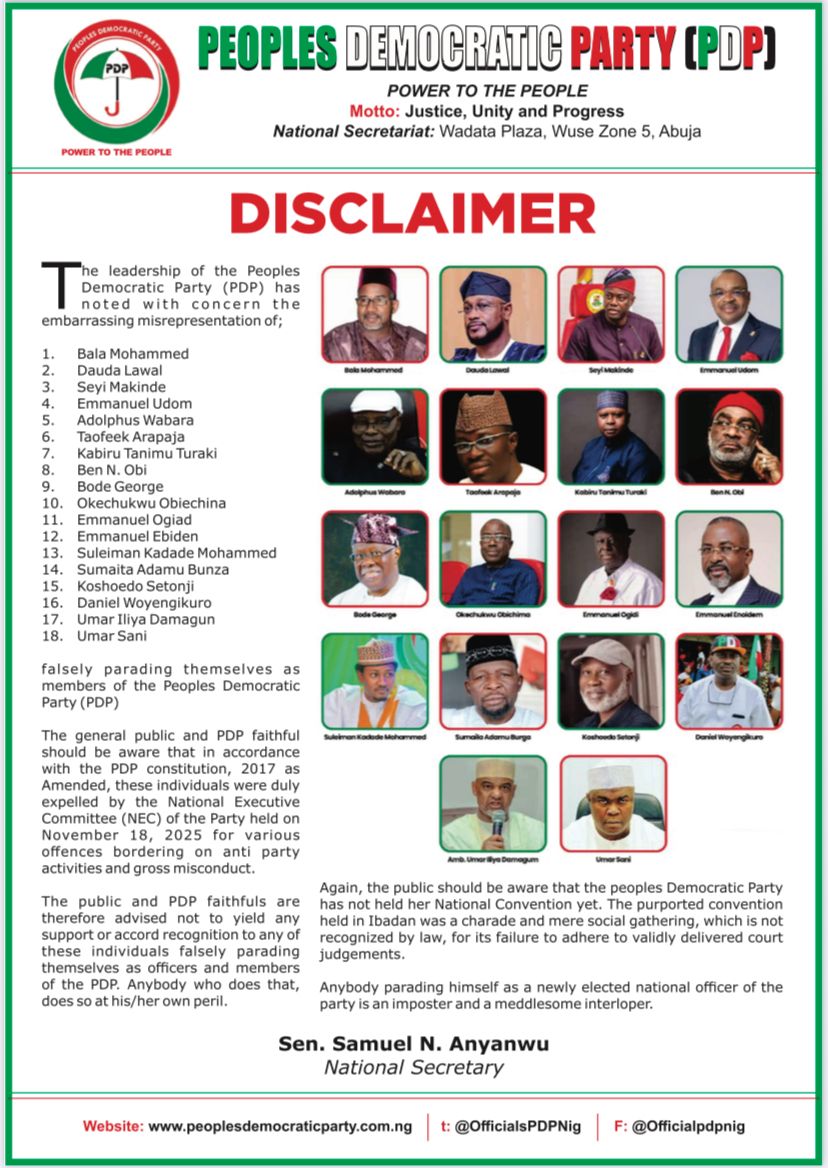
The Peoples Democratic Party (PDP) has officially announced the expulsion of several high-profile members, including Bauchi State Governor Bala Mohammed, Oyo State Governor Seyi Makinde, and former Kwara State Governor Dauda Lawal. The announcement, made on Wednesday, was contained in a disclaimer issued by the National Secretary of the party, Senator Samuel Anyanwu.
According to the statement, the individuals listed were expelled by the National Executive Committee (NEC) of the party on November 18, 2025, due to alleged anti-party activities and gross misconduct. The party described the expulsion as a necessary step to maintain discipline and uphold the values of the PDP.
“The leadership of the Peoples Democratic Party noted with concern the embarrassing misrepresentation of these individuals falsely parading themselves as members of the PDP,” the disclaimer read. It further cautioned the public and PDP faithful against supporting or recognizing the expelled members, warning that doing so would be at their own risk.
The disclaimer named 18 individuals as expelled members, including:
Bala Mohammed – Bauchi State Governor
Dauda Lawal – Former Kwara State Governor
Seyi Makinde – Oyo State Governor
Emmanuel Udom – Akwa Ibom State Governor
Adolphus Wabara – Former Senate President
Taofeek Arapaja
Kabiru Tanimu Turaki – Former Minister
Ben N. Obi
Bode George – Former PDP Deputy National Chairman
Okechukwu Obiechina
Emmanuel Ogiad
Emmanuel Ebiden
Suleiman Kadade Mohammed
Sumaita Adamu Bunza
Koshoedo Setonji
Daniel Woyengikuro
Umar Iliya Damagun
Umar Sani
The PDP maintained that the expulsions were in line with its constitution (2017, as amended) and followed due process by the National Executive Committee.
The disclaimer also addressed a recent National Convention purportedly held in Ibadan, Oyo State. The party described the convention as a “charade” and a mere social gathering, which failed to adhere to valid court judgments. PDP stressed that the Ibadan event was not legally recognized and warned that anyone presenting themselves as newly elected national officers from that gathering is an “imposter and a meddlesome interloper.”
This follows months of internal disagreements within the party over leadership positions and alleged violations of party protocols. Some party members had questioned the legitimacy of certain decisions made by the national leadership, claiming a lack of transparency in key appointments and conventions.
The PDP’s warning is aimed at curbing confusion among party members and the general public, especially ahead of upcoming elections where party unity is seen as critical. The party leadership emphasized that recognition of expelled members would undermine the organization’s discipline and stability.
Some political commentators argue that the expulsions may deepen existing rifts within the party, potentially leading to defections or the formation of breakaway groups. Others believe it may be a strategic move by the PDP leadership to consolidate control and send a strong message against internal dissent.
Governor Bala Mohammed of Bauchi State, Governor Seyi Makinde of Oyo State, and other expelled members have not immediately responded publicly to the PDP’s announcement. However, in previous statements, some of these leaders had expressed dissatisfaction with the party’s leadership and decision-making processes, suggesting that internal disagreements have been simmering for some time.
The PDP, Nigeria’s main opposition party, has a history of internal disputes leading to the suspension or expulsion of members. In past years, disagreements over party nominations, candidate selections, and leadership elections have often resulted in publicized disciplinary actions. Party leaders argue that such measures are necessary to ensure loyalty and adherence to party rules.
The latest expulsions reflect the party’s ongoing struggle to balance internal democracy with centralized authority. Experts say that while enforcing discipline is crucial, the party must also ensure that its actions do not alienate influential figures whose support is vital for political mobilization.
The PDP’s National Secretary, Senator Samuel Anyanwu, highlighted that the expulsion was executed in accordance with the PDP Constitution, emphasizing that due process was followed. Party members expelled are considered to have violated clauses relating to anti-party activities and misconduct, making them ineligible to hold any office or participate in party affairs.
For grassroots members and supporters of the PDP, the expulsion notice is a clear directive to avoid association with the listed individuals. Party officials have urged members to remain loyal to the officially recognized leadership and avoid confusion created by unauthorized claims to party positions.
The party’s statement reads: “The general public and PDP faithful should be aware that in accordance with the PDP constitution, these individuals were duly expelled for various offenses bordering on anti-party activities and gross misconduct. Support or recognition of these individuals as officers or members of the PDP is at one’s own risk.”
The PDP leadership has indicated that it remains focused on maintaining party unity and preparing for future electoral contests. By taking decisive action against expelled members, the party aims to reinforce internal discipline and prevent unauthorized factions from undermining its credibility.
As the political landscape in Nigeria continues to evolve, the expulsion of Bala Mohammed, Seyi Makinde, Dauda Lawal, and others underscores the PDP’s determination to enforce internal rules and assert authority over its membership. The party has warned that it will not tolerate misrepresentation or insubordination and will take firm action against any individual or group seeking to operate outside its constitution.
With upcoming elections and ongoing political maneuvering across Nigeria, the PDP’s latest move highlights the delicate balance between enforcing discipline and maintaining unity within one of the country’s largest political parties. Party members, supporters, and the general public are now closely watching how the expelled leaders will respond and how the party will manage its internal cohesion in the months ahead.