
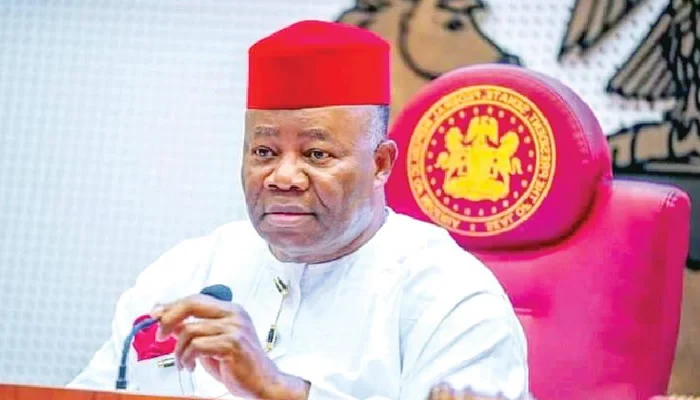
Senate President Godswill Akpabio has stated that he filed the ₦40 billion defamation lawsuit against Senator Natasha Akpoti-Uduaghan because she continued to make “grave and unsubstantiated” allegations against him, especially on social media. Akpabio made this known in a statement released by his media office, where he accused the Kogi State senator of spreading misinformation about the timing and nature of the case.
The statement was issued after Senator Akpoti-Uduaghan claimed online that the Senate President had just filed the lawsuit in connection with allegations of sexual misconduct she made earlier in the year. According to Akpabio, this claim is false, as the suit was filed more than three months ago. He said it only became public recently because Senator Akpoti-Uduaghan allegedly avoided several attempts by court officials to serve her the court papers.
The disagreement between the two senators began months ago when Senator Akpoti-Uduaghan publicly accused Akpabio of sexual misconduct. She repeated these claims during Senate proceedings and on social media platforms, insisting she had evidence to support her accusations. The matter attracted widespread public attention, with citizens debating the seriousness of the allegations and demanding an investigation.
These accusations were referred to a Senate committee for review. However, according to Akpabio, no evidence was ever presented before the committee or any recognised authority to support Senator Akpoti-Uduaghan’s claims. The matter later contributed to the tension that led to her suspension from the Senate for six months—a suspension she strongly opposed at the time.
Akpabio said her refusal to present proof and her continued use of social media to repeat the allegations made the defamation suit necessary.
In the new statement, Akpabio’s media office dismissed Senator Natasha’s claim that the lawsuit was recently filed. The statement explained that the case was initiated months earlier but moved slowly due to what it described as “normal administrative processes” and delays common in Nigerian courts.
The statement read:
“On 5 December 2025, Senator Natasha Akpoti-Uduaghan again resorted to social media to claim incorrectly and misleadingly that the Senate President had only just filed a multi-billion-naira defamation suit. These allegations have never been supported by a single shred of evidence before the Senate Committee or before any competent authority.”
It further explained that the court’s bailiff attempted several times to serve the originating summons on Senator Akpoti-Uduaghan but could not reach her. The Senate President’s team insisted that she was intentionally avoiding service, citing an affidavit submitted by the bailiff.
Defamation suits in Nigeria are often complex and can take years to conclude. Public office holders sometimes use such suits to clear their names when facing damaging accusations. Akpabio’s decision to seek ₦40bn in damages shows the seriousness with which he views the allegations.
The Senate President said that the claims made by Senator Natasha were capable of causing severe harm to his reputation, especially given his position as the head of the National Assembly. In Nigerian politics, where public trust is already low, allegations of misconduct against top officials tend to spread quickly and shape public perception.
One of the key issues highlighted in Akpabio’s statement is the role of social media in shaping narratives around political controversies. Both politicians and ordinary citizens increasingly use platforms like X (formerly Twitter), Facebook, and Instagram to share claims, counterclaims, and personal opinions. While this makes information more accessible, it also leads to situations where serious allegations spread without verification.
Akpabio’s media office said the senator’s reliance on social media over formal processes was part of a “pattern,” referring to how she responded to her earlier suspension.
“This behaviour is consistent with her pattern during her six-month Senate suspension, an entirely lawful disciplinary measure she sought to delegitimise through digital agitation,” the statement added.
The Senate President urged Senator Akpoti-Uduaghan to present whatever evidence she claims to have before the court instead of making public statements on social media. According to him, the courtroom—not online platforms—is the proper place to settle such disputes.
“It is time for Senator Akpoti-Uduaghan to present the ‘evidence’ she claims to possess before a court of competent jurisdiction, rather than relying on sensationalised commentary designed solely to attract sympathy,” the statement said.
Akpabio reminded the public that legal matters are decided based on proof, due process and established procedures, not emotions or social media reactions.
Senator Natasha Akpoti-Uduaghan, representing Kogi Central, is widely known for her activism and outspoken political style. Before entering the Senate, she contested several elections and became popular online for tackling issues such as corruption, human rights, and women’s inclusion in politics.
Her supporters often describe her as courageous and willing to challenge powerful figures. However, critics accuse her of using dramatic tactics to gain public sympathy.
Her conflict with Akpabio has generated mixed reactions. Many of her supporters believe she is being targeted for speaking out, while others argue that a public official must be prepared to defend any claims made in public, especially those of a serious nature.
So far, she has not publicly responded to the most recent statement from Akpabio’s camp. But she has consistently insisted she has evidence to support her claims.
With the court having approved substituted service in November, the case is expected to proceed more quickly. Substituted service means the court allowed Akpabio’s lawyers to deliver the documents through alternative means, such as by posting them at a known address or through publication, due to the unsuccessful attempts to deliver them directly.

