
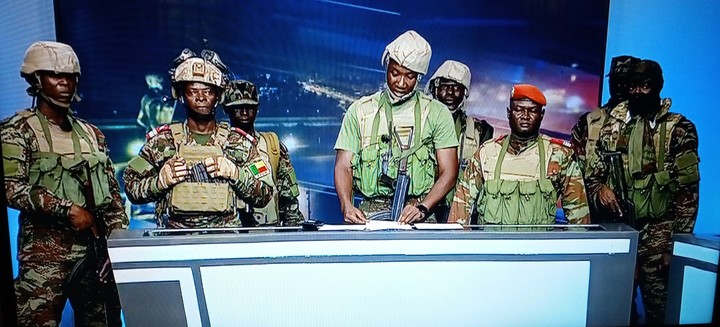
Benin Republic was thrown into political uncertainty on Sunday after a group of soldiers appeared on state television to announce that they had taken control of the government. The officers, who identified themselves as the Military Committee for Refoundation, declared that they had removed President Patrice Talon from office and dissolved all state institutions. They also announced the suspension of the country’s November 2025 constitution.
The soldiers made the announcement during a brief but carefully staged broadcast, saying they had acted “in the interest of national stability” and accusing the civilian leadership of failing to address rising tensions in the country. Although they did not provide detailed reasons for the takeover, the tone of their message suggested long-standing frustrations within sections of the armed forces.
Following the announcement, the committee said all land, sea, and air borders would be closed until further notice. Political party activities were also suspended, effectively shutting down all forms of political mobilisation. The soldiers did not say how long the suspension would last or when they planned to restore civilian rule.
The development marks yet another military intervention in West Africa, a region that has witnessed a wave of coups in recent years. From Mali and Burkina Faso to Niger and Guinea, democratic governments have increasingly come under pressure from disgruntled soldiers citing insecurity, corruption, and political disputes.
President Patrice Talon, who came into office in 2016, had been expected to complete his second and final term next April when Benin holds its presidential election. His government had been known for pushing a strong economic agenda and implementing major political reforms, but his critics often accused him of cracking down on opposition figures and tightening his control over state institutions.
The political environment has been tensed in recent years, with several opposition leaders barred from contesting elections and others forced into exile. Human rights groups have repeatedly criticised the government for shrinking civic space and limiting free expression. Sunday’s military announcement has now brought Talon’s nine-year rule to an unexpected end.
The coup comes at a time when Benin was preparing for what many expected to be a tightly controlled presidential election. The ruling party had presented former Finance Minister Romuald Wadagni as its preferred candidate. Wadagni, 49, had built a reputation as a financial reformer during his time in government and was widely considered the favourite to succeed Talon.
Meanwhile, the opposition had faced significant obstacles. The main opposition hopeful, Renaud Agbodjo, was rejected by the electoral commission on the grounds that he lacked the required number of sponsors. This rule had been one of the most controversial electoral reforms introduced under Talon, as many believed it allowed the ruling party to limit viable competitors.
Last month, Benin’s National Assembly added to the tension by approving an extension of the presidential term from five years to seven years, though the two-term limit remained unchanged. Supporters of the amendment argued that the longer term would help improve policy continuity, but critics said it was an attempt to influence the political transition and give the ruling elite more time to maintain power.
The military takeover in Benin adds to the growing list of West African nations that have experienced coups since 2020. Countries like Mali, Burkina Faso, Guinea, and Niger have all seen their democratically elected governments toppled, mainly by soldiers who accused political leaders of poor governance and failing to address insecurity.
Benin, once seen as one of West Africa’s most stable democracies, is now facing similar challenges. Although the country has not experienced the level of insecurity seen in its northern neighbours, tensions have grown in recent years due to political restrictions, concerns about electoral fairness, and disputes over constitutional changes.
As of Sunday night, there was no official comment from President Talon or members of his cabinet. It remains unclear whether the president is in the custody of the military or in a secure location. Calls to government ministries and ruling party officials went unanswered throughout the evening.
Major cities, including Cotonou and Porto-Novo, remained tense after the announcement. Residents reported seeing military patrol vehicles on some streets, although there were no major incidents of violence.
The Military Committee for Refoundation has not provided a timeline for a return to civilian rule or explained its long-term plans. West African diplomats say the next few days will be critical in determining how the situation unfolds.

