
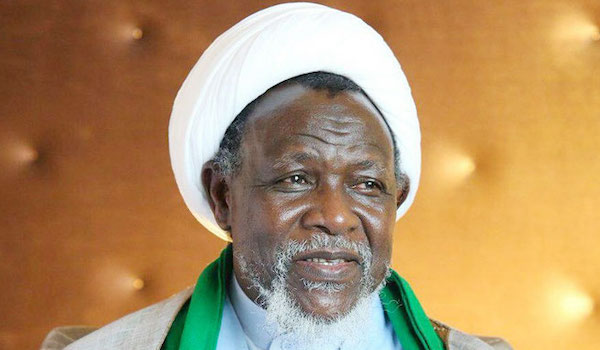
The leader of the Islamic Movement in Nigeria (IMN), Sheikh Ibraheem El‑Zakzaky, has accused the United States government and Nigerian political leaders of playing key roles in the insecurity facing the country. In a video that surfaced online on Wednesday, the cleric claimed that the U.S. created Boko Haram and the Islamic State groups that have operated in Iraq, Syria and West Africa.
El‑Zakzaky, who has been a controversial figure in Nigeria’s religious and political landscape, also alleged that the U.S. is currently funding ISWAP, Boko Haram, and other extremist groups in the region. The cleric did not provide evidence to support the claims, but insisted that the rise of terrorism in Nigeria cannot be separated from political interests and international influence.
His comments have attracted wide public reaction, especially at a time when Nigeria continues to struggle with banditry, insurgency, farmer–herder clashes, kidnappings and other violent crimes that have spread across several states.
In the viral video, El‑Zakzaky blamed Nigerian politicians for the worsening insecurity, saying they have the power to stop the violence but choose not to.
“The insecurity problem in Nigeria was created by politicians in power,” he said. “If they want to stop it today, they would, because they are the ones who engineered it.”
He questioned how groups described in the past as cattle rearers suddenly gained access to sophisticated firearms, armoured vehicles and other military‑grade equipment.
“How come those people who are known to be cattle rearers have guns in the bush?” he asked. “How come those people they call bandits have armoured vehicles in the bushes and they call them terrorists? Where did these tankers come from? From the earth or they moved through? Everybody knows that authorities are behind this insecurity.”
According to him, it is impossible for such weapons to move across borders and enter forests undetected without state involvement.
El‑Zakzaky extended his criticism to the United States, alleging that Washington has long been involved in the creation and support of extremist groups operating in Africa and the Middle East.
“By inviting the U.S., which we know very clearly is behind all this insecurity… the U.S. created Boko Haram, the U.S. is funding Boko Haram,” he claimed. “The U.S. created ISWAP, they created ISIS, and they confessed it openly. They said that they would use terrorism to conquer Africa.”
He accused the U.S. of using terrorism as a strategy to gain access to African resources, including oil, gold and gas.
“They will come to steal our resources. You will see them where there is gold, oil, gas, and other resources,” he said. “That is why you will see them protecting Christians in Zamfara and Katsina.”
Boko Haram emerged around 2009 in northeastern Nigeria under the leadership of Mohammed Yusuf. The group started as a radical sect opposed to Western-style education but quickly transformed into a violent insurgency after a clash with security forces. The group has been responsible for mass killings, bombings, kidnappings—including the Chibok and Dapchi schoolgirls—and widespread displacement.
In 2016, a faction of Boko Haram pledged allegiance to the Islamic State (ISIS), forming ISWAP (Islamic State West Africa Province). ISWAP controls pockets of territory in Borno State and continues to launch attacks on civilians and military formations.
Successive Nigerian governments, along with international partners including the U.S., EU and African Union, have denied funding or supporting these groups. Instead, they have provided technical and military support to Nigeria in the fight against extremism.
The United States has consistently denied any role in creating or supporting extremist groups. On the contrary, the U.S. has provided Nigeria with military equipment, intelligence-sharing, humanitarian support and training aimed at curbing Boko Haram and ISWAP activities.
In recent years, Nigeria has received aircraft, including the A‑29 Super Tucano fighter jets, from the U.S. to strengthen counter‑terrorism operations. The U.S. also partners with Nigerian security agencies and regional forces under initiatives such as the Multinational Joint Task Force (MNJTF).
There is no publicly available evidence supporting claims that the U.S. funds Boko Haram or ISWAP, and international security analysts typically attribute the rise of these groups to failed governance, poverty, corruption, and local conflicts.
El‑Zakzaky’s comments reflect a long‑standing distrust he has expressed toward Western governments and Nigerian authorities. The IMN leader spent several years in detention following a clash between members of his movement and the Nigerian Army in Zaria in 2015. The clash resulted in the deaths of hundreds of IMN followers, according to rights groups.
He and his wife were later released in 2021 after a Kaduna court dismissed the charges against them. Since then, El‑Zakzaky has continued to comment on political and security issues, often taking positions critical of the government and foreign involvement.
Over the past decade, more than 40,000 people have been killed and over two million displaced due to insurgency in the Northeast alone. Banditry in the Northwest, meanwhile, has affected states such as Zamfara, Katsina, and Kaduna, with mass kidnappings becoming common.
As of the time of this report, the Nigerian government has not issued an official response to El‑Zakzaky’s allegations.

