
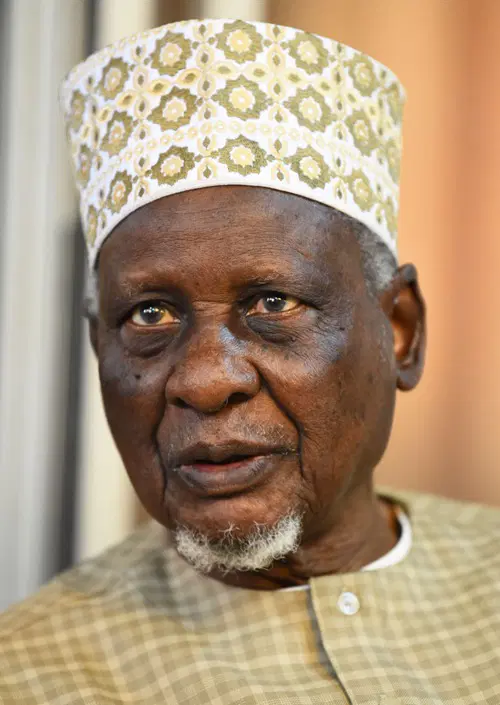
Elder statesman Alhaji Tanko Yakasai, who recently turned 100 years old, has dismissed claims that Christians in Nigeria are facing a “genocide,” saying such allegations are false and harmful to the country’s religious harmony. Speaking in a recent interview, the northern political icon accused some foreign media organisations and former United States President Donald Trump of spreading exaggerated or misleading claims about religious persecution in Nigeria.
Yakasai, a long-standing advocate for national unity, warned that careless statements about genocide can deepen mistrust between Christians and Muslims. He stressed that Nigeria’s two major religions have lived side by side for generations and share deep social and cultural ties across regions.
The elder statesman firmly rejected the narrative that Christians are being hunted or wiped out in Nigeria. According to him, the idea of “genocide” emerged from political actors who sought to gain favour with foreign governments, especially the United States.
“I don’t agree there is Christian genocide,” Yakasai said. “Some Christians close to the United States of America took advantage of their closeness to Donald Trump.”
He said certain individuals used their connections with the former American president to push an agenda that painted Nigeria as a place where Christians were under systematic attack. Yakasai insisted these claims were not based on reality but on political interests.
The debate over religious persecution in Nigeria gained international attention during Trump’s presidency, with some Christian advocacy groups claiming that Nigerian Christians were being targeted by armed groups. Trump himself made public statements suggesting that Christians were the victims of widespread killings. However, many Nigerian analysts have argued that insecurity affects both Christians and Muslims, depending on the region.
Yakasai also criticised some international media outlets for reporting that Christians in Nigeria are facing a coordinated genocide. He said such reports fail to capture the complexity of Nigeria’s security challenges, which involve banditry, communal clashes, farmer–herder conflicts, and terrorism that affect people of all faiths.
He warned that sensational reporting can worsen mistrust between religious groups.
“Christians and Muslims have been living in peace with one another; we are brothers and sisters,” he said.
Yakasai pointed out that many families in the Middle Belt and other parts of northern Nigeria have members belonging to both religions, a reality that contradicts the image of deep religious division.
“In every home, we have Christians and Muslims living together in peace,” he added.
One of the elder statesman’s key points is that Nigeria’s religious diversity is not new. He reminded Nigerians that long before colonial rule, communities in the Middle Belt, northern states, and some southern regions experienced mixed-faith family life.
This history, he argued, is proof that Christians and Muslims have been living together peacefully for many generations. According to him, conflicts in Nigeria should not be misinterpreted as religious wars because many of the clashes are driven by economic, political, and security issues rather than faith differences.
Historians and sociologists have often supported this view, noting that Nigeria’s major conflicts — from herder–farmer clashes to banditry often revolve around land, poverty, resource control, or crime. Still, religious interpretations are sometimes used to oversimplify the issues, both inside and outside the country.
Yakasai described Donald Trump as “an opportunist” who was misled by people seeking personal relevance. He accused Nigerian individuals with access to U.S. political platforms of exaggerating the country’s challenges in order to gain favour or support.
He argued that Trump was fed a distorted view of Nigeria’s religious situation, leading him to make statements that cast Nigeria in a negative light internationally.
Critics of Trump’s statements have previously argued that the former U.S. president relied heavily on lobbying groups and did not always receive balanced information from Nigeria. Some of these groups, they say, used Nigeria’s insecurity to push their own agendas in U.S. politics.
Speaking on the country’s security challenges, Yakasai said the problem affects the whole country but is particularly severe in northern states where bandits, kidnappers, and insurgents have carried out repeated attacks.
He said insecurity in Nigeria should not be framed as a religious problem because both Christians and Muslims suffer from the violence.
He also expressed support for the creation of zonal police commands to strengthen local security responses. However, he strongly rejected calls for state police, insisting they could easily be used for political manipulation.
“There was a move at one time that there should be the establishment of a zonal police… the number of the police force is not enough to cover the whole country,” he said.
He added that allowing states to run their own police forces may lead to abuse of power by governors or powerful individuals who could use the police for political gain.
“State police are subject to manipulation by individuals and political interests,” he cautioned.
The debate over state police has been ongoing for years, with some arguing it would help fight insecurity better, while others fear it could be misused during elections or political disputes.
On national politics, Yakasai said he expects President Bola Ahmed Tinubu to seek a second term in 2027. He believes the president has the political structure and resources needed to win re-election.
“President Tinubu will seek a second term and is most likely to win because he has the resources to back his ambition,” he said.
Yakasai, who has witnessed Nigeria’s political evolution from colonial rule to independence and beyond, said every nation faces challenges. He stressed that no single ethnic or religious group is responsible for Nigeria’s problems.
“Any country has its problems… wherever you have people, you have problems,” he said.
As one of Nigeria’s most respected elder statesmen, Yakasai’s comments carry significant weight. His message highlights the need for unity at a time when insecurity and political tension continue to test national cohesion.
He urged Nigerians not to allow misleading foreign reports or political actors to divide the country along religious lines. For him, the history of peaceful coexistence between Christians and Muslims remains stronger than the conflicts that often dominate headlines.

