
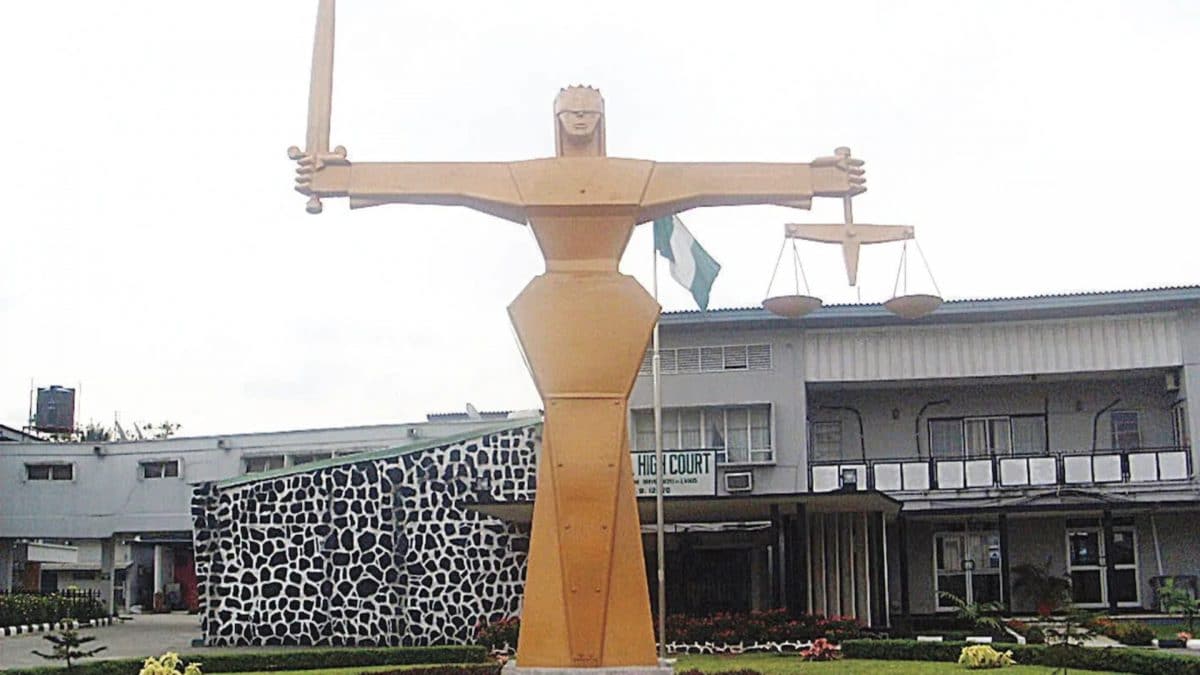
A Lagos-based man, Mr Kolawole Adesina, has appealed to the Lagos State High Court to intervene in what he described as prolonged delays in the reading of his late father’s will. According to him, the delay has worsened a long-standing family dispute and has made it difficult to properly manage and distribute the estate.
Kolawole is the son of the late Prince Emmanuel Adesina, a former senior manager with United Bank for Africa (UBA). Prince Adesina reportedly died in 2006 after a long illness. At the time of his death, the family believed he did not leave behind a will.
As a result, Kolawole said the family applied for and obtained Letters of Administration from the court in 2009. The document allowed the estate to be managed under the assumption that Prince Adesina died intestate, meaning without a will.
Prince Adesina was married to the late Mrs Frances Adesina, and the marriage produced two children, Kolawole and his sister, Adenike Adesina-Kupolati.
Kolawole explained that both he and his sister lived outside Nigeria for several years. During that period, a nephew of the deceased, Mr Franklin Erinle, reportedly lived with their parents and assisted Prince Adesina, especially during his declining health.
He said issues later arose concerning how some of his father’s personal and financial matters were handled during that time and after his death. According to Kolawole, he was unable to access his father’s personal belongings for many years and could not get clear information about certain transactions linked to the estate.
The matter, he said, remained unresolved for a long time until 2022, when his mother became critically ill. This development prompted him to return to Nigeria to take care of her.
While staying in his parents’ home, Kolawole said he discovered some documents in his father’s room that raised questions about past dealings related to the estate. Although he acknowledged that these findings have not yet been examined by the court, he said they increased his concern about how the estate had been managed.
In April 2022, Mrs Frances Adesina died. Kolawole said he was surprised when her will was read. According to him, the will listed assets that were already part of his father’s estate and covered by the earlier Letters of Administration.
He also questioned the appointment of an administrator named in his mother’s will, noting that the person was not involved in managing his father’s estate. He said this raised further questions about how both estates were being handled.
The dispute took another turn when a former caregiver to his father allegedly produced a sealed letter in 2022. Kolawole said the letter was said to have been written by his father in 2002. According to the contents of the letter, Prince Adesina had deposited his will with UBA for safekeeping.
Kolawole said he later contacted the bank for clarification. He claimed that UBA confirmed that a document believed to be a will was lodged with the bank in January 2006, shortly before his father’s death.
This discovery, he said, changed the entire situation surrounding the estate. He argued that if a valid will exists, the earlier administration of the estate under Letters of Administration should be reviewed.
In Nigeria, when a person dies without a will, the estate is shared based on laws of intestacy. However, where a valid will exists, the wishes of the deceased, as stated in the will, are expected to guide the distribution of the estate, subject to the law.
Kolawole said he approached the court to request that the alleged will be formally presented and read. However, the process has faced repeated delays.
According to him, lawyers representing his sister, Adenike, have raised objections, questioning the authenticity of the will and asking for further investigations before it can be read in open court.
Kolawole said he has no problem with anyone challenging the will but insisted that the will should first be read openly as required by law.
“I am not against anyone raising objections,” he said. “All I am asking for is transparency. Let the will be read, and then any party who is not satisfied can challenge it in court.”
He expressed concern that the continued delay has prevented the proper administration of the estate and prolonged the family conflict.
The dispute, he said, has also taken a personal toll on him. He revealed that the disagreement led to security concerns and legal issues, some of which resulted in court cases that were later struck out.
Family disputes over estates are common in Nigeria, especially where wills are disputed or discovered many years after a person’s death. Legal experts say such cases often drag on due to emotional tensions, lack of proper documentation, and conflicting interests among family members.
They also stress the importance of clear estate planning and timely disclosure of wills to prevent prolonged conflicts.
Kolawole said he is hopeful that the court will step in to ensure that due process is followed and that the matter is resolved fairly.
As of the time of this report, the Lagos State High Court has not fixed a new date for the reading of the will. The matter remains pending, with both parties waiting for the next legal step.
For Kolawole, the issue goes beyond inheritance. He said it is about honoring his father’s wishes, ensuring fairness, and bringing closure to a dispute that has lasted for nearly two decades.
He urged the court to act in the interest of justice and help restore peace within the family through a transparent and lawful process.