
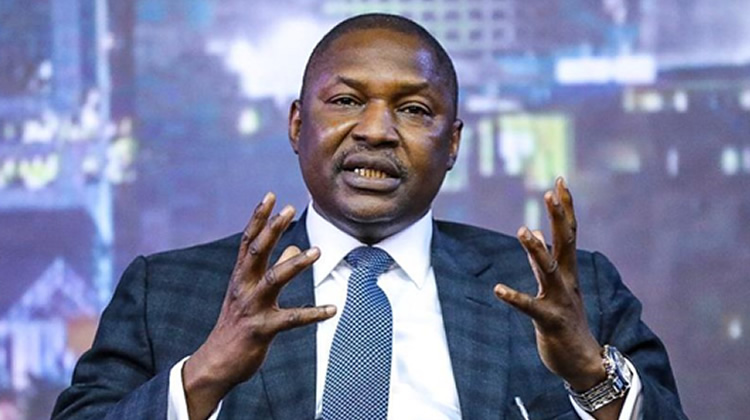
Former Attorney-General of the Federation and Minister of Justice, Abubakar Malami, SAN, has openly challenged the leadership of the Economic and Financial Crimes Commission (EFCC), calling on its Chairman to withdraw from an ongoing investigation and possible prosecution against him.
Malami described the investigation as unfair, politically motivated, and driven by personal anger rather than the rule of law. He accused the EFCC Chairman of acting out of vengeance and said the current process lacks credibility and transparency.
In a press statement issued on Monday and signed by his Special Assistant on Media, Mohammed Bello Doka, Malami said he has lost confidence in the EFCC’s ability to handle the matter objectively under its present leadership.
According to him, the EFCC Chairman should recuse himself from the case to allow for a fair and independent review. Malami also asked that the investigation be transferred to another government agency to protect public trust in the justice system.
Malami alleged that the probe and his recent detention are connected to his decision to defect from the ruling All Progressives Congress (APC) to the African Democratic Congress (ADC). He claimed the move triggered hostility against him from powerful individuals.
He further alleged that the EFCC Chairman holds a long-standing personal grudge against him, dating back to the Justice Ayo Salami Judicial Commission of Inquiry. That commission was set up during Malami’s time as Attorney-General to investigate corruption allegations within the EFCC.
Malami suggested that the findings and events of that period created bad blood between him and the EFCC Chairman, which he believes is now influencing the current investigation.
“The present investigation marked by illegal detentions, media harassment, and procedural abuses bears all the hallmarks of retaliatory persecution motivated by personal vengeance,” Malami said in the statement.
He argued that because of this alleged conflict, the EFCC Chairman cannot be expected to act fairly or without bias in a case involving him.
The former Attorney-General said allowing the EFCC Chairman to continue overseeing the investigation would damage the integrity of the anti-corruption fight and weaken public confidence in government institutions.
Malami formally demanded that the EFCC Chairman step aside from the matter. He also called on the current Attorney-General of the Federation to intervene urgently and ensure that the investigation follows due process.
According to him, failure to act could lead to further abuse of power and damage the reputation of the EFCC as a professional law enforcement agency.
Malami also raised concerns about his detention, saying it violates his fundamental rights as guaranteed by the Nigerian Constitution. He insisted that if there is a case against him, the proper step is to charge him to court without delay.
He cited Sections 35(3), (4), and (5) of the 1999 Constitution, which deal with personal liberty and timelines for arraignment. He stressed that only a competent court of law has the authority to determine guilt or innocence.
“Only a court—not a politically compromised agency can lawfully adjudicate the matter,” Malami said.
He called for immediate judicial oversight, adding that prolonged detention without trial is unlawful and unacceptable in a democratic society.
The former minister also accused the EFCC of planning to rely on questionable witnesses to support its case. According to him, some of these individuals have criminal convictions outside Nigeria.
He described this alleged strategy as “desperate, scandalous, and corrosive to the integrity of Nigeria’s criminal justice system.”
Malami warned that using such witnesses could weaken the credibility of any case brought against him and further damage public trust in the anti-corruption process.
As part of his legal response, Malami’s office has formally requested certified copies of the petitions and investigation reports being used by the EFCC to justify its actions.
He said the request covers petitions allegedly submitted by two groups: Human and Environmental Agenda, and Grassroot Advocacy for Peace and Good Governance.
According to Malami, access to these documents is necessary for transparency and to allow him respond properly to the allegations against him.
Malami maintained that he is not afraid of investigation and has nothing to hide. He said his main concern is that the process must be lawful, fair, and free from political influence.
His statement comes amid ongoing public debate about the independence of Nigeria’s anti-corruption agencies and their use during political disputes.
The EFCC has often been at the center of controversies, with critics accusing it of being used to target political opponents, while supporters argue that it is simply enforcing the law.
Malami himself served as Attorney-General and Minister of Justice from 2015 to 2023 under former President Muhammadu Buhari. During his tenure, he was one of the most powerful figures in government and was involved in several high-profile legal and political decisions.
His role as Attorney-General also placed him in a position of oversight over agencies like the EFCC, which may explain the tension he now alleges exists between him and the commission’s leadership.
Since leaving office, Malami has remained active in politics. His recent defection to the ADC has attracted attention, especially as political realignments continue ahead of future elections.
Malami ended his statement by saying his goal is to clear his name through open and lawful judicial processes. He warned against turning anti-corruption agencies into tools for political battles.
“The law must remain supreme—above politics, above power, and above persons,” he said.
As of the time of filing this report, the EFCC has not issued an official response to Malami’s claims or his demand that the Chairman recuse himself.