
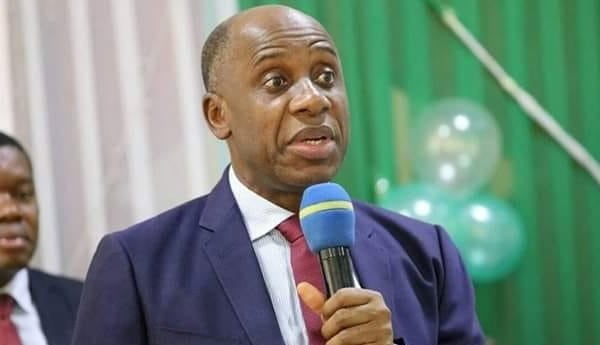
Former Minister of Transportation and former Governor of Rivers State, Rotimi Amaechi, has firmly ruled out the possibility of serving as vice president to any presidential candidate in the 2027 general elections.
Amaechi made this position clear amid growing speculation that he could emerge as a running mate to former Vice President Atiku Abubakar, who is believed to be positioning himself as the presidential flagbearer of the African Democratic Congress (ADC).
Speaking at a public event in Abuja, Amaechi dismissed the rumours, insisting that he has no interest in deputising any candidate in 2027. He said his political experience and understanding of governance make it impossible for him to accept the role of vice president.
“I will not be vice president to anybody. There are too many reasons why I won’t be vice president to anybody,” Amaechi said.
“The first reason is that I’m too presidential to be vice,” he added.
The comments come at a time when political activities ahead of the 2027 elections are beginning to take shape. Although the elections are still more than a year away, politicians and parties have started early consultations, realignments, and discussions.
Atiku Abubakar, who was the presidential candidate of the Peoples Democratic Party (PDP) in the 2019 and 2023 elections, has been linked with plans to contest again. Recent reports suggest he may do so on the platform of the African Democratic Congress (ADC), a smaller opposition party seeking to build a strong national presence.
Amaechi’s name has often come up in discussions about possible alliances, given his national profile and experience. This fueled speculation that he could be considered as Atiku’s running mate if the former vice president secures the ADC ticket.
However, Amaechi’s latest statement appears to have put an end to such talks.
Amaechi also made it clear that he is interested in contesting the presidency himself. According to him, his political journey has prepared him for the top job rather than a supporting role.
He said the challenge with the office of vice president in Nigeria goes beyond personal preference. Instead, he described it as a structural problem built into the system.
“The problem with the office of the vice president is not ceremonial, it is structural,” Amaechi said.
He argued that the Nigerian Constitution and political practice place the vice president in a subordinate position, making the office largely dependent on the president’s attitude and goodwill.
“In Nigeria, the office of the vice president is designed to be subordinate, often powerless, and depends entirely on the temperament of the president,” he said.
Amaechi said the structure of the vice presidency often leads to conflict between the president and the vice president. According to him, disagreements are common because the vice president may have ideas and ambitions but lacks the authority to act independently.
“We will quarrel,” he said, referring to the likely tension that would arise in such an arrangement.
“Instead of that, I would rather be a minister than be a vice president,” Amaechi added.
His remarks reflect a long-standing debate in Nigeria about the relevance and effectiveness of the vice president’s office. Over the years, several vice presidents have complained, openly or privately, about being sidelined or underutilised.
Since the return to democracy in 1999, relations between presidents and their deputies have often been strained. Former Vice President Atiku Abubakar himself had a troubled relationship with former President Olusegun Obasanjo during their second term in office.
Similarly, during the administration of former President Goodluck Jonathan, Vice President Namadi Sambo was widely seen as having limited influence. More recently, Vice President Yemi Osinbajo was praised for his performance when he acted as president, but observers noted that his influence reduced when President Muhammadu Buhari returned from medical leave.
These examples have strengthened arguments that the vice presidency in Nigeria is weak and depends largely on the president’s willingness to delegate power.
Amaechi is one of Nigeria’s most experienced politicians. He served as Speaker of the Rivers State House of Assembly before becoming governor of the oil-rich state from 2007 to 2015.
He later became Minister of Transportation under former President Muhammadu Buhari, serving from 2015 to 2022. In that role, he oversaw major railway projects, including the Abuja-Kaduna and Lagos-Ibadan rail lines.
Amaechi also contested the presidential primary of the All Progressives Congress (APC) in 2022 but lost to Bola Ahmed Tinubu, who went on to win the 2023 presidential election.
After the election, Amaechi became more vocal in his criticism of the APC-led government, citing concerns about governance, economy, and national direction.
The African Democratic Congress has in recent years attracted politicians dissatisfied with the two major parties, the APC and the PDP. While the party has not won the presidency before, it is seen by some as a possible platform for a broader opposition coalition in 2027.
Amaechi’s interest in the ADC presidential ticket suggests he may be looking to play a leading role in shaping such a coalition.
As political consultations continue, Amaechi’s statement adds clarity to his position and narrows the options for potential alliances. While Atiku Abubakar is yet to formally declare his plans, it is clear that Amaechi does not see himself as a supporting act in any ticket.