
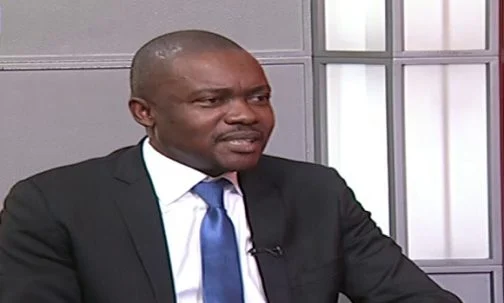
Former President of the Trade Union Congress (TUC), Peter Esele, has said that the Dangote Petroleum Refinery feels threatened by actions of government regulators, particularly the Nigerian Midstream and Downstream Petroleum Regulatory Authority (NMDPRA).
Esele made the remarks on Tuesday while speaking on Politics Today, a programme on Channels Television. He was reacting to the ongoing disagreement between the Chairman of Dangote Group, Aliko Dangote, and the Chief Executive Officer of the NMDPRA, Farouk Ahmed.
According to Esele, Dangote believes that regulatory decisions in the downstream oil sector are undermining his massive investment in local refining. He said the core of Dangote’s complaint is the continued issuance of multiple import licences for petroleum products, even as local refineries, especially the Dangote Refinery, are coming on stream.
“Now Dangote has made a series of allegations against NMDPRA,” Esele said. “What Dangote is against is why they are issuing multiple licences.
“Dangote refinery is being threatened, and Dangote feels that his business is being undermined by the regulators.”
The Dangote Petroleum Refinery, located in Lekki, Lagos, is Africa’s largest single-train refinery, with a capacity of 650,000 barrels per day. It was built to reduce Nigeria’s long-standing dependence on imported petroleum products and save billions of dollars spent on fuel imports annually.
For decades, Nigeria, despite being a major crude oil producer, has relied heavily on imported petrol, diesel, and aviation fuel due to the poor performance of government-owned refineries. Successive administrations have promised to fix the refineries, but progress has been slow.
The Dangote Refinery is seen as a major solution to this problem. It is expected to supply most of Nigeria’s fuel needs and even export to other African countries. However, the refinery has faced challenges, including regulatory issues, pricing concerns, and disputes over crude oil supply.
Recently, Aliko Dangote accused the NMDPRA of frustrating local refining by continuing to approve fuel imports. He argued that such actions discourage local production and expose local refiners to unfair competition.
Beyond policy disagreements, the conflict took a personal turn when Dangote made serious allegations against the NMDPRA boss, Farouk Ahmed. Dangote accused him of corruption and living beyond his known income as a public servant.
Dangote claimed that the lifestyle and foreign education of Ahmed’s children raised questions about the integrity of regulatory oversight in the downstream oil sector. He later submitted a petition to the Independent Corrupt Practices and Other Related Offences Commission (ICPC), calling for an investigation.
Esele said these allegations should not be ignored and must be properly investigated by the relevant authorities.
“On the second hand, Dangote making allegations against the MD of NMDPRA is something we all need to look at,” he said. “That’s something we should work on.”
The former TUC president stressed the importance of transparency and accountability in public service. According to him, public officers must be ready to explain how they live and how they earn their income.
“Public officers should be held accountable. We should know how they live their lives. We should know their source of livelihood,” Esele said.
He added that once a person accepts a public office, they must operate within clear limits and make their earnings and assets open to scrutiny.
“And once you are a public officer, that definitely means that you have to live within certain parameters. Your means of livelihood and your earnings should be made public,” he said.
Esele argued that such openness would strengthen public institutions and rebuild trust in government.
Despite the high-profile nature of the dispute, Esele said Nigerians should not be overly worried by the clash between Dangote and the NMDPRA leadership. Instead, he described it as a normal test of the system.
“So for the Dangote versus NMDPRA boss, I don’t see that as something that we should be worried about,” he said.
According to him, the situation presents an opportunity for institutions to prove their independence and effectiveness.
“It’s something that we expect our security agencies, the ICPC, or whoever is concerned, to go and look at Dangote’s allegations and see if it’s a fact,” Esele added.
The NMDPRA was created under the Petroleum Industry Act (PIA) of 2021 to regulate Nigeria’s midstream and downstream petroleum sectors. Its responsibilities include issuing licences, monitoring fuel supply, ensuring fair competition, and protecting consumers.
Supporters of the agency argue that fuel imports are still necessary to meet demand, especially during periods when local supply is not sufficient. They say the regulator must balance the interests of consumers, importers, and local refiners.
However, critics say the continued reliance on imports undermines investments in local refining and keeps Nigeria exposed to foreign exchange pressure and global price shocks.
As a former labour leader, Esele’s comments reflect concerns from workers and consumers who want stable fuel supply, affordable prices, and job creation.
Labour unions have long argued that local refining will create thousands of jobs, reduce fuel scarcity, and lower transport and production costs. Any action seen as discouraging local refineries, they argue, works against national interest.
Esele said resolving the Dangote–NMDPRA dispute fairly will send a strong signal to both investors and workers.
As investigations into the allegations begin, attention will focus on how the ICPC and other agencies handle the matter. Many Nigerians see the case as a test of the government’s commitment to fighting corruption and supporting local industries.
At the same time, policymakers will be under pressure to review fuel import policies and ensure that regulatory decisions support Nigeria’s long-term energy goals.