
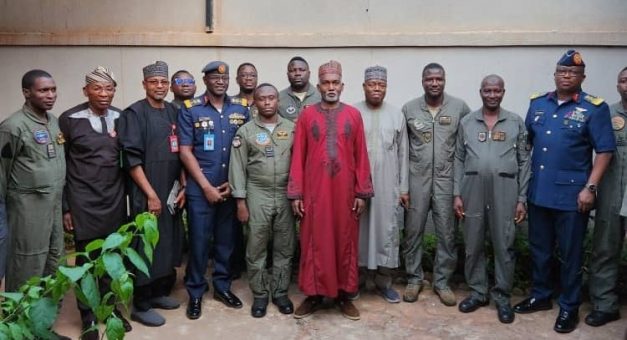
Burkina Faso has released a Nigerian Air Force (NAF) aircraft and 11 Nigerian military personnel who were detained after the aircraft made a precautionary landing in the country following technical problems.
The release came after diplomatic engagements between the Nigerian government and the military authorities in Burkina Faso, easing tensions that followed the incident.
The aircraft involved is a Nigerian Air Force C-130 transport plane. According to the Nigerian Air Force, the aircraft was on a ferry mission to Portugal when it developed technical issues and was forced to land in Bobo Dioulasso, a city in south-western Burkina Faso, about two weeks ago.
The Director of Public Relations and Information of the Nigerian Air Force, Mr. Ehimen Ejodame, explained that the aircraft made the landing strictly for safety reasons.
He said the crew acted in line with international aviation rules, which require pilots to land at the nearest safe airport whenever there is a technical problem that could endanger the aircraft and those on board.
According to him, the decision to land in Bobo Dioulasso was taken to protect the lives of the 11 personnel on board and to prevent further damage to the aircraft.
He stressed that the mission was not hostile and that the aircraft did not pose any security threat to Burkina Faso or any other country in the region.
Despite this explanation, the incident attracted strong reactions from leaders of the Confederation of Sahel States, a bloc made up of Mali, Burkina Faso, and Niger.
The leader of Mali’s military government, General Assimi Goita, who spoke on behalf of the bloc, described the Nigerian aircraft’s landing as an “unfriendly act” and claimed it violated international law.
Goita warned that Sahel States would take firm action against any aircraft they believe violates their airspace. He said such aircraft could be “neutralised,” a statement that raised concerns across the region.
The comments reflected the growing tension between Nigeria and some military-led governments in the Sahel, especially following recent political and security disagreements.
Relations between Nigeria and the Sahel military governments have been strained in recent years. Following military coups in Mali, Burkina Faso, and Niger, these countries withdrew from the Economic Community of West African States (ECOWAS) and formed the Confederation of Sahel States.
Nigeria, as a leading member of ECOWAS, has often supported diplomatic pressure and sanctions against military regimes, particularly after the 2023 coup in Niger.
These developments have affected cooperation on security, trade, and movement across borders, even as the region continues to face serious threats from terrorism, banditry, and organised crime.
The detention of the Nigerian aircraft and its crew was therefore seen by observers as part of wider political and security tensions in the region.
Following the detention, the Nigerian government moved quickly to resolve the issue through diplomatic channels.
A high-level delegation led by the Minister of Foreign Affairs, Ambassador Yusuf Tuggar, was sent to Ouagadougou, the capital of Burkina Faso, on the directive of President Bola Ahmed Tinubu.
The delegation met with Burkina Faso’s military leader, Captain Ibrahim Traoré, to discuss the incident and seek the release of the aircraft and its crew.
After the meeting, Tuggar briefed journalists and expressed satisfaction with the outcome of the talks.
He said the discussions were frank and respectful and helped to clear misunderstandings surrounding the landing of the Nigerian Air Force aircraft.
The release of the aircraft and the 11 personnel was later confirmed by the Ministry of Foreign Affairs.
The ministry’s spokesperson, Mr. Kimiebi Ebienfa, confirmed the development on Wednesday night.
“Yes, they have been released,” Ebienfa said, confirming that both the aircraft and the crew were no longer being held by Burkina Faso authorities.
Though full details of the release were not made public, officials said the matter was resolved peacefully through dialogue.
Aviation experts have noted that precautionary or emergency landings are common in global aviation and are recognised under international law.
When an aircraft develops a technical fault, pilots are required to land at the nearest suitable airport to ensure safety. Such landings are not considered acts of aggression or violations, especially when they are clearly linked to safety concerns.
Nigeria’s insistence that the landing followed international protocols aligns with global aviation standards observed by both civilian and military aircraft.
The incident highlights the delicate balance between security concerns and diplomacy in West Africa, where airspace control is a sensitive issue due to ongoing security threats.
Countries in the region are on high alert because armed groups often use remote and forested areas to launch attacks. This has made military authorities cautious about any foreign aircraft movements.
The release of the Nigerian Air Force aircraft and personnel is expected to ease tensions between Nigeria and Burkina Faso, at least for now.
It also shows the importance of diplomacy in resolving disputes, even at a time when political relations in the region are fragile.
For Nigeria, the safe return of its personnel is a relief and a reminder of the challenges of operating in a region facing both security threats and political uncertainty.
As West African nations continue to deal with terrorism, political instability, and strained alliances, incidents like this underline the need for dialogue, respect for international rules, and cooperation among neighbours.