
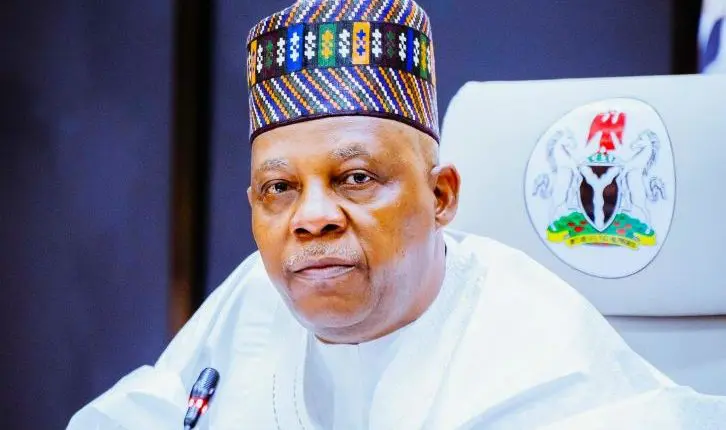
Vice-President Kashim Shettima has warned President Bola Ahmed Tinubu and leaders of the All Progressives Congress (APC) against complacency as political activities ahead of the 2027 general elections begin to take shape.
Shettima gave the warning during the 14th National Caucus meeting of the APC, held at the State House Conference Centre in Abuja. The meeting was attended by President Tinubu, APC governors, party leaders, and other top officials.
Using a strong historical reference, the vice-president said political success can easily be lost if leaders become comfortable and fail to work hard to maintain it.
“Rome was not destroyed by outside invaders. Rome was destroyed by the complacency of the Romans,” Shettima said. “To succeed is much easier than to maintain that success.”
Shettima said the APC must not assume that its current strength across the country guarantees future victories. According to him, history has shown that political parties often lose power not because of strong opposition, but because of internal weaknesses, poor planning, and overconfidence.
He urged party leaders at all levels to remain alert, united, and focused on governance, party organisation, and public trust.
The vice-president’s message comes at a time when the APC controls the federal government and a large number of states, following its victory in the 2023 general elections.
Shettima highlighted what he described as the growing dominance of the APC across Nigeria’s six geopolitical zones. He said the party has expanded its influence through electoral victories and defections from opposition parties.
According to him, the APC is now firmly rooted in many parts of the country.
“The whole of the South-South region is in the APC fold, the whole of the North-Central,” he said.
He added that out of the seven states in the North-West, five are controlled by the APC. In the South-West, the party governs four of the six states. In the North-East, APC controls four out of six states.
Shettima described the ruling party as “a force of nature,” saying its reach and influence have grown beyond expectations.
The vice-president made specific reference to Delta State as an example of the APC’s growing strength in areas previously dominated by the opposition Peoples Democratic Party (PDP).
He pointed out that key political figures from Delta State have now aligned with the APC, strengthening the party’s chances in future elections.
Shettima mentioned former PDP vice-presidential candidate and former Delta State governor, Senator Ifeanyi Okowa, who recently defected to the APC. He also cited Senator Ovie Omo-Agege, a former Deputy President of the Senate, as another major APC figure in the state.
“With Senator Ifeanyi Okowa within our fold, and with Senator Ovie Omo-Agege, how do you expect us to lose in Delta?” he asked.
He said similar political advantages exist for the APC in many other states across the federation.
Shettima also reassured governors and political leaders who recently defected to the APC from other parties, telling them they were welcome and safe within the ruling party.
He said the APC values loyalty and commitment and would provide a stable platform for those willing to work for the party’s ideals and national development.
The vice-president expressed happiness over the increasing number of politicians seeking to join the APC, noting that this reflects confidence in the party’s leadership and direction.
According to Shettima, the APC is not only focused on winning the next election but also on remaining relevant and dominant in Nigerian politics for many years.
He said the party must continue to strengthen its internal structures, manage conflicts wisely, and ensure that governance delivers real benefits to Nigerians.
The APC was formed in 2013 through a merger of several opposition parties and came to power in 2015, ending the PDP’s 16-year rule at the federal level. Since then, the party has won three consecutive presidential elections.
President Tinubu, a founding member of the APC, won the 2023 presidential election after serving two terms as governor of Lagos State. His administration has introduced major economic reforms, including fuel subsidy removal and exchange rate changes, which have sparked mixed reactions across the country.
As economic challenges continue to affect many Nigerians, analysts say public satisfaction with governance will play a major role in determining the outcome of the 2027 elections.
Shettima’s warning is seen by many as a call for humility and discipline within the ruling party. By reminding APC leaders of the fate of ancient Rome, he stressed that internal neglect, not opposition attacks, poses the greatest risk to the party’s future.
He urged leaders to focus on service delivery, unity, and accountability, saying these are the foundations of lasting political success.
Some APC members welcomed the vice-president’s comments, describing them as timely and necessary. They said the party must avoid repeating mistakes that have cost other ruling parties power in the past.
Opposition figures, however, argue that the APC’s growing dominance is due more to defections than performance, and they insist that voters will ultimately judge the party at the polls.
With more than two years to the next general elections, political activities are expected to increase across the country. Parties are already positioning themselves, building alliances, and strengthening their bases.
Shettima’s remarks suggest that the APC leadership is aware of the risks of complacency and the need to stay connected to the people.
As Nigeria moves closer to 2027, the ruling party faces the task of turning its wide political spread into lasting public support, while addressing the economic and social concerns of millions of Nigerians.