
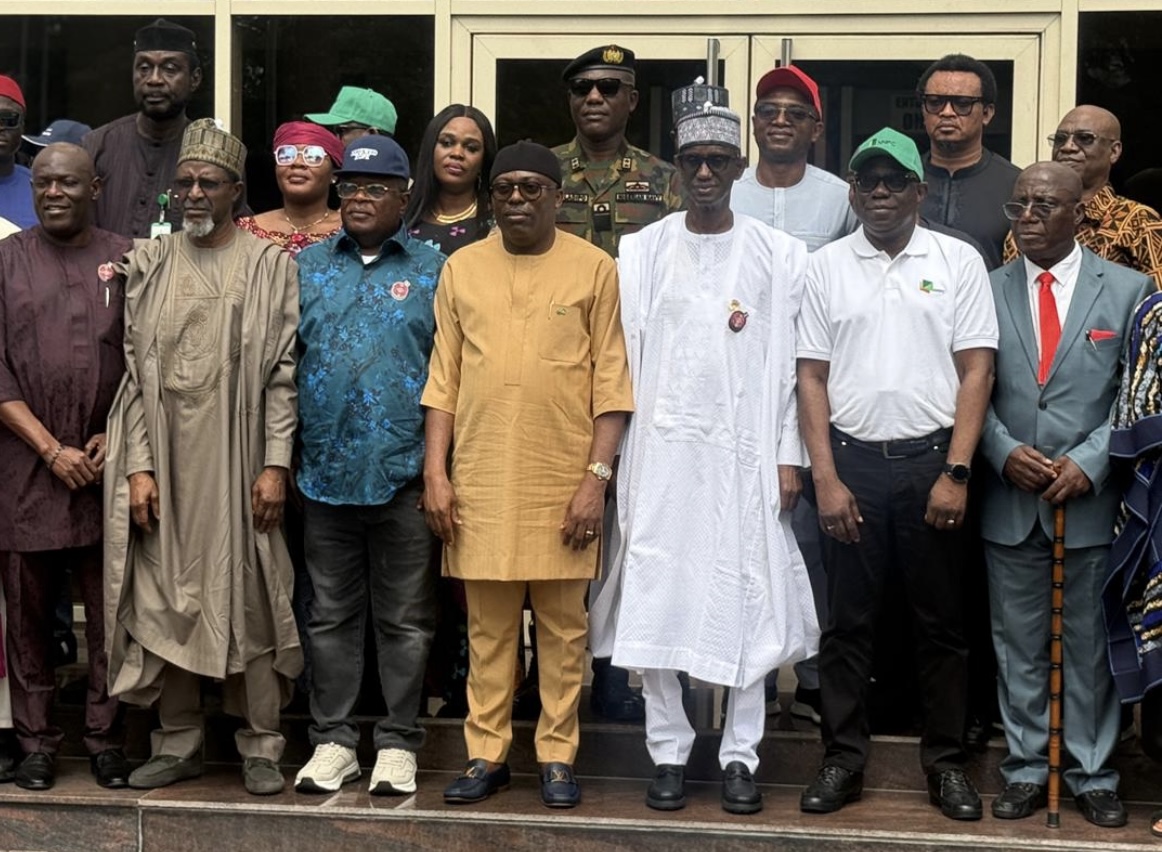
President Bola Ahmed Tinubu is pleased with the leadership of Rivers State Governor, Siminalayi Fubara, especially in promoting peace and coordination in the state. This message was delivered by the National Security Adviser (NSA), Mallam Nuhu Ribadu, during a high-level visit to the Rivers State Government House in Port Harcourt on Monday.
Ribadu led a presidential delegation that included the Minister of Works, David Umahi; the Minister of Environment, Balarabe Lawal; and senior officials of the Nigerian National Petroleum Company (NNPC) Limited. The visit was described as a courtesy call and part of ongoing efforts by the Federal Government to strengthen peace and development initiatives in Rivers State, particularly in Ogoniland.
Speaking during the visit, Ribadu said President Tinubu specifically asked him to convey his appreciation to Governor Fubara for his leadership style and commitment to peace. According to him, Rivers State is currently one of the most peaceful states in the country, despite its history of political tension and economic importance.
“The President asked me to thank you personally for your leadership and coordination,” Ribadu told Governor Fubara. “He is pleased with what you are doing in Rivers State.”
The NSA explained that the main purpose of the visit was to support and strengthen peace efforts in Ogoniland, a region in Rivers State that has faced decades of conflict linked to oil exploration, environmental damage, and community agitation.
According to Ribadu, a “new chapter” is opening in Ogoniland, with renewed efforts to promote dialogue, development, and national unity. He said the Federal Government believes that progress in Ogoni will contribute positively to Nigeria’s overall development.
“If transformation begins from places like Ogoni, Nigeria will surely become better,” Ribadu said.
He also thanked the people of Ogoni for their patience, cooperation, and support, noting that peace cannot be achieved without the understanding and participation of local communities.
Ogoniland has long been a sensitive area in Nigeria’s oil-producing Niger Delta region. Oil production in the area was halted in the early 1990s following widespread protests over environmental pollution and lack of development. Since then, the region has remained largely shut to oil exploration, while facing serious environmental challenges.
In recent years, the Federal Government has made several attempts to restore peace in Ogoniland, including the launch of the Hydrocarbon Pollution Remediation Project (HYPREP) to clean up oil spills and polluted land following a United Nations Environmental Programme (UNEP) report.
Ribadu said discussions are ongoing about the possible resumption of oil exploration in Ogoni, stressing that such talks must be handled carefully and with full consultation of the people.
He praised Governor Fubara for playing a key role in coordinating these discussions and ensuring calm in the state.
The NSA also commended the Rivers State Government for supporting federal institutions in the state. He specifically mentioned the provision of a campus for the University of Environment and the hosting of the South-South Zonal Office of the Office of the National Security Adviser.
According to Ribadu, these efforts show the state government’s commitment to education, environmental protection, and national security.
In his remarks, the Minister of Works, David Umahi, described the peace initiative in Ogoniland as “strategic to the renewed unity of Nigeria.” He said President Tinubu has a personal interest in the welfare and development of the Niger Delta region.
Umahi noted that peace in Ogoni and other parts of the Niger Delta is important not only for oil production but also for national stability and economic growth.
He assured residents that the Federal Government is committed to completing major infrastructure projects in the region, especially the East–West Road, which is a key transport route linking several Niger Delta states.
“All sections of the East–West Road affecting the Niger Delta will be completed to standard,” Umahi said.
He disclosed that the 15-kilometre Eleme axis of the East–West Road in Ogoniland includes five flyovers. According to him, one of the flyovers is being constructed by the Rivers State Government as part of its support for the President’s development agenda.
The East–West Road has been under construction for many years and has suffered repeated delays, causing hardship for residents and businesses. The road is vital for the movement of goods, oil services, and people across the region.
Umahi also revealed that, with the approval of President Tinubu, plans are underway to dualise the Bonny–Bodo Road from its starting point to the East–West Road. He said the project will include the construction of two flyovers to ease traffic and improve access.
The Bonny–Bodo Road is seen as a major project for the region, as it will provide better access to Bonny Island, which hosts major oil and gas facilities, including the Nigeria Liquefied Natural Gas (NLNG) plant.
In addition, the Minister of Works announced that the Lagos–Calabar Coastal Highway is being redesigned to pass through Ogoniland. He said this adjustment shows the Federal Government’s intention to integrate Ogoni communities into national infrastructure plans.
The proposed coastal highway is one of the flagship projects of the Tinubu administration and is expected to boost trade, tourism, and economic activities along Nigeria’s coastline.
Governor Siminalayi Fubara, who assumed office in 2023, has faced political challenges in Rivers State but has continued to emphasize peace, development, and cooperation with the Federal Government.
As discussions on peace, development, and possible oil resumption continue, many residents hope that the renewed engagement by the Federal Government will bring lasting benefits, including jobs, infrastructure, and environmental restoration.