
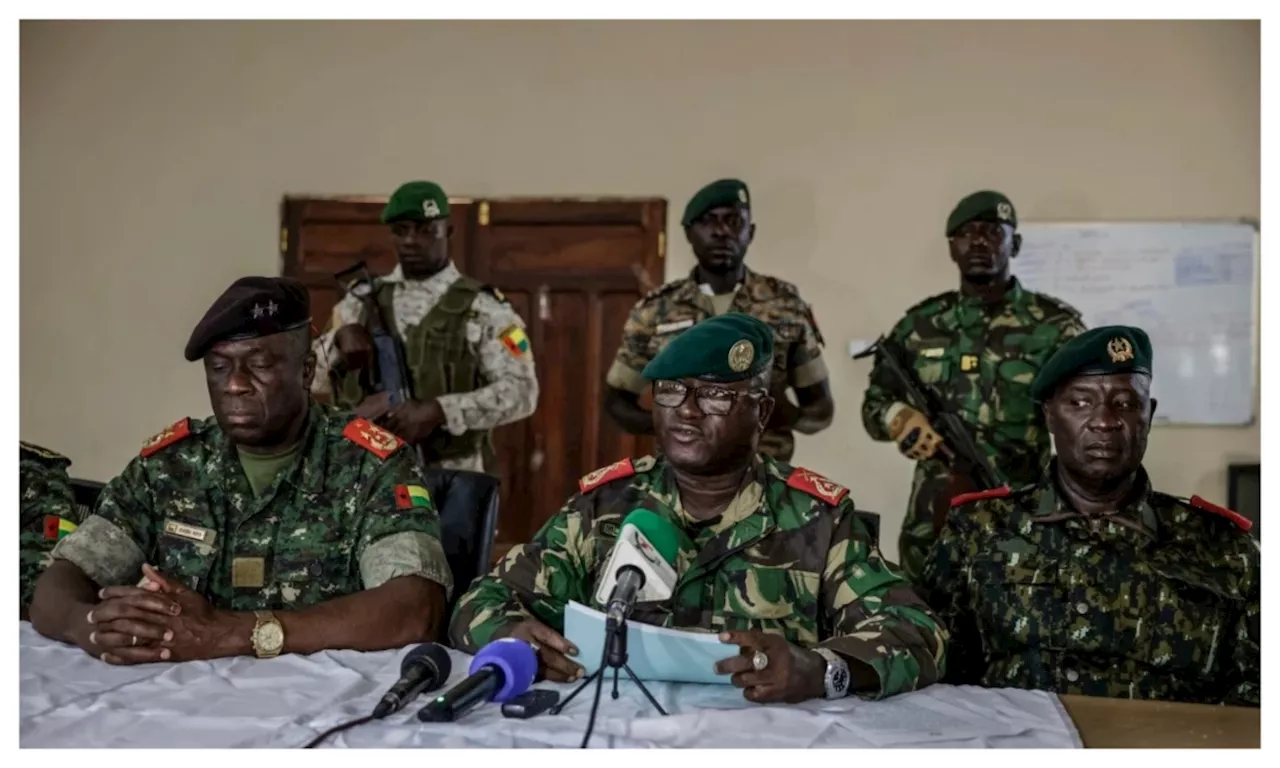
The military government in Guinea-Bissau has released six opposition politicians who were detained following a coup last month, raising hopes of a possible easing of tensions in the troubled West African country. The release was announced on Tuesday by the ruling junta, which described the move as a sign of goodwill and a step towards restoring constitutional order.
The six opposition members had been in custody since the military seized power on November 26. They are believed to be close allies of Domingos Simoes Pereira, the leader of the African Party for the Independence of Guinea and Cape Verde (PAIGC). The PAIGC is the party that led Guinea-Bissau to independence from Portugal in 1974 and remains one of the country’s most influential political groups.
According to reports, Pereira himself has remained in detention since the coup, although the junta has not provided clear details about his condition or location. His continued detention has drawn concern from both local and international observers, who see him as a key political figure in the country.
In a statement issued by the High Military Command, which serves as the governing body of the junta, the release of the six opposition figures was described as an act of good faith. The statement said the decision was meant to show the military’s commitment to a return to “constitutional normality” and respect for international human rights standards.
“The High Military Command has decided to release some detained political actors as a gesture of openness and dialogue,” the statement said. “This step is aimed at calming the political climate and paving the way for a peaceful transition.”
Guinea-Bissau has a long history of political instability, marked by frequent coups, military interference in politics, and weak democratic institutions. Since gaining independence in 1974, the country has experienced several coups and attempted coups, making it one of the most politically unstable nations in Africa.
The latest coup took place on November 26, when the army removed President Umaro Sissoco Embalo from power. The takeover followed a disputed presidential election, the outcome of which had already caused deep divisions within the political class and wider society.
After seizing power, the military suspended the electoral process and announced it would rule the country for a period of one year. The junta said this period would be used to “restore order” and reorganize state institutions, though critics fear it could lead to prolonged military rule.
In the days following the coup, several opposition figures were arrested or went into hiding. One opposition candidate, Fernando Dias, sought refuge at the Nigerian Embassy in Bissau. Nigeria granted him asylum, a move that highlighted regional concern over the situation in Guinea-Bissau.
Former President Embalo was also briefly detained by the military during the coup before fleeing the country. His current whereabouts remain unclear, but his removal from office marked a dramatic end to his presidency.
The detention of opposition politicians and the suspension of democratic processes drew criticism from regional and international bodies. The Economic Community of West African States (ECOWAS), the African Union, and the United Nations have all expressed concern about the coup and called for the restoration of civilian rule.
As part of diplomatic efforts to ease the crisis, Senegal’s Foreign Minister, Cheikh Niang, led a delegation to Guinea-Bissau. During his visit, he met with detained opposition figures and formally requested their release. Diplomatic sources say Senegal, along with other ECOWAS member states, has been working quietly to encourage dialogue between the military and civilian political actors.
The release of the six opposition members is being seen as a positive response to these regional efforts. However, many observers say it is only a first step and that more actions will be needed to rebuild trust and restore democracy.
Civil society groups in Guinea-Bissau have welcomed the release but remain cautious. They have called for the immediate release of all political detainees, including Domingos Simoes Pereira, and for a clear timetable for the return to civilian rule.
For ordinary citizens, the ongoing instability has made life more difficult. Economic activity often slows during political crises, while public services suffer. Many people fear that continued uncertainty could worsen unemployment and living conditions in one of the world’s poorest countries.
The junta has insisted that it does not intend to stay in power permanently and has promised a transition back to civilian government after one year. However, it has yet to provide a detailed roadmap or timeline for elections.