
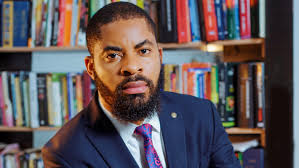
Human rights lawyer and activist, Deji Adeyanju, has called on President Bola Ahmed Tinubu to stop showing sympathy to terrorists and end policies that allow them to receive pardon or forgiveness. He made this call following United States military airstrikes on terrorist groups operating in Northern Nigeria on Christmas Day.
Adeyanju said Nigeria must now take a firm and clear stand against terrorism, rather than what he described as soft treatment of violent groups. He praised the United States for taking decisive action and urged the Nigerian government to do the same.
The US airstrikes were approved by former US President Donald Trump, who announced the operation on his social media platform, Truth Social. Trump described the strikes as powerful attacks against Islamic State (ISIS) members active in Nigeria, especially in the North West.
According to Trump, the mission was aimed at stopping the killing of Christians in Northern Nigeria and preventing what he called widespread violence against them.
In his post, Trump told US forces targeted ISIS camps in North West Nigeria. He accused the group of killing innocent people for many years and said the United States could no longer ignore the situation.
Trump also said that under his leadership, the US would not allow extremist Islamic groups to grow or succeed. He praised the US military and warned that more action could follow if terrorist violence continued.
The announcement attracted global attention and sparked serious debate in Nigeria, especially after the Federal Government later confirmed that the airstrikes were carried out as part of security cooperation between Nigeria and the United States.
The Ministry of Foreign Affairs said the operation followed intelligence sharing and strategic coordination and was aimed at protecting civilians and national unity.
Reacting to the development, Adeyanju openly praised Trump’s decision and criticized Nigeria’s approach to terrorism. In a post on X (formerly Twitter), he said the Nigerian government must stop shielding terrorists or organizing programs that forgive them.
“All hail President Donald Trump,” Adeyanju wrote. “Dear Nigerian government & @officialABAT the time to stop pampering terrorists and organizing forgiveness ceremonies for them is now.”
Adeyanju has in the past spoken strongly against government program that encourage the rehabilitation and reintegration of repentant terrorists. He believes such policies send the wrong message and fail to deliver justice to victims.
According to him, terrorists who have killed innocent Nigerians should face the full weight of the law rather than being rewarded with pardon.
For over a decade, Nigeria has battled terrorism, banditry, and violent extremism, particularly in the North East and, more recently, the North West. Groups such as Boko Haram and the Islamic State West Africa Province (ISWAP) have carried out attacks on villages, schools, places of worship, and security forces.
In response, the Nigerian government has used both military action and non-military approaches. One of these is the rehabilitation program for repentant fighters, which aims to encourage terrorists to surrender, disarm, and return to society.
While the government argues that such programs help reduce violence and gather intelligence, critics like Adeyanju say they are unfair to victims and may encourage more people to take up arms.
Families who lost loved ones in attacks have also complained that those responsible are sometimes released without proper accountability.
Northern Nigeria continues to face serious security challenges. In the North West, armed groups often described as bandits have carried out mass kidnappings, killings, and attacks on highways and rural communities.
Communities in states such as Zamfara, Kaduna, Katsina, Niger, and Sokoto have suffered repeated attacks, forcing many residents to flee their homes.
The recent US airstrikes have raised hopes among some Nigerians that stronger action could weaken these groups. However, others worry about foreign military involvement and its impact on Nigeria’s sovereignty.
The US airstrikes have divided opinion across the country. Supporters say the action shows seriousness and could help Nigeria defeat terrorists faster. Critics argue that Nigeria should not rely on foreign powers to secure its territory.
Adeyanju’s position focuses less on foreign involvement and more on Nigeria’s internal policies. He believes that regardless of who carries out military action, Nigeria must stop showing mercy to terrorists.
Adeyanju’s comments add to growing calls for stronger leadership and tougher decisions in the fight against insecurity. Many Nigerians believe the government must send a clear message that terrorism will not be tolerated.