
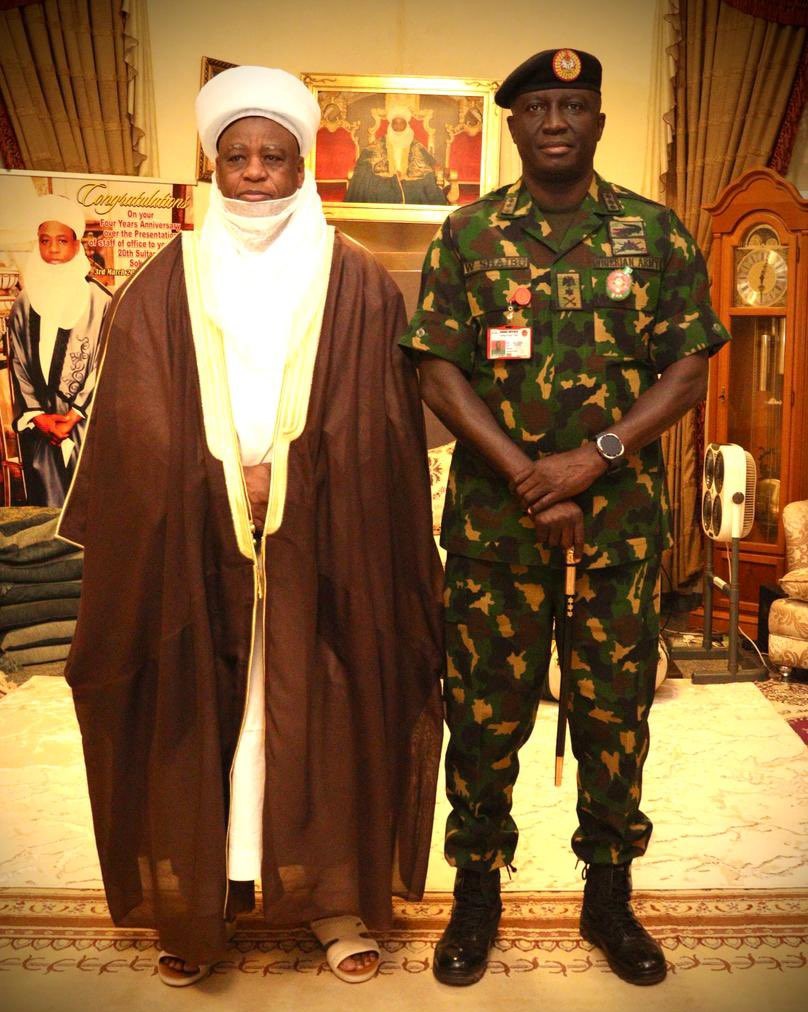
The Chief of Army Staff (COAS), Lieutenant General Waidi Shaibu, on Friday, December 26, 2025, paid a courtesy visit to the Sultan of Sokoto, His Eminence Alhaji Muhammad Sa’ad Abubakar III, CFR, at his palace in Sokoto State. The visit formed part of the Nigerian Army’s efforts to strengthen relations with traditional institutions and promote peace, unity and security across the country.
General Shaibu was warmly received at the palace by the Sultan and other members of the Sokoto Emirate Council. Photos from the visit showed a friendly atmosphere, with both leaders exchanging greetings and holding discussions in a calm and respectful setting. The meeting highlighted the importance of cooperation between the military and traditional rulers in addressing security and social challenges in Nigeria.
Speaking during the visit, the Army Chief said the Nigerian Army remains committed to working closely with community leaders to promote peace and peaceful coexistence. He explained that traditional rulers play a key role in guiding their people, resolving local disputes, and supporting security efforts at the grassroots level. According to him, the Army cannot succeed alone without the trust and support of local communities.
General Shaibu noted that Sokoto State and the wider North-West region are important to the nation’s stability. He said the Army values the advice and support of respected leaders like the Sultan of Sokoto, whose influence cuts across religious and ethnic lines. The COAS stressed that building strong civil–military relations helps the Army to better understand local concerns and respond more effectively to security threats.
The Sultan of Sokoto, Alhaji Muhammad Sa’ad Abubakar III, praised the Nigerian Army for its sacrifices in protecting the country. He commended officers and soldiers for their courage and commitment, especially those serving in difficult and dangerous areas. The Sultan also offered prayers for the Army and asked for continued success in its constitutional duty of defending Nigeria’s unity and protecting lives and property.
The Sultan, who is also the President-General of the Nigerian Supreme Council for Islamic Affairs (NSCIA), has long been a strong voice for peace, dialogue, and national unity. As the spiritual leader of millions of Muslims in Nigeria, his words carry weight across the country. Over the years, he has worked with governments, security agencies, and community groups to promote peace and mutual understanding.
The visit comes at a time when Nigeria continues to face various security challenges, including banditry, kidnapping, insurgency, and communal clashes in different parts of the country. In the North-West, including Sokoto and neighboring states, security forces have been working to contain criminal gangs and protect rural communities. The Army has often stressed that local support and good intelligence from residents are key to winning the fight against insecurity.
Civil–military relations have become an important focus for the Nigerian Army in recent years. The idea is to build trust between soldiers and civilians, so that communities see the military as partners rather than distant forces. Visits like the one to the Sultan’s palace are part of this approach, as they help open channels of communication and cooperation.
Traditional rulers in Nigeria have no formal security powers, but they remain very influential. They understand local cultures, languages, and traditions, and they often know what is happening in their communities. Security agencies frequently rely on them to pass messages, calm tensions, and encourage young people to avoid crime and violence. By engaging traditional leaders, the Army hopes to strengthen early warning systems and promote peaceful solutions to conflicts.
General Shaibu’s visit to Sokoto is also seen as a sign of respect for traditional institutions. The Sokoto Caliphate is one of the oldest and most respected traditional systems in Nigeria, with a history dating back over 200 years. The Sultan is regarded not only as a religious leader but also as a symbol of unity and moral authority.