
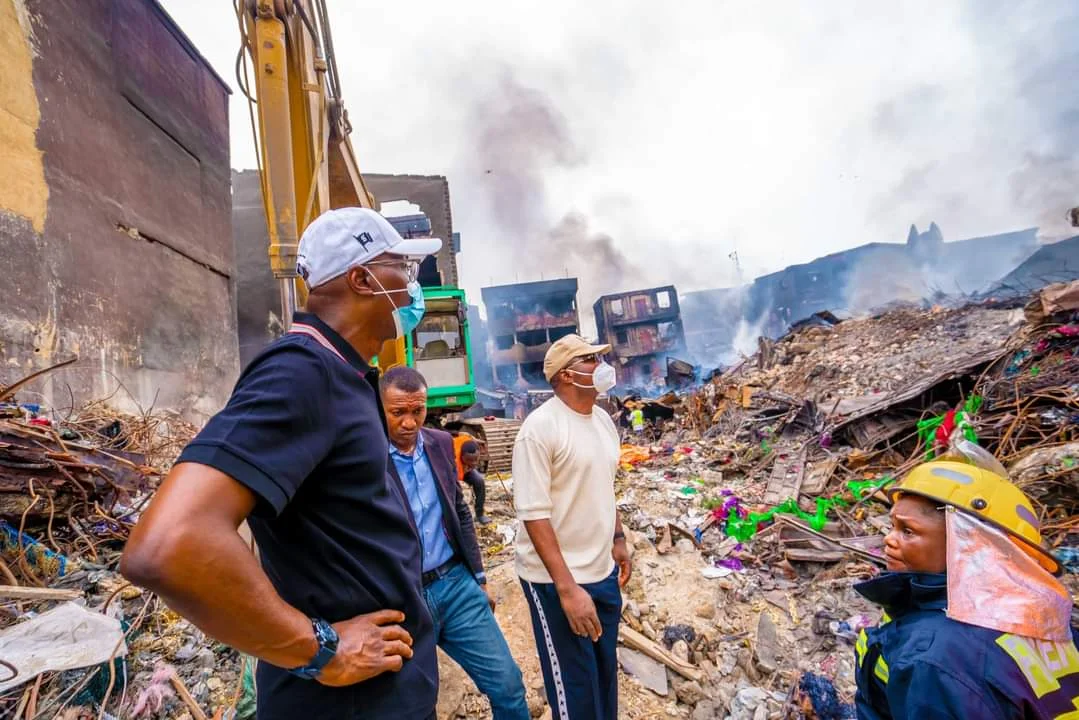
The Lagos State Government has ordered the immediate evacuation of residents and businesses located around the burnt Great Nigeria Insurance (GNI) building, warning that the structure now poses a serious threat to lives and property. The government said it is ready to enforce the directive issued by Governor Babajide Sanwo-Olu to prevent further danger in the area.
The order was announced in a statement issued on Tuesday by the Commissioner for Information and Strategy, Mr Gbenga Omotoso. The statement was also shared on his official Facebook page. According to the government, the decision followed a detailed safety assessment carried out by experts after the fire incident at the building.
The 25-storey GNI building, located in a busy part of Lagos, was gutted by fire on Wednesday, December 24, 2025. The fire lasted several hours and drew the attention of emergency agencies, residents, and business owners in the area. Although no deaths were officially reported, the incident caused panic and raised concerns about the safety of nearby structures.
In the statement, Omotoso said the government had no choice but to act quickly after experts warned that the burnt building had become unstable.
“The Lagos State Government is set to enforce Governor Babajide Sanwo-Olu’s directive that residents and businesses around the burnt Great Nigeria Insurance (GNI) building must vacate the area immediately,” the statement said.
“The government deployed experts to assess the site of the fire, and their findings clearly indicate significant danger to lives and property within a 100-metre radius of the building.”
According to the assessment, the fire severely weakened the structure of the GNI tower. Parts of the building are at risk of collapse, while nearby buildings have also been affected by heat, smoke, and falling debris.
“Several surrounding structures have been compromised and must be evacuated as a precautionary measure,” the statement added.
The government explained that the evacuation order is not limited to the GNI building alone but also covers homes, shops, offices, and other businesses within the danger zone. Officials said this step is necessary to prevent loss of life should the damaged structure give way or cause further incidents.
Mr Omotoso also expressed concern about the actions of some business owners who have ignored safety warnings and continued to operate near the site. He said such behaviour puts lives at serious risk.
“Some shop owners are breaking through the no-movement barrier erected at the scene. This is extremely dangerous and must stop,” he warned.
The Lagos State Government said security agencies and emergency officials have been directed to ensure full compliance with the evacuation order. The government stressed that it would not hesitate to take firm action against anyone who disobeys the directive.
The GNI building fire has once again drawn attention to issues of building safety and emergency response in Lagos, Nigeria’s commercial capital. Lagos is known for its high population density, busy business districts, and many high-rise buildings, some of which are old or poorly maintained.
In recent years, the state government has faced criticism over fire outbreaks and building collapses. However, officials say efforts have been stepped up to improve safety standards, enforce building regulations, and strengthen emergency response agencies such as the Lagos State Fire and Rescue Service.
Governor Sanwo-Olu has repeatedly said that the safety of Lagos residents remains a top priority of his administration. Following the GNI fire, the governor ordered immediate investigations into the cause of the incident and instructed relevant agencies to take all necessary steps to prevent secondary disasters.
Although the exact cause of the GNI fire has not yet been officially announced, fire outbreaks in Lagos are often linked to electrical faults, poor wiring, use of generators, or flammable materials stored in buildings.
Residents and business owners affected by the evacuation order have expressed mixed reactions. Some welcomed the move, saying it is better to be safe than sorry.
“I don’t want to lose my shop, but my life is more important,” said a trader whose shop is close to the GNI building. “If the government says we should leave, then we should leave.”
Others, however, are worried about the impact on their livelihoods, especially during a difficult economic period.
“This is our source of income,” another shop owner said. “We hope the government will support us or allow us to return once it is safe.”
The state government has not yet announced any compensation or support plans for displaced residents and businesses. However, officials said safety must come first and that further decisions will be taken based on expert advice.
The evacuation order also highlights the need for better public awareness about safety rules during emergencies. Authorities have warned residents against spreading rumours or ignoring official instructions, especially during incidents that involve structural risks.
Emergency agencies are expected to continue monitoring the GNI site, while engineers work on plans to either secure, repair, or possibly demolish the damaged structure.
For now, the Lagos State Government has made it clear that the area around the burnt GNI building is unsafe and must be cleared immediately. Residents and business owners have been urged to cooperate fully, as the government insists that the evacuation order is aimed solely at protecting lives and property.