
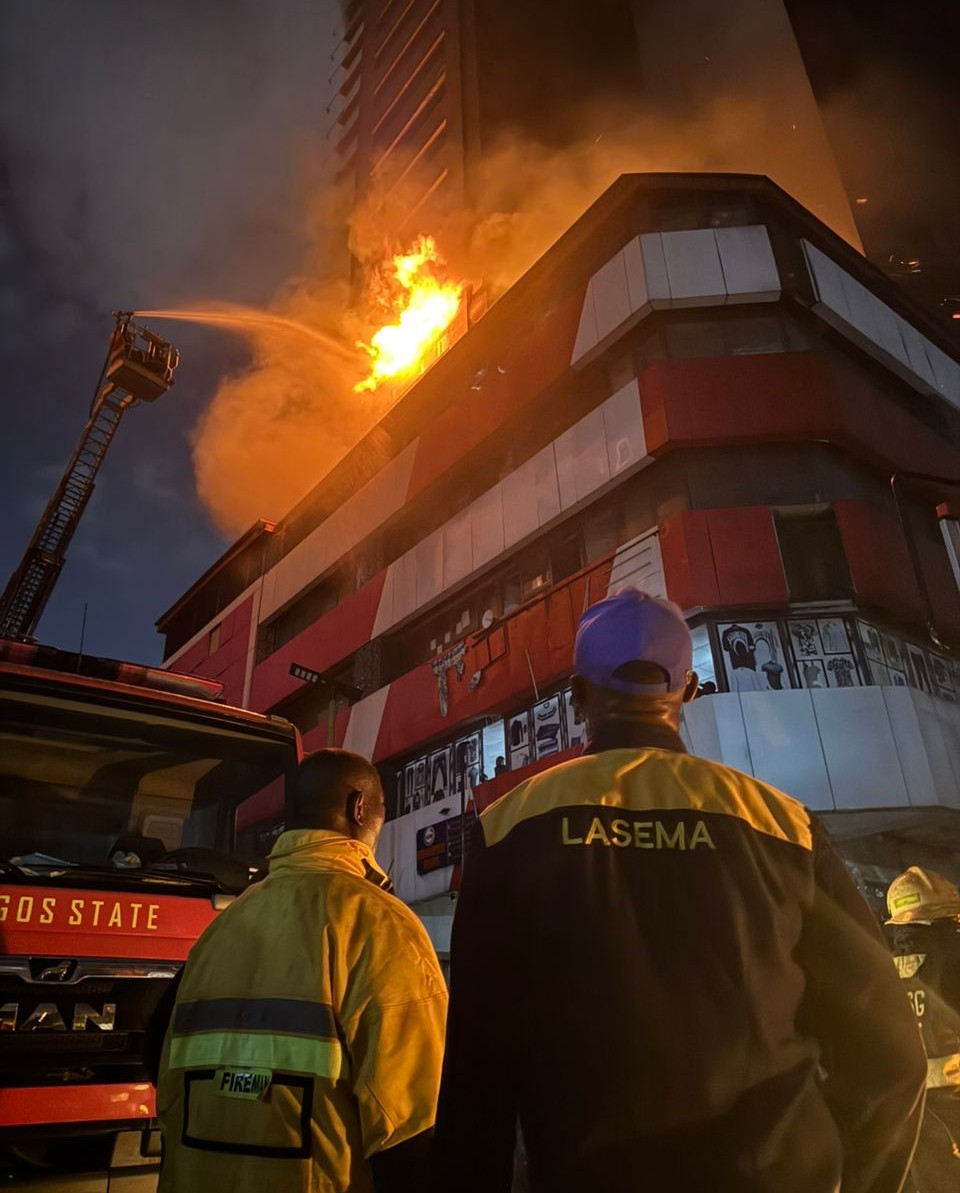
The Lagos State Government has set up a Technical Recovery and Demolition Committee to oversee the planned demolition of the fire-damaged Great Nigeria Insurance (GNI) Building on Lagos Island. The decision comes as emergency response and safety operations continue at the site, which authorities say remains unstable and dangerous.
The development followed a second inspection visit to the scene by Governor Babajide Sanwo-Olu on January 2, 2026. An update released on Friday by the Lagos State Fire and Rescue Service said the governor approved the formation of the committee after assessing the level of damage and the risks still present at the location.
According to the update, the committee will be led by the Commissioner for Special Duties and Intergovernmental Relations. Its main task is to design and carry out a carefully planned demolition of the affected building and its immediate surroundings. Officials said the process would be handled with caution and speed, with the safety of residents, traders, and emergency workers placed above all other concerns.
The GNI Building, located in a busy part of Lagos Island, was severely damaged by a major fire that broke out earlier in the week. The building housed shops and storage areas, many of which contained large quantities of goods. Since the incident, the site has remained under tight security, with emergency responders working round the clock.
Providing an update on the current condition of the building, the Lagos State Fire and Rescue Service said the structure is still highly unstable. In a statement signed by the agency’s Controller General, Margaret Adeseye, the service described the area as “extremely sensitive and volatile.”
She explained that large volumes of rubble and debris are still piled within and around the building. According to her, the fire severely weakened the structure, including its foundation, making it unsafe for any form of use or human activity.
Emergency teams have also continued to detect small pockets of fire within the debris. Adeseye said these fires are not coming from the building materials themselves but from combustible items stored inside the building, such as textiles and clothing.
“These materials are deeply buried within the rubble, and accessing them requires specialised technical planning and extreme caution,” the statement said. She added that careless or rushed attempts to remove debris could lead to further collapse of the already weakened structure.
The Fire and Rescue Service noted that although the remaining fire pockets do not pose an immediate threat to nearby buildings, the risk of sudden collapse remains high. Officials explained that some of the debris may currently be providing unintended support to the damaged structure, meaning that removing it without a proper plan could worsen the situation.
Authorities stressed that all actions at the site are being guided by international disaster response standards. According to them, the safety of emergency responders is a top priority, and no step will be taken unless it is considered safe.
“Large-scale incidents like this often take weeks or even months to fully resolve,” the agency said, urging the public to remain patient and avoid spreading rumours or misinformation.
As part of safety measures, the affected market and surrounding areas remain closed to the public. Access to the site is strictly limited to authorised emergency and technical personnel. This has affected many traders and residents in the area, but the government says the restriction is necessary to prevent further loss of life.
To address concerns and provide information, an information desk has been set up near the site. Officials at the desk are attending to enquiries from families, traders, and other stakeholders affected by the incident.
On the issue of casualties, the Lagos State Fire and Rescue Service confirmed that eight people have died so far as a result of the fire. Five of the victims have been identified, while three are yet to be identified. Thirteen people were rescued alive and received medical attention.
Search and rescue operations are still ongoing in sections of the debris that have been declared safe for access. Emergency teams said the goal is to ensure that no one remains trapped under the rubble.
Preliminary investigations have also revealed serious fire safety violations within the GNI Building. According to officials, the building had excessive storage of combustible materials, stacked from floor to ceiling with little or no ventilation. This created conditions that allowed heat to build up quickly.
Authorities also found that the building lacked functional fire safety installations, such as fire alarms and sprinkler systems. In addition, dangerous practices were reportedly common at the site, including the use of generators inside buildings and shops constructed very close to electrical transformers.
The Fire and Rescue Service warned that such conditions greatly increase the risk of fire. Adeseye explained that intense heat build-up can even lead to spontaneous combustion, sometimes without any clear external ignition source.
The incident has once again raised concerns about building safety, fire prevention, and enforcement of safety regulations in Lagos, especially in densely populated commercial areas. Over the years, Lagos has recorded several market and building fires, many of which were linked to poor safety practices and weak enforcement.
Governor Sanwo-Olu has repeatedly said his administration is committed to improving safety standards across the state. Officials say lessons from the GNI Building fire will help strengthen regulations and enforcement to prevent similar tragedies in the future.
Reassuring the public, Adeseye said emergency operations at the site would continue until all risks are fully removed.
“All actions being undertaken are deliberate, professional and driven by safety considerations,” she said. “Operations will persist until ground zero is completely accessed and the incident is conclusively brought to an end.”
.