
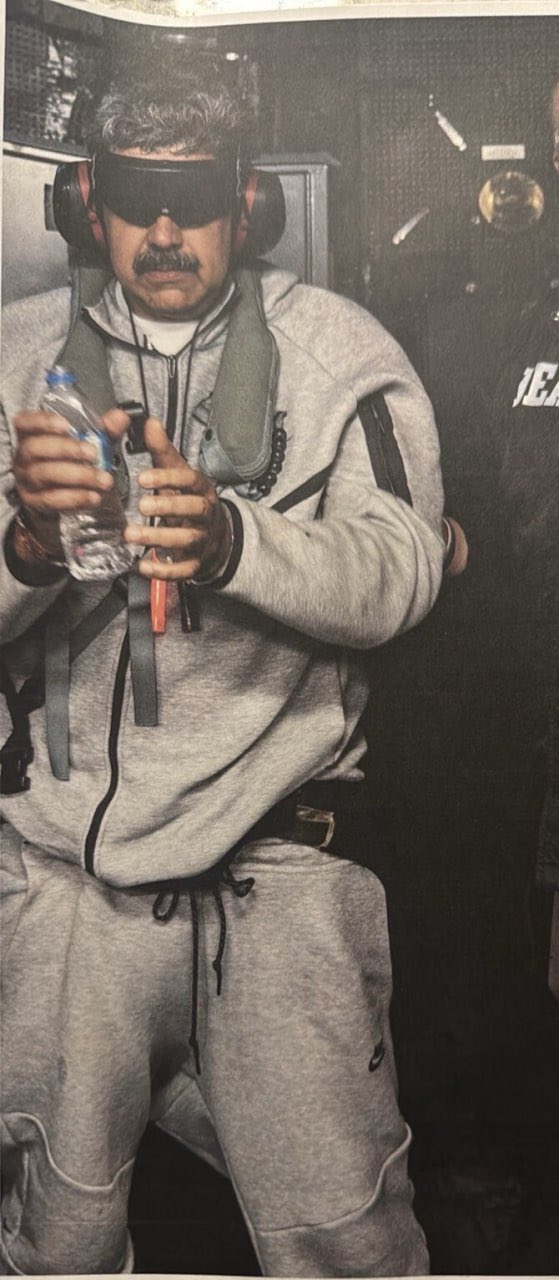
In a dramatic and rare development on the global stage, U.S. President Donald Trump released the first photograph of Venezuelan President Nicolás Maduro after a reported U.S. military operation led to his capture earlier today. The image was shared on Trump’s social media platform and appears to show Maduro aboard the U.S. Navy ship USS Iwo Jima following his removal from Venezuela.
In the released picture, Maduro is seen wearing a tracksuit and protective noise-cancelling headphones, with an eye covering and handcuffs. He is holding a bottle of water and is flanked by what appear to be U.S. personnel. Trump’s caption stated: “Nicolas Maduro on board the USS Iwo Jima.”
This move marks a striking escalation in tensions between the United States and Venezuela, culminating in U.S. forces striking Venezuelan military targets overnight before capturing Maduro and his wife, Cilia Flores. The operation drew immediate global attention and widespread reactions from leaders around the world.
According to U.S. officials, a large-scale military action was launched against key military installations in Caracas, the capital of Venezuela, early this morning. Explosions and sounds of low-flying aircraft were reported in various parts of the city, as U.S. forces targeted military bases and infrastructure believed to be controlled by Maduro’s administration.
President Trump later announced that Maduro and his wife were captured and “flown out of the country” in a coordinated operation involving elite forces. Maduro was indicted by U.S. authorities in New York on long-standing criminal charges, including drug trafficking and related offenses, and is expected to face prosecution in the United States.
Russian and Venezuelan officials have demanded clarity and proof of life after initial reports of the capture. Venezuela’s vice president, Delcy Rodríguez, said the government had lost contact with Maduro and Flores, raising international diplomatic concerns.
Nicolás Maduro has led Venezuela since 2013, succeeding the late President Hugo Chávez. His rule has been marked by sharp political division, economic crisis, and international sanctions led by the United States and European Union. Venezuela, once one of Latin America’s richest nations due to vast oil reserves, has faced deep recessions, hyperinflation, and mass migration under Maduro’s administration.
Before today’s events, the U.S. government had long accused Maduro’s government of corruption and involvement in drug trafficking, a charge Maduro always denied. The formal indictment in New York was part of a broader U.S. strategy to hold international leaders accountable under American law.
News of the U.S. military action and Maduro’s capture has sparked strong reactions around the world. Leaders in Latin America and Europe expressed alarm at the magnitude of the U.S. intervention. Some critics described the operation as a serious breach of Venezuela’s sovereignty, while others welcomed the move as a step toward removing an authoritarian rule.
The Venezuelan government condemned the strikes and the apparent removal of its president, calling it an act of aggression. International organisations and human rights groups have called for calm and for all parties to respect international law.
The situation remains fluid, with Venezuela’s military and political institutions still operational in parts of the country. It is not yet clear how power will be managed inside Venezuela now that Maduro is reportedly in U.S. custody. President Trump said the U.S. might play a role in overseeing a transition, including stabilising governance and economic activity until new leadership is established.
Venezuela holds the world’s largest proven oil reserves, and the international community is watching closely to see how oil production and exports will be managed amid political uncertainty. U.S. officials have said that stabilising Venezuela’s economy and energy sector will be part of the broader strategy going forward.
As of now, Maduro is being transported to New York City, where he is expected to face trial on multiple charges. The U.S. government is preparing a press briefing and further diplomatic statements, and world leaders are calling for restraint and dialogue.