
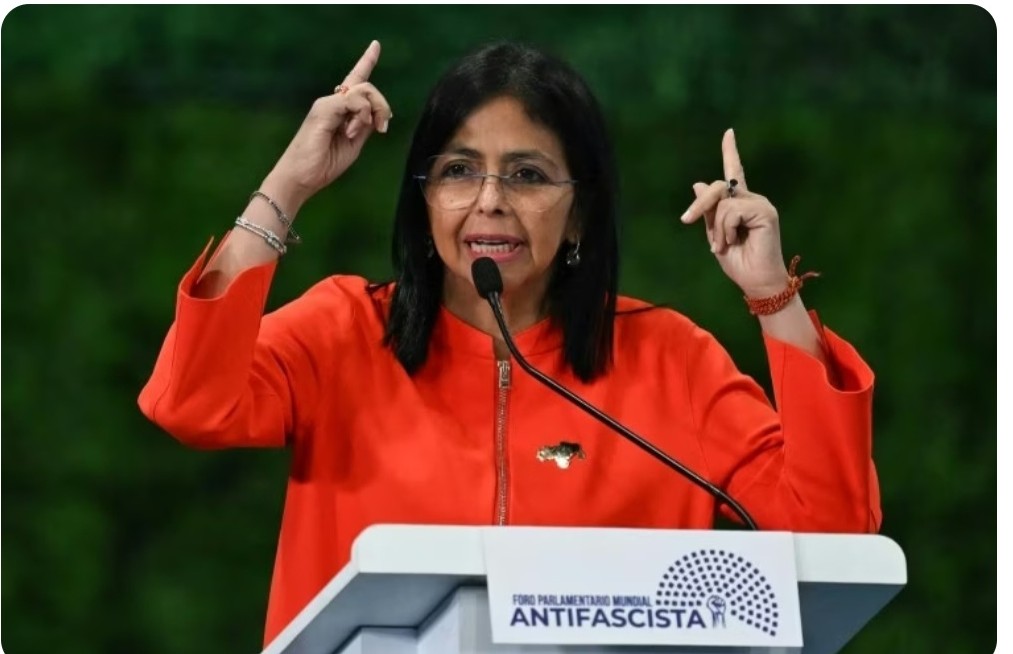
Venezuela has entered a new and uncertain political chapter following the swearing-in of Vice President Delcy Rodriguez as Acting President. The move came after reports that President Nicolas Maduro was abducted on Saturday, a development that has shocked the country and drawn international attention.
Rodriguez, a long-time ally of Maduro, was sworn in to lead the South American nation as authorities work to confirm the whereabouts and safety of the president and his wife, Cilia Flores. The government has accused the United States of being involved in the incident, a claim Washington has not officially confirmed.
Speaking shortly after assuming office, Rodriguez demanded proof of life for President Maduro and his wife. She strongly condemned what she described as foreign interference in Venezuela’s internal affairs.
“We call on the peoples of the great homeland to remain united because what was done to Venezuela can be done to anyone,” she said in a national address broadcast on state television channel VTV. “That brutal use of force to bend the will of the people can be carried out against any country.”
Rodriguez’s sudden rise to the role of Acting President has brought her background and political history into sharp focus, both at home and abroad.
Born in Caracas on May 18, 1969, Delcy Eloina Rodriguez is deeply rooted in Venezuela’s left-wing political tradition. She is the daughter of Jorge Antonio Rodriguez, a rebel fighter and founder of the Socialist League party in the 1970s. Her father’s death in 1976, while he was being tortured in police custody, became a powerful symbol for many activists and helped shape the political views of his family.
The killing of Jorge Antonio Rodriguez shocked the country at the time and influenced a generation of leftist leaders, including a young Nicolas Maduro, who later became president. For Delcy Rodriguez, her father’s legacy has remained central to her political identity.
Her brother, Jorge Rodriguez, is also one of the most powerful figures in Venezuela’s current government. He serves as the head of the National Assembly, further strengthening the family’s influence within the ruling structure.
Delcy Rodriguez studied law at the Central University of Venezuela, one of the country’s leading institutions. After graduating as an attorney, she entered public service and rose quickly through the political ranks over the past decade.
She has been a strong defender of the socialist movement started by late President Hugo Chavez, often referred to as the Bolivarian Revolution. Supporters of this movement, known as Chavistas, see it as a fight for social justice and national independence. Critics, however, blame it for Venezuela’s long-running economic and political crisis.
Rodriguez first gained national prominence when she was appointed Minister of Communication and Information in 2013, shortly after Maduro took office following Chavez’s death. In that role, she became one of the main voices defending the government’s policies and responding to criticism from opposition groups and foreign governments.
From 2014 to 2017, she served as Venezuela’s Foreign Minister. During this period, she was a familiar face at international forums, where she often clashed with Western leaders and regional rivals over sanctions, human rights, and democracy in Venezuela.
In 2017, Rodriguez was appointed head of the pro-government Constituent Assembly. The body was created to rewrite the constitution but was widely seen by critics as a tool to weaken the opposition-controlled National Assembly. The Constituent Assembly expanded President Maduro’s powers and became one of the most controversial institutions in recent Venezuelan history.
Despite her tough public image, Rodriguez is often described as more calm and measured in tone than some other figures in the government. Even so, Maduro once referred to her as a “tiger,” praising her strong and loyal defence of his administration.
When Maduro named her Vice President in June 2018, he described her in glowing terms. He called her “a young woman, brave, seasoned, daughter of a martyr, revolutionary and tested in a thousand battles.” The appointment made her one of the most powerful women in Venezuelan politics.
Under Venezuela’s constitution, the Vice President can assume leadership duties if the president is unable to govern. This provision formed the legal basis for Rodriguez’s swearing-in as Acting President following reports of Maduro’s abduction.
The political situation in Venezuela has remained tense for years. The country has faced deep economic problems, including high inflation, food shortages, and mass migration. Millions of Venezuelans have left the country in search of better opportunities, putting pressure on neighbouring nations.
International sanctions, especially from the United States and its allies, have further strained the economy. The Maduro government has repeatedly accused foreign powers of trying to remove it from office through pressure and covert actions.
The latest crisis has raised fears of further instability. Supporters of the government have called for unity and calm, while opposition figures are demanding clarity about Maduro’s situation and questioning the government’s claims.
Across Latin America and beyond, governments are closely watching developments in Caracas. Some countries have expressed concern over reports of an abduction, while others have called for restraint and respect for international law.
For now, Delcy Rodriguez faces the difficult task of leading a divided country during one of its most serious political moments. Her supporters see her as a strong and experienced leader who can defend Venezuela’s sovereignty. Her critics worry that her leadership will mean more of the same policies that have led to years of crisis.
As Acting President, Rodriguez has promised to stand firm against what she called external aggression and to protect the country’s independence. Whether her leadership will calm tensions or deepen divisions remains to be seen.