
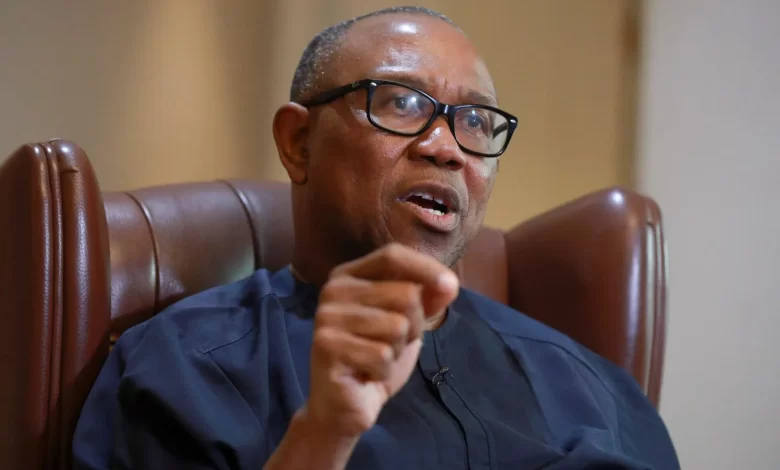
Former Anambra State governor and 2023 presidential candidate of the Labour Party (LP), Mr Peter Obi, has said Nigeria is not a poor country and can afford basic necessities for its citizens if leaders make the right choices. He blamed the country’s hardship on poor leadership and wrong priorities, especially in critical sectors like healthcare.
Obi made the remarks in a series of posts on his verified X (formerly Twitter) account on Tuesday. He shared a personal encounter with a young Nigerian woman who recently graduated from a nursing school in the United States and was visiting Nigeria for the first time with her parents.
According to Obi, the meeting took place on an Air Peace flight. During the trip, the young nurse expressed deep sadness and confusion about the state of Nigeria, especially why basic services that are taken for granted in other countries are difficult to access at home.
Obi said the lady spoke about her shock after experiencing Nigeria’s healthcare system firsthand when her sister had a domestic accident that injured her hand.
“She narrated her experience at a government-owned hospital in Nigeria,” Obi wrote. “On arrival, even though her sister’s hand was bleeding, the hospital staff insisted that payment must be made before any treatment could begin.”
The former governor said the family was shocked by the response of the hospital staff. They questioned whether the staff truly understood the urgency of the situation, but instead of showing concern, they were shown other patients with even worse injuries who were also waiting because they had not paid.
Eventually, the family made the required payment before any treatment could start. However, that was only the beginning of their ordeal.
Obi said the lady explained that when it was time for a blood test, they discovered that the hospital had only one blood-testing machine serving all patients. Even more worrying, the equipment was not being sterilised between uses.
“When she raised concerns that the equipment had not been properly sterilized, they were bluntly told to stop asking questions if they wanted her sister to be treated,” Obi said.
Despite making payments, the family was still asked to buy all the medical items needed for the treatment. This experience left the young nurse traumatized.
According to Obi, the lady said she found the situation hard to believe. Based on her training and experience in the United States, treatment always comes first in emergency cases, while payment is sorted out later.
“She told me that in every hospital she had visited during her training, patients are treated first before any discussion about money,” Obi added.
The former presidential candidate also revealed that the lady and her family had once considered organizing a GoFundMe campaign to raise funds to support healthcare in Nigeria. However, they were discouraged by relatives who warned them that any money raised would likely be stolen or mismanaged.
One statement by the lady, Obi said, struck him deeply.
“She said, ‘I now understand what happened to Boxer Joshua. This is why there was no ambulance to rush him to a nearby hospital,’” Obi wrote.
The reference was to the tragic death of a Nigerian boxer, popularly known as Boxer Joshua, who reportedly died after collapsing during a bout due to the absence of an ambulance and proper emergency response.
The young nurse also wondered whether Nigeria’s problems were simply because the country was poor. At the same time, she expressed a strong desire to help.
“She said she would willingly offer her skills and service for free and even help raise money to make things better,” Obi said.
Responding to her concerns, Obi said he encouraged her not to lose hope in Nigeria. He stressed that the country has enough resources to take care of its people but suffers from poor governance.
“I painfully replied by encouraging her not to lose hope. The country is not poor, but it is poorly governed,” Obi stated.
He argued that Nigeria can afford basic and critical necessities, but leaders often fail to prioritise them due to what he described as incompetent leadership.
Obi went further to compare spending on luxury and prestige projects with the urgent needs of ordinary Nigerians, especially in healthcare.
According to him, a standard ambulance costs about ₦150 million, which is roughly $100,000. He said Nigeria recently spent ₦39 billion on refurbishing the International Conference Centre in Abuja and ₦21 billion on rebuilding the residence of Vice-President Kashim Shettima.
“Those two projects alone cost about ₦60 billion,” Obi said. “That amount could have provided about 400 brand-new ambulances, roughly 11 per state, including the Federal Capital Territory.”
He added that if Ogun State alone had 11 functional ambulances, one might have been available to save the life of Boxer Joshua.
Obi also spoke about the cost of building healthcare facilities. He said constructing a primary healthcare centre in a community costs about ₦75 million.
He contrasted this with the reported ₦300 billion spent on the purchase of an additional presidential jet.
“That money could have built over 4,000 primary healthcare centres, about 110 per state,” he said.
Obi criticised what he described as misplaced priorities, saying the only visible benefit of the presidential jet is that it allows the president to travel without the public knowing his whereabouts.
“The only visible value the jet adds is the ability of the president to occasionally disappear without the public knowing where he is,” he said.
Nigeria’s healthcare system has long faced challenges, including poor funding, lack of equipment, shortage of personnel and frequent strikes by medical workers. Many public hospitals struggle with basic supplies, while patients are often required to pay out-of-pocket before receiving care.
Obi’s comments have again brought attention to the debate over government spending priorities and the need to focus more on human development rather than luxury projects.
As a former presidential candidate who campaigned on issues of prudent spending and accountability, Obi has continued to speak out on national issues since the 2023 elections.
For many Nigerians, his latest comments reflect everyday experiences in public hospitals and highlight the gap between government spending and the real needs of citizens.