
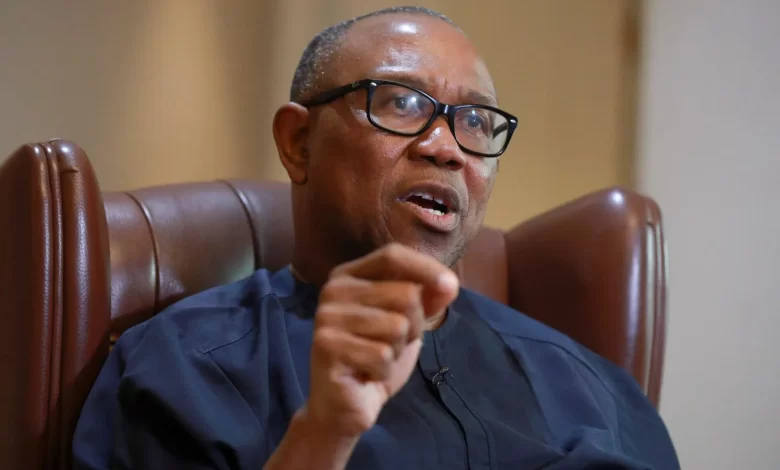
Former Anambra State Governor and Labour Party presidential candidate, Mr Peter Obi, has called on the Federal Government to pause the implementation of Nigeria’s controversial new tax law, warning that the policy is riddled with errors and lacks public trust, clarity, and clear benefits for citizens.
In a strongly worded statement released on Tuesday, Obi said recent findings by global accounting firm KPMG have confirmed serious flaws in the new tax framework. According to him, the firm identified at least 31 critical problem areas in the law, ranging from drafting mistakes to policy contradictions and administrative gaps.
Obi said these findings should worry any responsible government and prompt urgent action.
“It is now undeniable that the tax laws have been fundamentally altered,” Obi said. “Even a firm as esteemed as KPMG has pinpointed 31 critical problem areas. This revelation should prompt every responsible government to take immediate action.”
The former governor expressed concern that the problems in the tax law only came to light after private meetings between the National Revenue Service and KPMG. He argued that if experts needed closed-door discussions to understand the law, then ordinary Nigerians stood little chance of knowing what was expected of them.
“If experts require private meetings to navigate the complexities of our tax laws, what hope does the average Nigerian have of understanding the obligations being imposed on them?” Obi asked.
He warned that such a situation could deepen confusion, mistrust, and resistance among citizens already struggling to cope with economic hardship.
Obi stressed that taxation is more than just a way for government to raise money. He described it as a social contract between the state and the people, which must be based on trust, understanding, and mutual benefit.
“Taxation transcends mere fiscal policy; it represents a social contract between the government and its citizens,” he said. “You cannot enforce a social contract that isn’t understood or trusted.”
He explained that in many countries, tax policies are justified by visible benefits such as good healthcare, quality education, job creation, strong infrastructure, and social support for the vulnerable. According to him, this is what gives taxation legitimacy.
However, Obi said Nigeria’s current approach focuses mainly on how much money the government wants to collect, rather than what it plans to give back to the people.
“In Nigeria, the narrative is all about how much more the government seeks to extract, rather than what it is prepared to offer in return,” he said. “A tax system without clear public benefits isn’t reform; it is extortion.”
Another major concern raised by Obi is the absence of broad consultation before the tax law was finalised. He noted that in many countries, tax reforms take months or even years of engagement with businesses, workers, professionals, and civil society groups.
He said such consultations help people understand not only how much they will pay, but also what benefits they can expect in return.
“Typically, months, if not years, are dedicated to consulting with businesses, workers, and civil society before tax drafts are presented for public discussion,” Obi said. “This is how legitimacy is built.”
In Nigeria’s case, he argued, the public was largely left out of the process, leaving many citizens confused about the new tax rules and their expected benefits.
“We have seen no such public consultations or discussions regarding the final tax laws,” he said. “Ordinary citizens have been left completely in the dark.”
Obi’s comments come at a time when many Nigerians are struggling with rising living costs. Since the removal of fuel subsidy and recent economic reforms, prices of food, transport, and basic goods have increased sharply, while incomes have remained low.
Obi said Nigerians are still waiting to see the benefits of earlier economic decisions, even as new financial burdens are being introduced.
“Even after the removal of subsidies, Nigerians remain in limbo, waiting for tangible benefits or relief,” he said. “Instead, they are grappling with skyrocketing food prices, high transport costs, reduced purchasing power, and rising poverty.”
He warned that introducing a wide-ranging new tax regime under such conditions could worsen the suffering of ordinary people.
The former governor said the 31 red flags raised by KPMG show that the new tax law was rushed and poorly thought out. He described the situation as a sign of weak governance.
“Before we have even begun to address these issues, we are being forced into an expansive new tax regime filled with inconsistencies,” Obi said. “This is not the mark of responsible governance.”
He warned that without trust, taxation feels like punishment, and without clarity, it creates confusion. Without visible public value, he said, it becomes outright exploitation.
Obi called on the government to pause the implementation of the tax law and open it up for wider review and discussion. He said this would allow experts, businesses, workers, and civil society groups to study the law, point out problems, and suggest improvements.
According to him, building national consensus is the only way to achieve lasting and effective reform.
“Nigeria cannot afford to place further burdens on its already struggling citizens,” Obi said. “What we need is a government that listens, communicates clearly, and builds consensus.”
Nigeria has long struggled with low tax compliance and weak revenue collection. Successive governments have argued that expanding the tax base is necessary to fund public services and reduce dependence on oil revenue.
However, critics have often pointed out that poor service delivery, corruption, and lack of transparency make citizens unwilling to pay more taxes. Many Nigerians believe they already pay too much through indirect taxes, high utility costs, and poor infrastructure.
The new tax law was introduced as part of broader economic reforms by the current administration, aimed at boosting government revenue and stabilising the economy. While officials say the reforms are necessary, opposition figures and civil society groups have raised concerns about timing, fairness, and implementation.
Beyond the tax law, Obi used his statement to restate his vision for Nigeria. He said genuine reform must be people-focused and driven by dialogue, not force.
“Without trust, taxation feels like punishment. Without clarity, it breeds confusion. Without public value, it amounts to robbery,” he said.
He concluded by saying that a better Nigeria is possible, but only if leaders put the people first.
“A New Nigeria is not just a possibility; it is an imperative,” Obi said.