
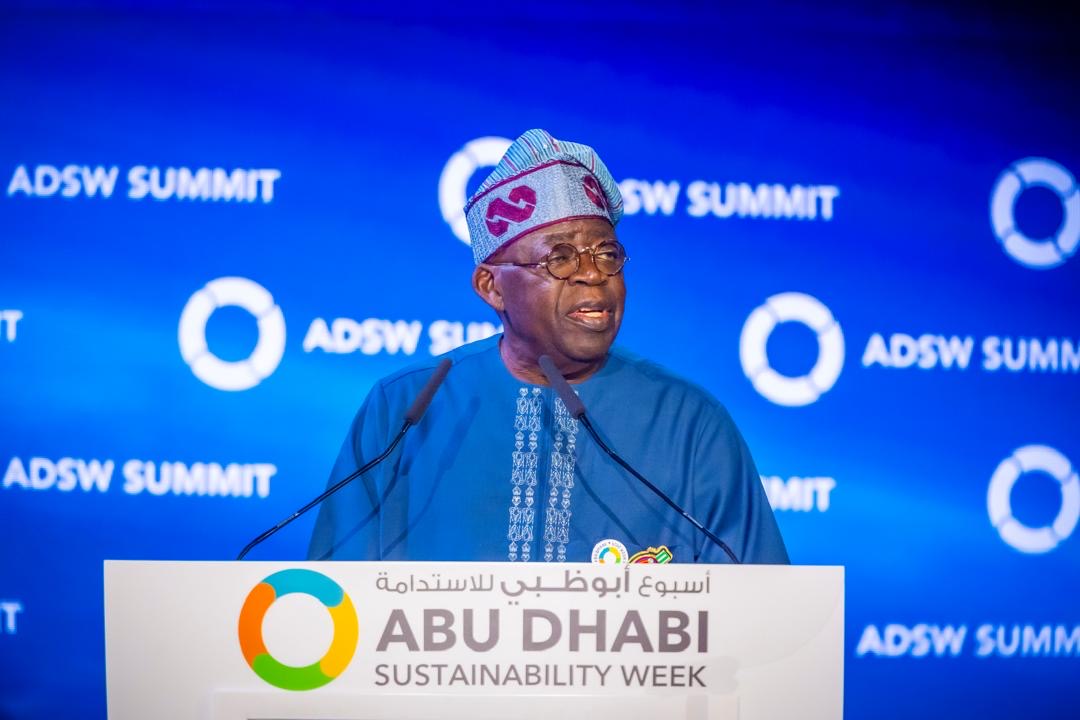
President Bola Ahmed Tinubu has outlined Nigeria’s plans to play a major role in the global clean energy transition, with a strong focus on lithium and other critical minerals. He spoke on Tuesday in Abu Dhabi while delivering a keynote address at the 2026 Sustainability Week, a global event that brings together world leaders, investors, policymakers, and experts on climate change and sustainable development.
In his address, President Tinubu told the audience that Nigeria is positioning itself to take advantage of the growing global demand for clean energy. He said the country is prioritising lithium and other rare minerals that are needed for renewable energy, electric vehicles, and modern power storage systems.
“Nigeria is also prioritising critical minerals for clean energy future,” the president said. “Among other rare earth minerals in abundance supply in Nigeria, our lithium reserve has transformative potential for battery production, energy storage and power capacity.”
The Sustainability Week in Abu Dhabi is one of the world’s leading platforms for discussions on climate action, renewable energy, and sustainable economic growth. Leaders from both developed and developing countries attend the event to share ideas, attract investment, and build partnerships. President Tinubu’s participation signals Nigeria’s desire to be seen as a serious player in the global move away from fossil fuels.
During his speech, President Tinubu explained that Nigeria’s clean energy drive is guided by a clear national policy known as the Energy Transition Plan (ETP). According to him, the plan brings together several important goals under one framework.
“Nigeria energy transition plan integrates energy access, climate refrigeration, industrial growth, and social development into single coherent framework,” he said.
The Energy Transition Plan aims to move Nigeria gradually from heavy dependence on fossil fuels, especially crude oil and petrol, to cleaner and more sustainable energy sources. At the same time, the government says it wants to ensure that millions of Nigerians who still lack access to electricity are not left behind.
Nigeria is Africa’s largest oil producer, and oil revenue has remained a major source of income for decades. However, falling oil prices, rising global climate concerns, and pressure to reduce carbon emissions have pushed the country to rethink its energy future. The Energy Transition Plan is designed to help Nigeria reach net-zero emissions by 2060 while supporting economic growth.
President Tinubu noted that the plan is not just a document on paper but is already being implemented through various pilot projects across the country.
The president revealed that Nigeria has begun testing clean energy ideas through pilot programmes, including in the transport sector. He said one of the key areas of focus is electric mobility.
“Our pilot electricity mobility project is also delivering national energy efficiency programs, and aimed at reducing emissions, lowering cost, and stimulating the industrial development,” Tinubu stated.
Electric mobility refers to the use of electric-powered vehicles instead of petrol or diesel engines. This includes electric buses, cars, motorcycles, and tricycles. In Nigeria, transport is a major source of air pollution and fuel consumption, especially in large cities such as Lagos, Abuja, and Port Harcourt.
By promoting electric vehicles, the government hopes to cut fuel costs, reduce pollution, and create new industries around vehicle assembly, battery production, and charging infrastructure. Lithium, which is used in most electric vehicle batteries, therefore becomes a key resource in this plan.
Lithium has become one of the most important minerals in the world today. It is a key component in batteries used for electric vehicles, mobile phones, laptops, solar energy storage, and other renewable energy systems. As countries move away from petrol and diesel, demand for lithium has increased sharply.
Nigeria is believed to have significant deposits of lithium and other critical minerals in states such as Nasarawa, Kogi, Kwara, Ekiti, and parts of the North-West. In recent years, small-scale mining of lithium has attracted attention from both local and foreign investors.
President Tinubu’s speech placed Nigeria’s lithium resources at the centre of its clean energy and industrial strategy. He stressed that the country does not want to remain just a source of raw materials for other countries.
One of the strongest messages from the president was his call for partnerships that go beyond the simple extraction of minerals. He urged investors to support local processing and manufacturing in Nigeria.
“I take this opportunity to invite partners or partnerships that ensure not just extraction of minerals, but local processing and value addition, thus creating jobs and strengthening industrial capacity at home in Nigeria,” he said.
For many years, Nigeria has exported raw materials while importing finished products at higher prices. This has limited job creation and industrial growth. By insisting on value addition, the government hopes to build factories, develop skills, and keep more economic benefits within the country.
Local processing of lithium could lead to the production of batteries and other energy storage systems in Nigeria. This would support industries such as renewable energy, electric vehicles, and power infrastructure, while also creating thousands of jobs.
President Tinubu also assured foreign investors that Nigeria is open for business and ready to work with credible partners. He said the government is working to make the business environment more friendly and attractive.
“Nigeria heading to do business with you, it’s easy in easy out, we just want value addition,” he said.
This message comes at a time when Nigeria is trying to attract foreign direct investment to revive its economy. The country has faced challenges such as foreign exchange shortages, inflation, and unemployment. The Tinubu administration has introduced several reforms, including changes to fuel subsidy and foreign exchange policy, to stabilise the economy and boost investor confidence.
By speaking directly to global investors in Abu Dhabi, the president sought to present Nigeria as a country with vast resources, a large market, and clear plans for the future.
Globally, the shift to clean energy is gaining speed as countries work to meet climate targets and reduce greenhouse gas emissions. Major economies are investing heavily in renewable energy, electric vehicles, and green technology. This has increased competition for critical minerals like lithium, cobalt, and nickel.
For Nigeria, this global shift presents both a challenge and an opportunity. While oil remains important, over-reliance on it has exposed the country to economic shocks. Clean energy and critical minerals offer a chance to diversify the economy and secure long-term growth.
President Tinubu’s address at the 2026 Sustainability Week reflects Nigeria’s desire to be part of this global transformation. By highlighting lithium, energy transition plans, and investment opportunities, the government is sending a message that Nigeria wants to move with the times.