
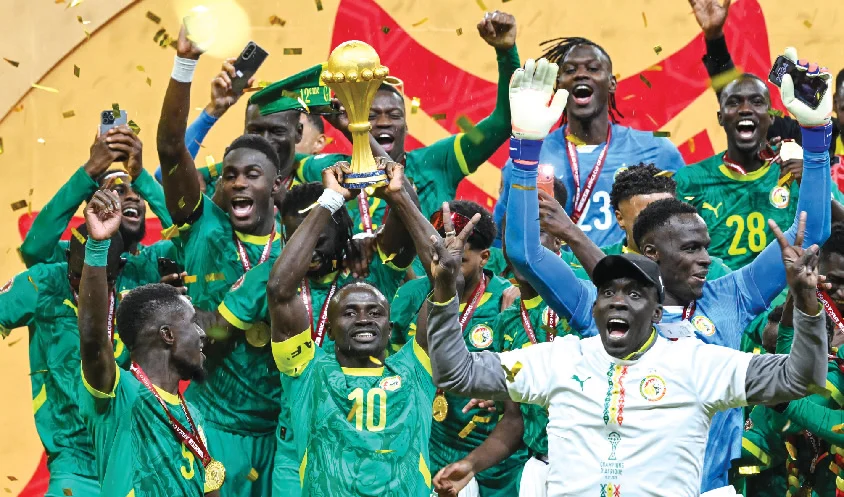
A fresh controversy has emerged following Senegal’s dramatic 1–0 victory over Morocco in the final of the Africa Cup of Nations (AFCON), after a Moroccan politician, Mohamed Simou, accused the Senegalese team of performing “magic rituals” before a crucial penalty kick.
The final, played on Sunday in Rabat, saw Senegal claim their second AFCON title after a tense and highly charged match against host nation Morocco. While Senegal celebrated the historic win, the match has continued to generate debate due to several controversial moments and strong reactions from Moroccan officials and fans.
Mohamed Simou, a Moroccan politician, caused a stir on social media and in local media circles when he alleged that Senegal carried out ritual practices in their dressing room shortly before Morocco’s penalty kick was taken.
According to Simou, the alleged ritual took place before Real Madrid forward Brahim Díaz stepped up to take the penalty for Morocco. Díaz attempted a Panenka-style kick, but Senegal’s goalkeeper, Edouard Mendy, saved the effort, denying Morocco a chance to equalise.
Simou did not provide evidence to support his claim but insisted that the incident raised questions about the conduct of the Senegalese team and the overall fairness of the final.
His comments have sparked mixed reactions, with some Moroccan supporters backing his concerns, while others criticised the claim as baseless and distracting from the football itself.
The AFCON final was filled with tension from start to finish and nearly descended into chaos after a series of controversial decisions by the match officials.
A few minutes before Morocco were awarded the penalty, Senegal appeared to have scored what many believed was a valid goal. However, the referee disallowed the goal, citing a foul on Moroccan defender Achraf Hakimi. The decision angered Senegalese players and officials, who felt they had been unfairly treated.
Shortly after, Morocco were awarded a penalty, a decision that further inflamed the situation. In protest, Senegalese players briefly walked off the pitch, refusing to continue the match.
The referee, Jean Jacques Ndala, later convinced the players to return to the field, and the game resumed. The penalty was then taken by Díaz and saved by Mendy, a moment that proved to be a turning point in the match.
Senegal later scored the winning goal, securing a narrow 1–0 victory and sealing the AFCON title.
Beyond the claim of dressing-room rituals, Simou also raised serious concerns about the officiating of the final. He called for referee Jean Jacques Ndala to be suspended and prosecuted for allowing the match to continue after Senegalese players walked off the pitch.
According to Simou, the referee should have applied the rules strictly, arguing that the walkout should have led to disciplinary action or even abandonment of the match.
He insisted that restarting the game under such circumstances damaged the integrity of the competition and set a dangerous precedent for future matches.
While the Confederation of African Football (CAF) has not officially responded to Simou’s demands, the refereeing decisions during the final have been widely discussed across Africa.
Despite the controversy, Senegal’s victory has been widely celebrated by their fans and football community. The win marks the country’s second AFCON title, further strengthening their status as one of Africa’s football powerhouses.
Senegal had entered the tournament as one of the favourites, boasting a strong squad filled with experienced players competing at top clubs in Europe. Goalkeeper Edouard Mendy’s penalty save was one of the standout moments of the final and played a key role in securing the trophy.
The Senegalese Football Federation and team officials have focused on celebrating the achievement, choosing not to engage with the allegations made by Simou.
For Morocco, the loss was a painful one, especially as they were playing at home and had enjoyed strong support throughout the tournament. The Atlas Lions had raised hopes of lifting the trophy in front of their fans, following impressive performances in earlier rounds.
Brahim Díaz, who missed the penalty, has since received messages of support from teammates and fans. Many Moroccan supporters have pointed to the officiating decisions rather than individual players as the main reason for the defeat.
Simou’s claim about ritual practices has reopened an old debate in African football, where accusations of superstition and “juju” are sometimes raised after major defeats. While such beliefs remain part of cultural discussions in some quarters, football authorities generally stress professionalism, discipline, and fair play.
As discussions continue, attention has turned to CAF to see whether it will review the refereeing decisions from the final or respond to calls for action against the match officials.
For now, Senegal remain AFCON champions, while Morocco and their supporters are left to reflect on a final that will be remembered as much for its controversy as for the football played on the pitch.