
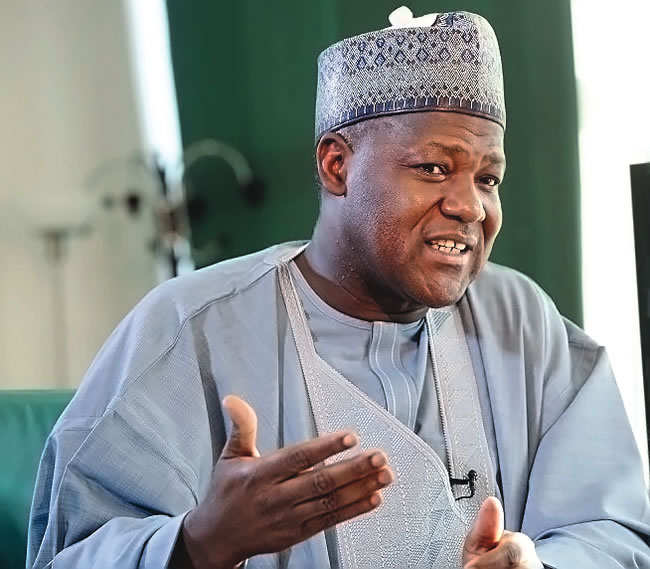
Former Speaker of the House of Representatives, Yakubu Dogara, has asked to be left out of growing discussions suggesting that he could replace Vice President Kashim Shettima as President Bola Ahmed Tinubu’s running mate ahead of the 2027 general election.
Dogara made this known on Sunday while speaking on Sunday Politics, a programme aired on Channels Television. His comments came amid renewed public debate and political speculation over whether the ruling All Progressives Congress (APC) may again present a Muslim–Muslim presidential ticket in the next election cycle.
Since the emergence of President Tinubu and Vice President Shettima as candidates of the APC in the 2023 election, the issue of religious balance has remained a sensitive topic in Nigerian politics. Although the Tinubu–Shettima ticket won the election, concerns raised by some Christian groups and political observers have not completely faded. With 2027 still some years away, discussions around zoning, religion, and inclusion have already begun to surface.
Reacting to reports linking him to plans to replace Shettima, Dogara was clear that he did not want to be drawn into such talks. “I would have sincerely pleaded with you to leave me out of this, but let me say something,” he said during the programme. According to him, decisions about leadership and political arrangements should not be driven by fear or pressure but by what is right for the country.
Dogara, who represented Dass/Tafawa Balewa/Bogoro Federal Constituency of Bauchi State and served as Speaker from 2015 to 2019, stressed the need for Nigeria to focus on building an inclusive system of governance. He said Nigeria’s diversity in religion, ethnicity, and region should be seen as a strength, not a weakness.
“Whatever we are doing shouldn’t be because we are afraid of anybody breathing down our necks; it should be because it is the right thing to do,” Dogara said. He added that the goal should be to run a government that carries everyone along. “We are talking about running an inclusive government, bringing everybody in this country together, so that we can build a nation that works for all of us,” he stated.
Dogara’s comments reflect a wider national conversation about fairness and representation in government. Nigeria operates an informal power-sharing arrangement that often considers factors such as region, religion, and ethnicity when selecting leaders. While this arrangement is not written into the Constitution, it has helped to manage the country’s diversity and reduce tension over the years.
The former Speaker also spoke on the issue of rotational presidency, which has been part of Nigeria’s political culture since the return to democracy in 1999. Under this arrangement, the presidency is expected to rotate between the North and the South, although it is not legally binding. Dogara noted that discussions around rotation should also take religion into account.
“If we are talking about rotational presidency, there is nothing stopping us from having that discussion as well,” he said. According to him, the issue goes beyond Northern Christians alone and affects the Christian faith across the country. He argued that religious balance should be clearly reflected in leadership choices.
Dogara explained his view by suggesting that candidates should be seen as representatives of their religious communities, regardless of where they come from. “If you have a Muslim, whether he comes from the North or the South, let it be that he is representing the Muslim community. And if you have a Christian, wherever he comes from, he represents the Christian faith. That way, you achieve religious balance,” he said.
This position has drawn attention because Dogara is a Northern Christian from Bauchi State, a region where religion often plays a strong role in politics. In 2023, his support for Tinubu was seen by some as an attempt to reassure Christians in the North about the APC’s Muslim–Muslim ticket. His latest comments suggest that the conversation around balance is far from over.
On the question of whether the APC may choose a Christian running mate in 2027, Dogara said the issue is already being discussed within political circles. “It’s a discussion, and I am aware that such discussions are already taking place,” he said, without giving details of who is involved or what direction the talks are taking.
However, Dogara also pointed out a political reality in Nigerian party politics. He noted that sitting presidents usually have a strong grip on their party structures. “At the end of the day, whatever the president decides, nobody who is a serving president has ever lost the party primaries. So, we assume that the president will get the party’s ticket,” he said.
This statement suggests that President Tinubu is likely to secure the APC presidential ticket if he decides to seek re-election in 2027. In that case, the decision on who becomes his running mate would largely rest with him, although party leaders and other stakeholders may offer advice.
Vice President Kashim Shettima, a former governor of Borno State, has not publicly responded to the speculation. There has also been no official statement from the APC leadership on plans for 2027 or on whether the party is considering changes to its presidential ticket.
For now, Dogara has made it clear that he does not want to be seen as campaigning for any position or pushing to replace anyone. His comments appear aimed at shifting attention away from personalities and towards broader principles of inclusion, unity and fairness.