
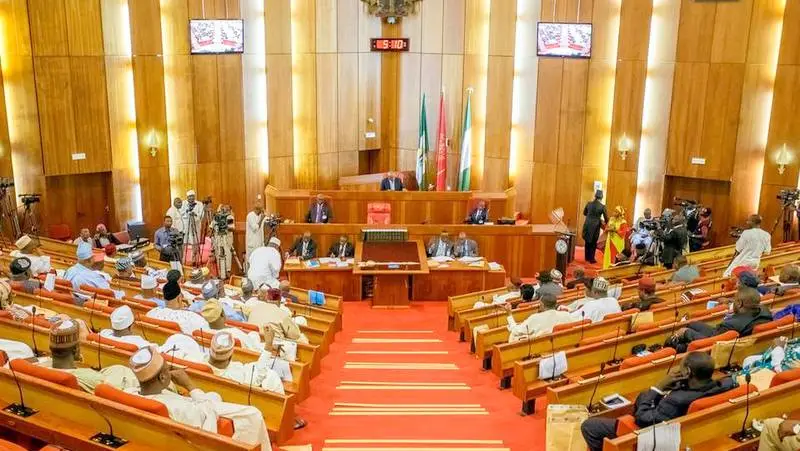
The Senate has constituted a seven-member ad hoc committee to harmonise and streamline senators’ views on the proposed amendment of the Electoral Act, as preparations intensify ahead of the 2027 general elections.
The committee includes former Edo State Governor Adams Oshiomhole and former Sokoto State Governor Aminu Tambuwal, alongside other senior lawmakers. The move signals the Senate’s resolve to strengthen Nigeria’s electoral laws and improve public confidence in the voting process.
The decision followed a three-hour closed-door executive session held on Thursday, during which senators examined the Electoral Act (Repeal and Enactment) Bill currently before the National Assembly. Lawmakers agreed that the bill required deeper scrutiny due to its wide-ranging impact on Nigeria’s democratic process.
Announcing the outcome of the session, Senate President Godswill Akpabio said the committee was set up to distil and harmonise the views of senators on the proposed amendments.
According to him, the panel is expected to “contribute, galvanise and distil the opinion of senators on the bill” before it is presented again for consideration on the Senate floor.
“In no particular order, the committee will be led by Senator Niyi Adegbonmire, Chairman of the Senate Committee on Judiciary, Human Rights and Legal Matters,” Akpabio said.
Other members of the committee are Senators Adamu Aliero, Aminu Tambuwal, Adams Oshiomhole, Danjuma Goje, Tony Nwoye and Titus Zam.
Akpabio added that the committee has a maximum of three days to complete its assignment and submit its report to the Senate by Tuesday.
The Senate had earlier on Wednesday stepped down consideration of the report on the Electoral Act amendment bill. Instead, it opted for an executive session to allow senators more time to study the proposed law and address concerns raised during debate.
The decision came after deliberations on the report of the Senate Committee on Electoral Matters, which was presented in the absence of its chairman, Senator Simon Lalong. Many senators expressed the view that the bill was too important to be rushed, given its implications for future elections.
“This is a very important bill, especially as it is election time,” Akpabio said. “We must take our time to ensure justice is done to all, so that we do not end up at the tribunal.”
Although the House of Representatives has already passed the bill, the Senate leadership stressed the need for careful examination before concurrence. Lawmakers noted that flaws in electoral laws often lead to disputes, litigation, and public mistrust in election outcomes.
Nigeria’s Electoral Act was last amended ahead of the 2023 general elections, introducing innovations such as electronic accreditation of voters and the use of technology in result transmission. While the reforms were widely praised, challenges experienced during the elections exposed gaps that lawmakers now seek to address.
According to the report of the Senate Committee on Electoral Matters, a clause-by-clause review of the new bill shows that the proposed amendments would strengthen electoral integrity, improve transparency, and boost public confidence in the electoral system.
The committee therefore recommended the passage of the Electoral Act (Repeal and Enactment) Bill, 2025, as amended. It noted that the reforms would expand voter participation, curb electoral malpractice, and strengthen the institutional capacity of the Independent National Electoral Commission (INEC).
Earlier, Senate Leader Opeyemi Bamidele outlined key aspects of the proposed amendments, describing the bill as a major step towards improving electoral credibility and safeguarding the independence of electoral institutions.
According to him, the bill introduces stiffer penalties for electoral offences, particularly vote-buying, which has become a major challenge in Nigerian elections.
Under the proposed law, anyone found guilty of vote-buying could face a fine of up to N5 million, a two-year jail term, and a 10-year ban from contesting elections.
The bill also prescribes tougher penalties for result falsification and obstruction of election officials, offences that have undermined public trust in past elections.
One of the major innovations in the proposed amendments is the introduction of electronically generated voter identification. This includes a downloadable voter card with a unique QR code, which is expected to improve voter authentication and reduce fraud.
The bill also makes the electronic transmission of polling unit results mandatory, a move aimed at improving transparency and reducing manipulation during collation.
Bamidele further disclosed that the proposed law recognises the voting rights of prisoners. If passed, INEC would be required to register eligible inmates and make provisions for them to vote during elections.
In addition, the bill seeks to standardise delegates for indirect party primaries, addressing long-standing complaints about inconsistencies and manipulation in party nomination processes.
Another key provision requires the release of election funds at least one year before polling day. Lawmakers say this would enable INEC to plan better and avoid last-minute challenges that often affect election preparations.
According to Bamidele, the reforms are aimed at guaranteeing credible, transparent, and secure elections starting from the 2027 general polls.
However, he noted that some of the amendments would require approval by at least two-thirds of state Houses of Assembly, in line with constitutional requirements.
“At the end of it all, good governance, enhanced security and the welfare of our constituents shall remain our cardinal objectives,” Bamidele said.
As the committee begins its work, expectations are high that the final version of the Electoral Act amendment will strengthen Nigeria’s democratic process and reduce post-election disputes.
With less than two years to the 2027 general elections, the outcome of the Senate’s review is expected to play a crucial role in shaping the future of elections in the country.