
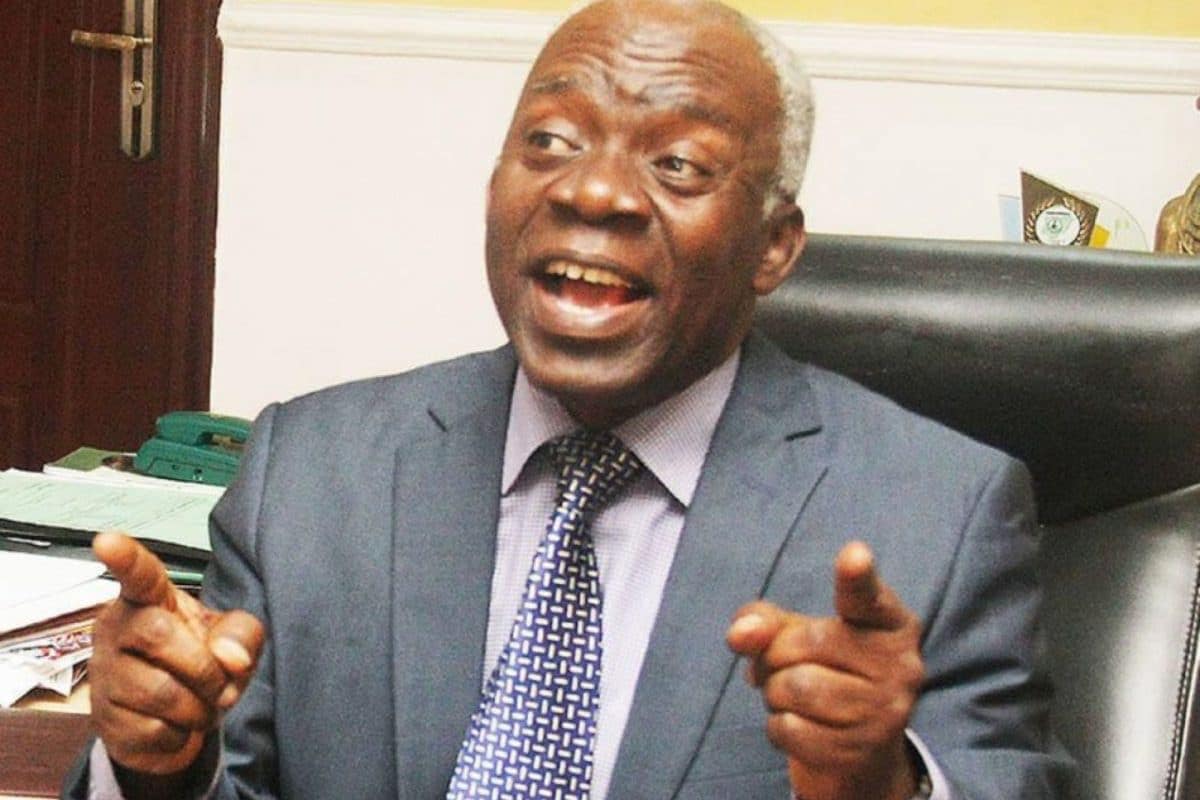
Human rights lawyer and Senior Advocate of Nigeria, Mr. Femi Falana, has said that amending Nigeria’s Electoral Act without proper enforcement is a complete waste of time. He warned that without strong action against electoral offenders, any new changes to the law will not improve the country’s democratic process.
Falana made this statement on Sunday during an interview on Arise Television, where he spoke at length about the ongoing efforts to amend the Electoral Act and the challenges facing Nigeria’s democracy. According to him, Nigeria does not suffer from a lack of laws, but from the failure of those in power to enforce existing laws.
He explained that Nigeria already has laws that clearly address electoral crimes such as vote buying, political thuggery, and campaign finance abuse. However, these laws are rarely applied, and offenders are hardly punished. This, he said, has created an environment where politicians act without fear of consequences.
“We operate in an atmosphere of reckless impunity,” Falana said. “The ongoing amendment exercise is time wasting if there’s no enforcement. We have always had very steep penalties on purchase of votes, thuggery and other electoral offences.”
Falana blamed the political class, especially those in power, for failing to take enforcement seriously. He said that successive governments have refused to use state institutions, including security agencies, to arrest and prosecute people who violate electoral laws.
According to him, this lack of enforcement has weakened public trust in elections and allowed bad behaviour to continue unchecked. He noted that while lawmakers often focus on changing laws, they ignore the more important issue of making sure the laws work.
The senior lawyer also spoke about a long-standing recommendation to establish an Electoral Offences Commission. He recalled that as far back as 2008, a government panel led by the late Justice Muhammadu Uwais, often referred to as the Uwais Panel, recommended the creation of a special body to handle electoral crimes.
That panel was set up after the widely criticised 2007 general elections, which were described by local and international observers as deeply flawed. One of its key recommendations was the establishment of an independent Electoral Offences Commission to investigate, arrest, and prosecute electoral offenders.
Falana expressed disappointment that despite this recommendation, no government has taken steps to set up such a commission.
“As far back as 2008, the panel recommended the establishment of an electoral offences commission to arrest offenders and prosecute them. No regime, including the one that campaigned for electoral reforms, has ever thought of setting that up,” he said.
He questioned why the government is now pushing for amendments to the Electoral Act without first addressing this critical gap in enforcement.
Another major concern raised by Falana was the issue of political defections. He said that ideology, good governance, and quality representation no longer matter in Nigerian politics. Instead, what matters most is personal gain.
According to him, politicians freely abandon the parties that brought them into office and move to new parties without facing any punishment. This practice, he warned, poses a serious threat to democracy.
“The only important political point in Nigeria today is the gale of defections, and nobody is talking of that, even in the proposed amendment,” Falana said.
He explained that frequent defections weaken political parties and confuse voters, who often vote based on party platforms. When elected officials defect without consequences, voters feel betrayed, and the political system becomes unstable.
Falana also criticized plans to increase campaign spending limits, noting that existing limits are already ignored. He said that no political party or candidate truly complies with campaign finance rules, yet there are no sanctions.
“We want to increase campaign funds and nobody has ever complied with that,” he said, adding that changing the figures in the law will not make any difference if violations are not punished.
The Electoral Act 2022 was signed into law to improve transparency and credibility in elections. It introduced provisions on electronic transmission of results, campaign finance limits, and penalties for electoral offences. Despite these provisions, many observers say enforcement remains weak.
Civil society groups have repeatedly called on the government to focus on prosecuting electoral offenders and strengthening institutions like the Independent National Electoral Commission (INEC). They argue that without accountability, elections will continue to be marred by irregularities.
Falana’s comments have added to the growing debate on electoral reform in Nigeria. As lawmakers consider further amendments to the Electoral Act, his message is clear: without enforcement, reforms will only exist on paper.
He warned that unless Nigeria addresses the culture of impunity in politics, democracy will continue to suffer, regardless of how many times the law is amended.