
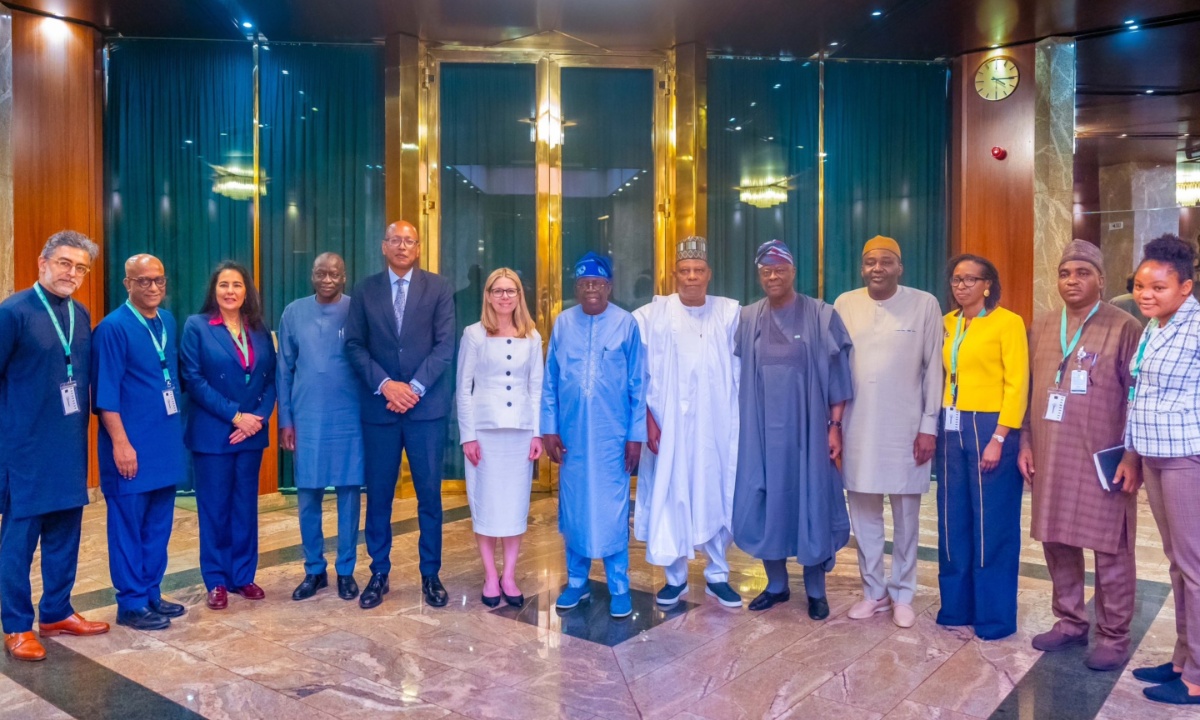
President Bola Ahmed Tinubu and Vice President Kashim Shettima on Tuesday received a high-level delegation from the World Bank at the State House in Abuja, in a meeting seen as part of ongoing engagement between Nigeria and international development partners.
The World Bank delegation was led by the Managing Director of Operations, Ms. Anna Bjerde. The meeting was held behind closed doors, and full details of the discussions have not yet been made public.
The visit was confirmed in a post on X (formerly Twitter) by the President’s Special Adviser on Information and Strategy, Mr. Bayo Onanuga.
Although the Presidency did not immediately release an official statement on the outcome of the meeting, the visit has attracted attention because of its timing and the current economic situation in the country.
The meeting comes at a time when Nigeria is working to stabilise its economy and carry out key reforms under the Tinubu administration.
Since assuming office in May 2023, President Tinubu has introduced major economic policies, including the removal of petrol subsidy and the unification of the foreign exchange market. These reforms, while aimed at long-term growth, have also led to short-term challenges such as rising inflation and cost of living pressures.
The World Bank has been one of Nigeria’s long-standing development partners, supporting projects in areas such as education, health, power, infrastructure, agriculture, and social protection.
Nigeria is currently one of the World Bank’s largest borrowers in Africa, with several active loans and development programmes across federal and state levels.
Ms. Anna Bjerde, who led the delegation, is the World Bank’s Managing Director of Operations. In this role, she oversees the Bank’s work in different regions, including Africa.
Her visit to Nigeria signals the importance the World Bank places on its relationship with the country, especially given Nigeria’s size, population, and influence on the African continent.
While the exact issues discussed at the State House meeting were not disclosed, such high-level talks typically cover economic performance, fiscal reforms, poverty reduction, and ways to improve service delivery to citizens.
The Abuja meeting came just 48 hours after Lagos State Governor, Mr. Babajide Sanwo-Olu, hosted a World Bank delegation at Lagos House, Marina, on Sunday.
That delegation was also led by Ms. Bjerde and included Mr. Ethiopia Tafara, the International Finance Corporation (IFC) Regional Vice President for Africa.
The Lagos meeting focused on development partnerships at the state level, particularly in areas such as infrastructure, transportation, climate resilience, and private sector investment.
Lagos State has a long history of working with the World Bank and other development institutions on major projects, including urban transport, drainage systems, health services, and education reforms.
Nigeria operates a federal system where both the central government and state governments play important roles in development.
The World Bank often works directly with states on specific projects while also engaging the federal government on national policies and reforms.
The meetings with Governor Sanwo-Olu and President Tinubu may be part of a broader review of World Bank-supported projects across the country.
They may also be linked to discussions on how to attract more private investment through the IFC, which focuses on supporting businesses and creating jobs.
Nigeria is currently facing several economic challenges, including high inflation, unemployment, and pressure on public finances.
The government has said it is committed to economic reforms aimed at restoring growth, improving revenue, and reducing poverty.
International partners like the World Bank often provide financial support, technical advice, and policy guidance to countries undergoing reform.
In recent years, the World Bank has supported Nigeria through budget support loans, social investment programmes, and funding for infrastructure and human capital development.
Although no official details were released, the presence of both the President and Vice President at the meeting suggests its importance.
Such meetings usually allow both sides to exchange views on Nigeria’s reform agenda and the World Bank’s role in supporting it.
They also provide an opportunity for Nigeria to explain its priorities and challenges directly to top officials of the global institution.
For the World Bank, engaging closely with Nigeria is critical, as developments in the country have a major impact on poverty levels and economic growth in Africa.
More details of the discussions may be released in the coming days, either by the Presidency or the World Bank.