
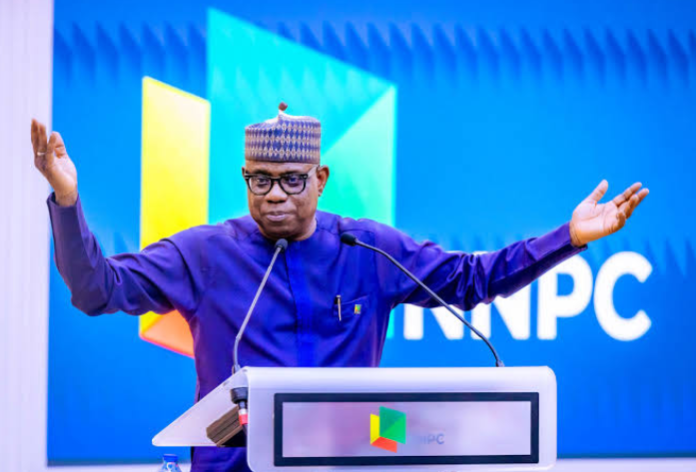
The Nigerian National Petroleum Company Limited (NNPC) has admitted that the country’s state-owned refineries were operating at a “monumental loss,” prompting management to halt operations to prevent further financial damage.
The disclosure came from the Group Chief Executive Officer (GCEO) of NNPC, Bayo Ojulari, on Wednesday in Abuja during a fireside chat titled “Securing Nigeria’s Energy Future” at the Nigeria International Energy Summit 2026. The session offered rare insights into the commercial and operational realities of Nigeria’s refining sector.
Ojulari said Nigerians’ frustration over the performance of the refineries was understandable. Over the years, the government has invested massive sums in these facilities, with the public expecting consistent fuel supply and operational efficiency.
“On the refineries, Nigerians were angry. A lot of money has been spent, and expectations were very high. So we were under extreme pressure, extreme pressure,” Ojulari said.
He admitted that refining was not his area of expertise, having spent most of his career in the upstream oil and gas sector, but said he quickly had to get up to speed to manage accountability effectively.
“My background is upstream, so I was on a vertical learning curve. You are accountable, so you must learn very quickly. Otherwise, there is no escape,” he explained.
Ojulari revealed that once his management team began a detailed review of refinery operations, the financial realities became clear.
“The first thing that became clear, and I want to say this very clearly, is that we were running at a monumental loss to Nigeria. We were just wasting money. I can say that confidently now,” he stated.
He explained that crude was consistently pumped into the refineries each month, yet utilisation levels hovered around 50–55 per cent. The situation caused huge value leakages as operational costs and payments to contractors far exceeded the value of products produced.
“We were spending a lot of money on operations, a lot of money on contractors. But when you look at the net, we were just leaking away value,” Ojulari said.
Even more concerning, he noted, was the absence of a credible plan to recover these losses. “Sometimes you make a loss during investment, but you have a line of sight to recovery. That line of sight was not clear here,” he added.
As a result, the first major decision of his administration was to halt refinery operations to prevent further financial bleeding and allow for a rapid reassessment.
“We decided to stop the refinery and do a quick check. We planned that if things were lined up, we would reopen and work on them,” he said.
Part of the value destruction, Ojulari said, stemmed from the quality of products being produced at the refineries. He cited the Port Harcourt Refinery as an example, explaining that the crude processed often produced mid-grade products, which were far less valuable than the inputs.
“The crude we were taking into Port Harcourt was producing mid-grade products. When you aggregate their value compared to what you put in, it was a waste,” he said.
He also acknowledged that halting operations was politically sensitive. Historically, NNPC has been pressured to keep refineries running to ensure fuel supply continuity, even when it was economically unsound.
“There were political pressures to keep the refinery product, lots of pressure. But when you have been trained for over 35 years to focus on commerciality and profitability, you can’t sleep with that,” Ojulari explained.
Nigeria’s four state-owned refineries—Port Harcourt (two plants), Warri, and Kaduna—have operated far below capacity for decades, despite repeated attempts at turnaround maintenance. At various times, these refineries have functioned at single-digit capacity or have been shut down entirely, forcing the country to rely heavily on imported fuel.
Between 2015 and 2023, successive administrations approved multiple rehabilitation contracts, yet domestic refining output remained negligible. This underperformance has intensified public scrutiny of NNPC’s operational efficiency and raised questions about the economic viability of continuing refinery operations under existing conditions.
Ojulari’s remarks represent one of the most candid acknowledgments by an NNPC chief executive that continued refinery operations, without significant structural reforms, were economically unjustifiable.
The GCEO’s statements also reflect a broader shift in NNPC under the Petroleum Industry Act (PIA), which aims to ensure commercial discipline even in politically sensitive areas such as domestic refining.
Ojulari highlighted that the decision to halt refinery operations was driven by the need to preserve value and ensure accountability in the use of public funds.
“Sometimes, decisions are politically sensitive, but our duty is to ensure commercial viability and protect the nation’s resources,” he said.
The NNPC chief noted that his leadership is committed to learning from past mistakes and instituting reforms that will make the refineries commercially sustainable and aligned with Nigeria’s energy goals.
Nigeria’s refining challenges have long contributed to fuel scarcity, price volatility, and dependence on imported petroleum products. Experts say that without decisive reforms, continued operations at loss-making refineries will deepen public losses and undermine confidence in domestic energy policy.
Ojulari’s candid disclosure provides an important step toward transparency and highlights the need for strong governance in Nigeria’s oil and gas sector.
The fireside chat at the Nigeria International Energy Summit 2026 also underscored broader discussions about securing Nigeria’s energy future, improving domestic refining capacity, and reducing dependency on imported fuel.
Moving forward, the NNPC leadership under Ojulari is expected to conduct a thorough assessment of refinery operations, determine strategies for commercial viability, and explore possible partnerships or modernization programs.
While the decision to halt operations may face political resistance, analysts say it is a necessary move to stop further erosion of public funds and restore credibility to Nigeria’s state-owned refineries.
Ojulari’s remarks mark a new phase in the management of NNPC, reflecting a commitment to financial accountability, operational efficiency, and the long-term sustainability of Nigeria’s oil and gas sector.