
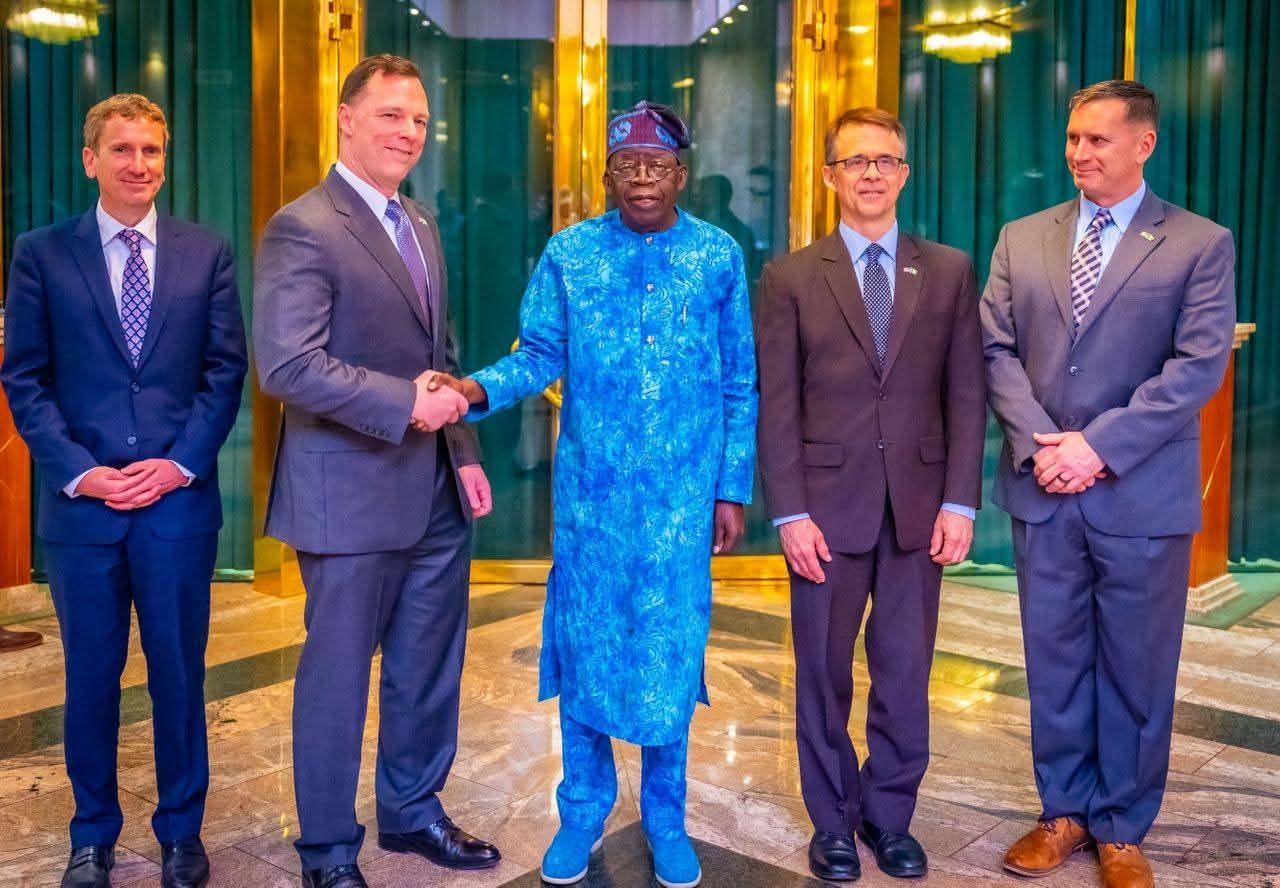
President Bola Tinubu on Sunday held high-level security talks with the Commander of the United States Africa Command (AFRICOM), General Dagvin Anderson, at the Presidential Villa in Abuja. The meeting brought together top military, intelligence, and security officials from both countries and comes at a time of renewed cooperation between Nigeria and the United States on counterterrorism and regional security.
The meeting was confirmed by the State House media office in a photo news statement released to journalists on Sunday evening. Although details of the discussions were not made public, the talks are believed to have focused on security challenges facing Nigeria and the wider West African region, especially terrorism, insurgency, and violent extremism.
The visit by the AFRICOM delegation followed recent airstrikes carried out on Christmas Day against terrorist camps in Sokoto State. The strikes targeted Islamic State-linked militants operating in the Bauni forest area of Tangaza Local Government Area. AFRICOM later confirmed that the operation was carried out at the direction of the President of the United States and the US Secretary of War, and in coordination with Nigerian authorities.
The airstrikes marked a major development in the security relationship between Nigeria and the United States, showing a higher level of joint action against terrorist groups operating in the region. Northern Nigeria, particularly the North-West and North-East, has continued to face attacks from armed groups linked to Islamic State and Boko Haram, as well as bandit groups involved in kidnapping and other crimes.
Sunday’s meeting also comes against the background of diplomatic tensions between both countries. In October 2025, US President Donald Trump redesignated Nigeria as a “Country of Particular Concern” under the International Religious Freedom Act. The designation was based on claims that Nigeria was tolerating serious violations of religious freedom, including the killing of Christians by radical Islamist groups.
Trump also warned that the United States could consider military action if the killings continued. The move sparked strong reactions in Nigeria, with the Federal Government rejecting the claims. Nigerian officials insisted that terrorist groups do not target Christians alone, but attack Muslims and Christians alike, as well as security personnel and civilians across the country.
The Nigerian government maintained that the violence in the country is driven by terrorism and criminality, not by government support for religious persecution. Officials also argued that Nigeria remains committed to protecting all citizens, regardless of religion or ethnicity.
In response to the designation and growing pressure from Washington, the Tinubu administration reportedly hired a US-based lobbying firm, DCI Group, for $9 million. The contract, signed in December 2025 through the Office of the National Security Adviser, was aimed at explaining Nigeria’s security efforts to US policymakers and maintaining American support for counterterrorism operations in West Africa.
The decision to hire the lobbying firm has drawn criticism from some US lawmakers, who questioned the use of funds and Nigeria’s human rights record. Despite the criticism, Nigerian officials say the engagement was necessary to correct what they described as a wrong narrative about the country.
Those present at Sunday’s meeting reflected the importance both sides attached to the talks. The US delegation included the Chargé d’Affaires at the US Embassy in Nigeria, Mr Keith Heffern; Command Sergeant Major Garric M. Banfield, AFRICOM’s Command Senior Enlisted Leader; and Ambassador Peter Vrooman, AFRICOM’s Senior Foreign Policy Adviser.
On the Nigerian side, President Tinubu was joined by key security chiefs. They included the National Security Adviser, Mallam Nuhu Ribadu; the Minister of Defence, General Christopher Musa (retd.); the Chief of Defence Staff, General Olufemi Oluyede; the Chief of Army Staff, Lieutenant General Waidi Shaibu; and the Chief of Defence Intelligence, Lieutenant General Emmanuel Uandiandeye.
Also in attendance were the Director-General of the National Intelligence Agency, Mohammed Mohammed, and the Director-General of the Department of State Services, Tosin Ajayi. The presence of top intelligence officials suggested that intelligence sharing and coordination were key parts of the discussions.
Nigeria and the United States have a long history of security cooperation, especially in the fight against terrorism. AFRICOM has supported Nigeria through training, intelligence sharing, logistics, and advisory roles. In recent years, the partnership has become more important as terrorist groups expand their activities across West Africa.
In November 2025, National Security Adviser Nuhu Ribadu visited Washington, where he held talks with senior Pentagon officials. After the visit, the United States said it would deepen security cooperation with Nigeria. AFRICOM later confirmed that it had continued joint operations and intelligence sharing with the Nigerian military.
President Tinubu, since assuming office, has made security a top priority of his administration. He has repeatedly said that no meaningful development can take place without peace and stability. His government has increased support for the armed forces and intelligence agencies and has also pushed for better coordination among security bodies.
The Christmas Day airstrikes in Sokoto were seen by many analysts as a sign of stronger action against terrorist groups that had found safe havens in remote forest areas. The Bauni forest, like other forests in the North-West, has been linked to the movement and operations of armed groups.
While the Federal Government welcomed the success of the strikes, some civil society groups have called for transparency and care to avoid civilian casualties during such operations. Both Nigerian and US officials have said that efforts are made to ensure precision and protect innocent lives.
As Nigeria continues to face pressure over security and human rights issues, Sunday’s meeting in Abuja signals a desire by both countries to maintain close engagement. Observers say the talks could help ease tensions, strengthen trust, and improve joint efforts to tackle terrorism and insecurity in Nigeria and the wider region.