
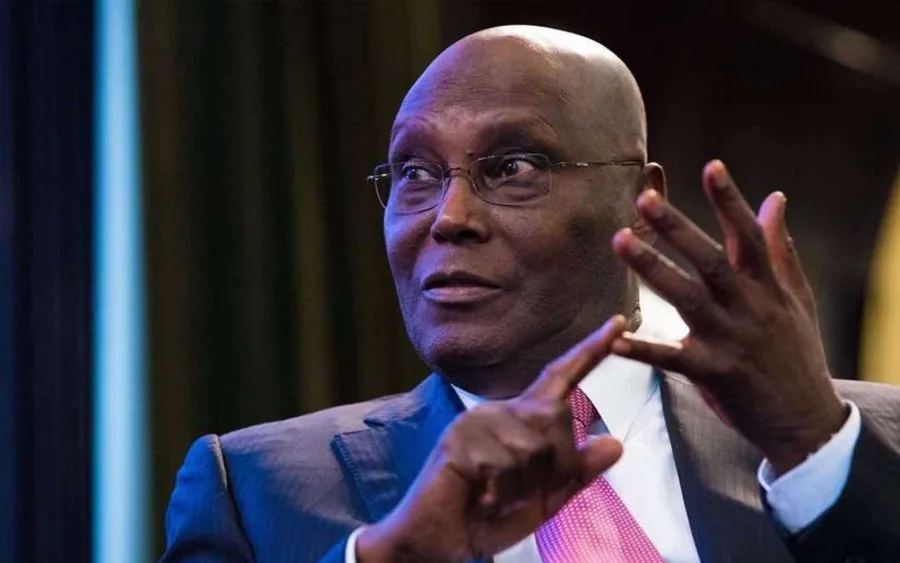
Former Vice President Atiku Abubakar has called on opposition political parties in Nigeria to unite and push for a transparent and credible electoral system, warning that the current plan to mix electronic and manual transmission of election results could lead to confusion and chaos.
Atiku made the call on Tuesday during a press briefing in Minna, Niger State, after a closed-door meeting with former Military President, General Ibrahim Babangida (rtd). He spoke against the backdrop of recent decisions by the Senate on amendments to the Electoral Act.
According to Atiku, Nigerians are expecting a clear and transparent election process that allows results to be transmitted electronically in real time from polling units. He said the Senate’s decision to allow a combination of electronic transmission and manual collation does not meet public expectations.
“The expectations of Nigerians are real-time electronic transmission of election results,” Atiku said. “What we got is a mixture of electronic and manual transmission, and this is going to cause more confusion or chaos than if we have a single-tier system that is fully electronic.”
Atiku stressed that having one clear method of transmitting results would reduce disputes and improve trust in the electoral process. He warned that combining two systems could create loopholes and raise doubts about the credibility of election outcomes.
According to him, a fully electronic system that transmits results in real time from polling units to central servers would be easier to manage and more transparent.
“That would be our preference,” he said. “And I think there is a need for all the opposition political parties to come together to pursue this issue.”
The former Vice President said the issue of credible elections goes beyond party politics and personal ambition, adding that it is about the future of Nigeria’s democracy.
Atiku also criticised the Senate’s recent adoption of the amended Clause 60(3) of the Electoral Act Amendment Bill. The clause allows electronic transmission of results but keeps manual collation as a backup option in areas where technology may fail.
The Senate took the decision during an emergency plenary session held after public backlash over an earlier version of the clause, which appeared to weaken the role of electronic transmission.
While the amendment was seen by some lawmakers as a compromise, Atiku said it does not go far enough to guarantee transparency.
“I don’t think we should allow it to rest where they wanted it to rest today,” he said. “Absolutely not. I don’t support that.”
He argued that without making electronic transmission compulsory and real-time, doubts would continue to surround election results.
The debate over electronic transmission of election results has been ongoing in Nigeria for several years. Many civil society groups, opposition parties, and election observers believe that electronic transmission will reduce result manipulation, delays, and human interference.
During the 2023 general elections, the Independent National Electoral Commission (INEC) introduced the Bimodal Voter Accreditation System (BVAS) and promised to upload results to its Result Viewing Portal (IReV). However, technical challenges and delays in uploading results led to controversies and legal battles.
These issues have kept the conversation around electoral reforms alive, especially as Nigeria prepares for future elections.
Supporters of electronic transmission argue that Nigeria already uses technology in banking, telecommunications, and voter registration, making it possible to fully adopt electronic transmission for elections.
Opponents, however, often point to poor network coverage, insecurity, and technical failures in some parts of the country as reasons to keep manual processes as backup.
Atiku said opposition parties must put aside their differences and speak with one voice on electoral reforms. He said unity among opposition parties is necessary to pressure the government and lawmakers to adopt policies that strengthen democracy.
According to him, a divided opposition makes it easier for weak reforms to pass without strong resistance.
He did not name specific parties but stressed that the issue affects all Nigerians, regardless of political affiliation.
When asked about his visit to Minna and speculations about the 2027 presidential election, Atiku dismissed claims that his presence had anything to do with early campaigning.
“Is it the first time you have seen me here? Certainly not,” he said. “I have always come here to pay my respects.”
On the issue of contesting the 2027 election, Atiku said the matter does not currently arise.
“The issue of contesting the 2027 election does not even arise,” he said.
He explained that his focus is on strengthening the African Democratic Congress (ADC), the party he currently belongs to.
“I am a member of ADC, and we are busy trying to make sure that our structures are firmly rooted from the ward level to the national level,” he said.
According to him, the party is also involved in mobilising supporters and registering new members across the country.
Atiku also spoke on the issue of zoning in political parties, a long-standing practice in Nigerian politics where key positions are rotated among regions.
He said the ADC does not have zoning in its constitution.
“In fact, the only party that has zoning in its constitution is the PDP,” he said.
Zoning has often played a major role in presidential elections, especially in debates about fairness and inclusion among Nigeria’s regions.
The Senate’s decision followed an emergency plenary session convened to reconsider a disputed clause in the Electoral Act Amendment Bill. The upper chamber approved the transmission of results to INEC’s Result Viewing Portal but refused to make electronic transmission compulsory.
It also rejected the idea of mandatory real-time upload of results, maintaining manual collation as a fallback option.
The decision has continued to attract mixed reactions from politicians, civil society groups, and the general public.
While some believe the compromise reflects Nigeria’s current technological realities, others, like Atiku, argue that it weakens electoral transparency and leaves room for manipulation.
As debates over electoral reforms continue, Atiku’s comments add to growing pressure on lawmakers to revisit the Electoral Act.