
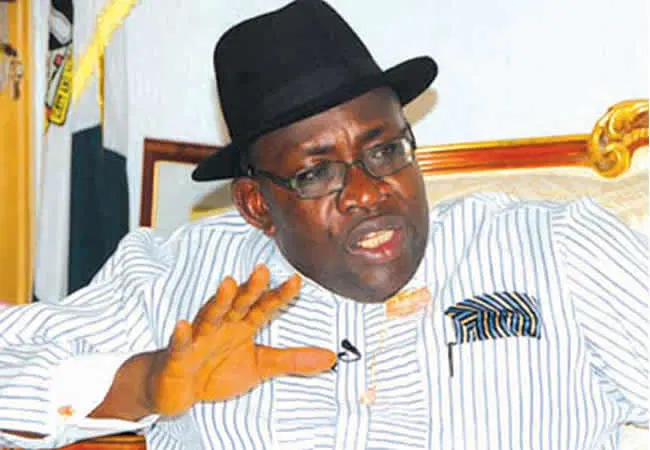
Senator Henry Seriake Dickson, who represents Bayelsa West in the National Assembly, has renewed his call for the adoption of electronic voting and full electronic transmission of election results in Nigeria. He expressed shock that there is still resistance and fear around the electronic transmission of results, even though voting and counting are done manually.
The senator made his position known on Thursday while speaking at a panel discussion on electoral reform organised by ActionAid Nigeria in Abuja. The event brought together civil society groups, activists, and stakeholders to discuss how to improve Nigeria’s electoral laws ahead of future elections.
Dickson thanked ActionAid Nigeria and other civil society organisations for their steady efforts to push for reforms in a peaceful manner. He said their commitment shows that many Nigerians still believe in democracy and want a better electoral process.
He urged citizens not to lose faith in the country or in its democracy. According to him, democracy can only grow stronger when people continue to participate and demand accountability.
During his remarks, Dickson said he was surprised by the ongoing debates and disagreements over electronic transmission of election results. He pointed out that Nigeria still conducts elections manually. Voters cast paper ballots. Votes are counted by hand. Results are written manually on forms at each polling unit.
He questioned why there should be fear about transmitting those same manually prepared results electronically to a central server.
“It is shocking,” he said, adding that the resistance shows the deeper challenges facing the country’s political system.
In recent years, the issue of electronic transmission has been at the centre of debates in the National Assembly. The 2022 Electoral Act made provisions for electronic transmission of results, but there have been complaints about inconsistent implementation during elections. Some politicians have argued that network challenges and technical issues make electronic transmission unreliable, especially in rural areas. Others insist that technology will reduce fraud and manipulation.
Dickson said Nigeria has “no business with excessive paperwork and manual voting” in this modern age. He argued that the current system creates room for interference, tampering, and human error.
The senator restated his long-standing position that Nigeria should move beyond partial reforms and adopt full electronic voting. Under such a system, voters would cast their ballots electronically at polling units. Results would then be recorded and monitored in real time.
According to him, this would improve transparency and reduce disputes after elections. He said civil society groups should work closely with lawmakers and other stakeholders to make this goal a reality.
For now, he admitted that Nigeria may not be fully ready for complete electronic voting. However, he said the minimum step should be the compulsory electronic transmission of results from each polling unit to a central server.
He referred to Form EC8A, the official result sheet completed at each polling unit. He said once this form is filled manually and signed by party agents, it should be scanned and transmitted electronically without delay.
Dickson urged the Independent National Electoral Commission (INEC) to issue clear and mandatory guidelines. According to him, every polling unit result must be electronically transmitted, and only results that have been transmitted should be used for collation at higher levels.
INEC introduced the Result Viewing Portal, known as IReV, to allow the public to view uploaded polling unit results. While the portal was praised for improving transparency, there were reports of delays and technical glitches during past elections. These problems led to court cases and public criticism.
Dickson said these challenges should not be used as excuses to abandon electronic transmission. Instead, he argued that the country should improve the system and fix the gaps.
To support his argument, the senator compared Nigeria’s electoral system with that of India. He noted that India has more than 980 million registered voters, with recent figures approaching 990 million. The country is known for its wide ethnic, religious, and cultural diversity. It also manages about one million polling stations during elections.
Despite these huge numbers, Dickson said, India conducts elections that are largely seen as free and fair. He said the Election Commission in India enjoys broad trust from political parties and citizens.
In contrast, Nigeria has about 176,000 polling units and far fewer registered voters. Yet, elections in Nigeria are often followed by disputes, court cases, and allegations of rigging.
The senator said Nigeria should learn from countries that have successfully used technology to strengthen their electoral systems. He added that trust in the electoral body is key to building confidence in democracy.
Dickson also renewed his support for the House of Representatives’ version of the Electoral Act amendment bill. He said that regardless of which version is eventually adopted, both the Senate and the House now agree in principle on electronic transmission of results.
He stressed that reforming the electoral system is not just a technical matter but a national duty. According to him, flawed elections have damaged Nigeria’s image and created division instead of unity.
Nigeria returned to democratic rule in 1999 after years of military government. Since then, the country has conducted several general elections. While there have been improvements over time, issues such as vote-buying, violence, and result manipulation have remained concerns.
Dickson warned that with a fast-growing youth population and high unemployment, the country cannot afford badly managed elections. He said many young Nigerians already feel frustrated due to lack of jobs, limited access to quality education, and economic hardship.
If elections are not handled properly, he cautioned, it could lead to a serious national crisis.
“We hope that day does not come,” he said.
In his closing remarks, the senator called on Nigerians to prepare for future elections by organising and mobilising. He urged citizens to register, collect their voter cards, and turn out to vote for candidates of their choice.
He also encouraged voters to insist that their votes count and that results from their polling units are electronically transmitted to INEC’s IReV portal by presiding officers.
“Don’t give up on our democracy. Don’t give up on elections. Organise and mobilise!” he said.