
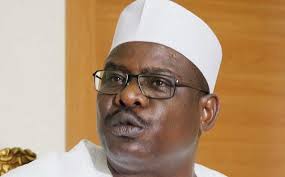
Ali Ndume has said he would again support the involvement of the United States military in carrying out airstrikes against Boko Haram insurgents operating in parts of North-East Nigeria.
The senator, who represents Borno South Senatorial District, made the remarks on Friday while speaking on Politics Today, a program on Channels Television.
Ndume said his position is based on the continued presence of Boko Haram fighters in communities within his constituency, especially around the Mandara Mountains, where he said insurgents have operated for more than a decade.
“I called for it,” Ndume said during the interview. “In fact, I was thinking that they will start from my local government. Yes, because the Boko Haram issue has dominated for the past 15 years.”
His comments have reopened debate about foreign military involvement in Nigeria’s fight against insurgency.
Ndume said the Mandara Mountains, which stretch along the Nigeria-Cameroon border, remain a stronghold for insurgents despite years of military operations.
“They have dominated the Mandara Mountain up till now,” he said. “And we had wanted, and have been calling that there must be consistent and sustained attack until they are all eliminated.”
The Boko Haram insurgency began in 2009 in Borno State. Over the years, it spread to other parts of the North-East, including Yobe and Adamawa states. The violence has also affected neighbouring countries such as Cameroon, Chad, and Niger.
The conflict has led to thousands of deaths and the displacement of millions of people. Many residents of Borno State have spent years in Internally Displaced Persons (IDP) camps.
According to humanitarian agencies, Borno remains one of the states most affected by insecurity in Nigeria. Although the Nigerian military has recorded several victories and reclaimed territories in recent years, attacks still occur in some rural and border communities.
Ndume said sustained and consistent military offensives are necessary to end the crisis and allow displaced people to return home.
“That’s when our people that are still in the IDP camps, under the mountain, can go back,” he said.
He explained that some residents still attempt to farm in the mountainous areas but are forced to flee whenever insurgents attack.
“There are people who still live in the mountains and farm in the mountains, but they have to run away. Boko Haram chase them. There are some of them that are still captives,” he added.
The Mandara Mountains have long been difficult terrain for security forces because of their rocky landscape and limited road access. Insurgents have often used the area as a hiding place.
Security experts say such terrain makes it harder for conventional ground troops to operate effectively without strong air support.
Ndume said residents of Gwoza and surrounding communities would welcome foreign military assistance if it would help restore peace.
“In fact, we want the… I’m speaking for my people, especially my own local government. If the 200 Americans that Nigerians are talking about now don’t have… they are not comfortable, please let them go to my local government and stay and operate from there, our people will be happy,” he said.
He even offered to vacate his home in Gwoza to accommodate foreign troops if that would bring lasting peace.
“I can move out of my house in Gwoza for them to come over my house for them to stay as long as we will have peace,” he said.
Gwoza, once declared the headquarters of Boko Haram’s self-styled caliphate in 2014, has witnessed some of the worst violence in the insurgency. Although Nigerian troops later recaptured the town, surrounding areas have continued to face threats.
Ndume revealed that due to insecurity, he has not been able to visit his own village for many years.
“For the past 16 years I cannot go to my village, especially this time around, no matter what, even under escort, you don’t risk going from now,” he said.
His remarks reflect the frustration of many residents in Borno who say insecurity has lasted too long.
Nigeria has in the past received support from foreign partners in its fight against Boko Haram. The United States has provided intelligence, training, and equipment to Nigerian forces.
There have also been joint operations involving regional forces under the Multinational Joint Task Force (MNJTF), which includes troops from Nigeria, Chad, Niger, and Cameroon.
However, direct US airstrikes inside Nigerian territory would likely raise questions about sovereignty and national security policy.
Some Nigerians argue that foreign military intervention could help speed up the defeat of insurgents, especially in hard-to-reach areas like the Mandara Mountains.
Others caution that Nigeria must rely mainly on its own armed forces and avoid heavy foreign military presence.
The Federal Government has repeatedly stated that Boko Haram has been “technically defeated,” meaning the group no longer holds large territories as it once did. However, splinter groups and other armed factions continue to carry out attacks, including kidnappings and raids on villages.
Human rights groups have also raised concerns about civilian casualties in air operations, urging careful planning and protection of non-combatants.
Ndume’s comments come at a time when insecurity remains a major national issue. Apart from Boko Haram in the North-East, other regions face challenges such as banditry, kidnapping, and communal clashes.
As a long-serving lawmaker from Borno, Ndume has often spoken about the suffering of his constituents. His latest call reflects what he described as the desperation of communities that have endured years of violence.
For many residents of Borno South, the main concern is not who carries out the operation but whether peace can finally return.
Families who have lived in IDP camps for years hope to return to their farms and rebuild their lives.
Ndume’s message was clear: he believes stronger and more sustained military action, including possible foreign air support, is necessary to end the insurgency.
Whether the Federal Government will consider such a move remains to be seen. But his remarks underline the deep frustration in communities that have lived under the shadow of Boko Haram for more than 15 years.
For now, the people of Gwoza and the wider Borno South Senatorial District continue to wait for lasting peace.