
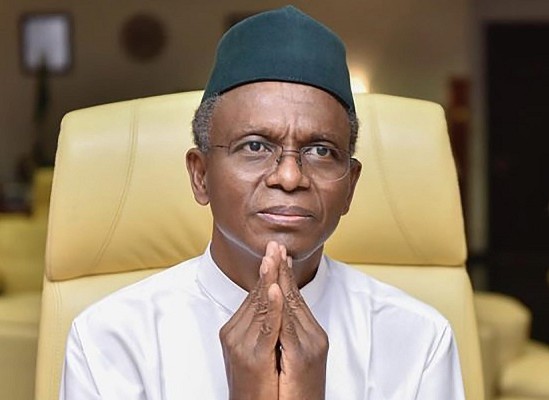
Former Kaduna State Governor, Nasir El-Rufai, was on Monday night detained by the Economic and Financial Crimes Commission (EFCC) after hours of questioning over an alleged N432 billion fraud probe.
El-Rufai arrived at the EFCC headquarters in Jabi, Abuja, around 10am following an invitation by the anti-graft agency. He was said to have been grilled throughout the day before he was held back late in the evening.
A source within the commission said the investigation into the former governor had been ongoing for about a year.
“As a commission, we do not rush to invite suspects. Persons accused are usually invited after investigations have reached an advanced stage,” the source said.
The EFCC spokesman, Dele Oyewale, confirmed that El-Rufai honoured the invitation but declined to give further details about the interrogation or the next step.
The probe is linked to a 2024 report by the Kaduna State House of Assembly, which accused the former governor’s administration of mismanaging loans, violating due process in awarding contracts, and pushing the state into heavy debt between 2015 and 2023.
The Kaduna State House of Assembly had set up an ad hoc committee in 2024 to examine the state’s finances during El-Rufai’s eight years in office.
While presenting the report during plenary, the committee chairman, Henry Zacharia, alleged that many of the loans obtained under El-Rufai were not used for the purposes for which they were secured.
The Speaker of the House, Yusuf Dahiru Leman, alleged that about N423 billion was siphoned during the period, leaving the state with serious financial liabilities and a rising debt profile.
The committee recommended that the former governor and some of his cabinet members be investigated and prosecuted for alleged abuse of office, diversion of public funds, money laundering, reckless borrowing, and awarding contracts without due process.
The Assembly later petitioned the EFCC and the Independent Corrupt Practices and Other Related Offences Commission (ICPC), urging them to investigate the matter.
Beyond the N423 billion allegation, the report also mentioned disputed payments and contracts worth over N155 million. It further alleged that N1.37 billion meant for a light rail project was diverted and that N64.8 million was laundered by senior aides.
El-Rufai has consistently denied the allegations. He described the probe as politically motivated and insisted that all loans obtained during his tenure were properly approved and used for infrastructure, education reforms, healthcare improvements, and security.
However, his detention suggests that the EFCC has moved from preliminary review to active interrogation.
El-Rufai, a former Minister of the Federal Capital Territory and a prominent political figure, has recently been vocal in criticising the Federal Government and security agencies. His latest legal troubles have added to political tension in the country.
While the EFCC was questioning El-Rufai over financial matters, the Federal Government filed criminal charges against him at the Federal High Court in Abuja over alleged unlawful interception of the phone communications of the National Security Adviser, Nuhu Ribadu.
The three-count charge, marked FHC/ABJ/CR/99/2026, was filed under the Cybercrimes (Prohibition, Prevention, etc.) Amendment Act, 2024, and the Nigerian Communications Act, 2003.
The charges stem from comments El-Rufai allegedly made during an appearance on Arise TV’s Prime Time Programme on February 13, 2026.
According to court documents, he allegedly admitted during the interview that he and unnamed associates intercepted Ribadu’s phone communications.
In one of the counts, the Federal Government alleged that El-Rufai admitted to unlawfully intercepting the NSA’s communications, an offence punishable under Section 12(1) of the Cybercrimes Act.
Another count accused him of failing to report someone he knew had intercepted the NSA’s phone, while the third count alleged that he and others used technical equipment to compromise national security.
During the television interview, El-Rufai reportedly said he learnt of an alleged plan to arrest him through a leaked conversation from the NSA’s phone.
He was quoted as saying that although the act was technically illegal, the government also listened to calls without court orders.
The comments sparked strong reactions from government officials and security experts. Analysts warned that if true, the interception of the NSA’s phone could amount to a serious breach of national security.
The Special Adviser to the President on Information and Strategy, Bayo Onanuga, accused El-Rufai of trying to create political tension and divert attention from the corruption allegations in Kaduna State.
In Nigeria, unauthorised interception of phone calls is a serious offence. Under the Cybercrimes Act 2015, offenders can face up to 10 years in prison, fines of up to N10 million, or both, depending on the offence.
As of press time, no date had been fixed for El-Rufai’s arraignment.
In a related development, the Department of State Services has reopened investigations into the 2019 disappearance of Abubakar Idris, popularly known as Dadiyata.
Dadiyata, a lecturer at the Federal University Dutsinma in Katsina State, was declared missing on August 1, 2019, after gunmen reportedly took him from his residence in Kaduna. His whereabouts remain unknown nearly seven years later.
Security sources said the DSS had begun probing El-Rufai and his sons in connection with the case. However, no formal charges have been announced.
The reopening of the case adds another layer to the mounting legal and political challenges facing the former governor.
Amid the unfolding controversy, President Bola Tinubu on Monday praised Ribadu during a one-day visit to Adamawa State.
Speaking at the Government House in Yola, the President described Ribadu as honest, bold, and committed to his duties as National Security Adviser.
“With you, we will defeat the bandits and terrorists,” Tinubu said, adding that Adamawa State should be proud of its son.
The President’s remarks came days after El-Rufai wrote a letter dated January 30, 2026, accusing the Office of the National Security Adviser of procuring about 10 kilogrammes of thallium sulphate, a toxic chemical.
In the letter, El-Rufai asked Ribadu to clarify the purpose of the chemical and whether relevant health agencies were notified.
The Office of the National Security Adviser denied the allegation in a response dated February 13, 2026 and referred the matter to the DSS for investigation.