
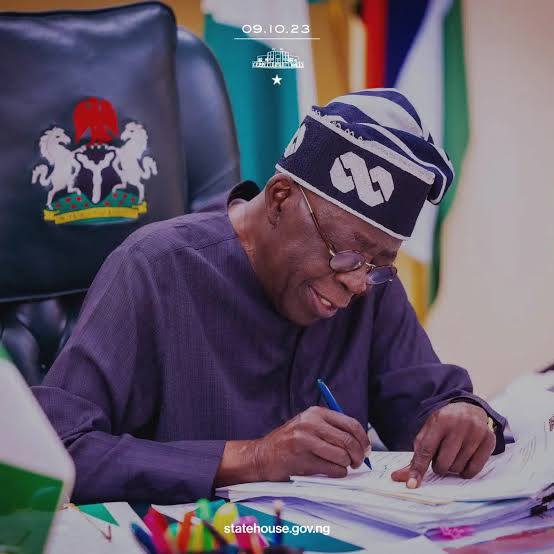
President Bola Tinubu on Wednesday signed the Electoral Act 2026 (Amendment) into law, just days after the Independent National Electoral Commission (INEC) released the timetable for the 2027 general elections.
The signing ceremony took place around 5:00 p.m. at the Presidential Villa in Abuja. Principal officers of the National Assembly were present at the event, marking the completion of the legislative process that began earlier this year.
The National Assembly passed the amendment bill on Tuesday before transmitting it to the President for assent.
The new law comes at a crucial time as political parties and stakeholders prepare for the next round of general elections. INEC has already fixed February 20, 2027, for the Presidential and National Assembly elections, while Governorship and State Houses of Assembly elections will be held on March 6, 2027.
The amendment has, however, revived debates about the use of technology in Nigeria’s elections, especially the electronic transmission of results from polling units.
A major issue surrounding the amended Electoral Act is the electronic transmission of election results. Civil society groups and opposition figures have long demanded real-time transmission of results directly from polling units to INEC’s central server.
Supporters of electronic transmission argue that it will reduce human interference, prevent tampering during collation, and increase public confidence in election outcomes. They believe that technology, if properly implemented, can strengthen Nigeria’s democracy.
The debate gained fresh attention following the 2023 general elections. During that election, INEC introduced the Bimodal Voter Accreditation System (BVAS) and promised to upload results to its Results Viewing Portal (IReV) in real time. However, the portal experienced technical problems on election day. Many results were not uploaded immediately, leading to widespread complaints and allegations of rigging from opposition parties.
Last week, protesters gathered at the National Assembly complex in Abuja to demand clear legal backing for live electronic transmission of results. The protesters said the problems experienced in 2023 should not be repeated in 2027.
They argued that without strong legal provisions, Nigeria could face another round of disputes and court cases after the elections. Many Nigerians will recall that the outcome of the 2023 presidential election was challenged up to the Supreme Court, following disagreements over the conduct of the polls.
On the other hand, some stakeholders have urged caution. They say not all parts of Nigeria have strong telecommunications networks. Rural communities, in particular, face poor internet connectivity. These stakeholders suggest a phased or hybrid system that allows manual collation in areas where electronic transmission fails.
The ruling All Progressives Congress (APC) has expressed support for greater use of technology but also agrees that infrastructure challenges must be considered. Lawmakers involved in the amendment say the new law seeks to provide clearer guidance on how technology should be deployed during elections.
With the 2027 general elections less than a year away, preparations are already underway. INEC’s early release of the election timetable is seen as part of efforts to give political parties and voters enough time to prepare.
Nigeria’s elections are among the largest democratic exercises in Africa. The country has over 90 million registered voters spread across 36 states and the Federal Capital Territory. Ensuring credible elections remains a major concern for citizens and the international community.
Since Nigeria’s return to democracy in 1999, electoral reforms have been introduced to address challenges such as ballot box snatching, voter intimidation, and result manipulation. The Electoral Act 2022 introduced several reforms, including the use of technology for voter accreditation and result management.
However, controversies from the 2023 elections showed that legal reforms alone are not enough. Many Nigerians are calling for stronger institutions, better training for election officials, and improved technology systems.
Civil society organisations have welcomed the amendment but say the real test will be its implementation. They are urging INEC to begin early testing of its electronic systems and to work closely with telecommunications providers to improve network coverage in underserved areas.
For many Nigerians, the main issue is simple: they want their votes to count. As political activities begin to gather momentum ahead of 2027, attention will remain on how the new law addresses past shortcomings.
The coming months are expected to see further engagement between INEC, political parties, civil society groups, and security agencies to ensure a peaceful and transparent process.
With President Tinubu’s signature now in place, the focus shifts from legislation to implementation. The success of the 2027 elections may depend largely on how well the provisions of the amended Electoral Act are applied across the country.

