
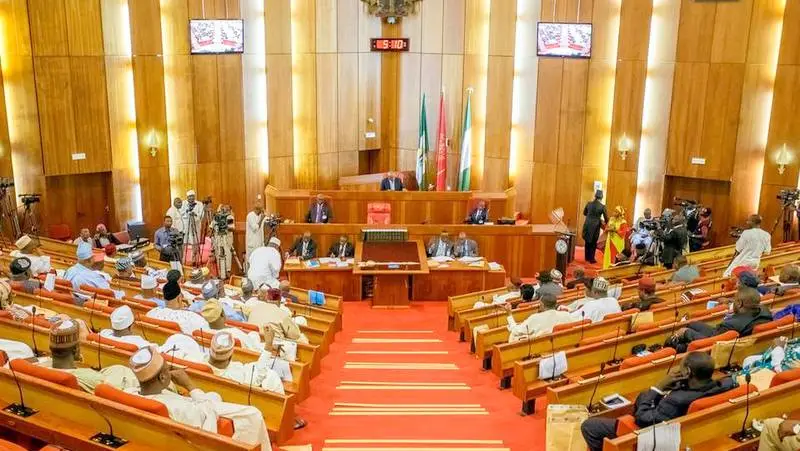
The Senate on Thursday grilled the Federal Government’s economic team for about five hours over rising national debt, projected revenues, and what lawmakers described as “unrealistic assumptions” in the proposed 2026 budget.
The session followed deliberations on the N58.472 trillion 2026 Appropriation Bill, during an interactive meeting with the Senate Committee on Appropriations, chaired by Senator Solomon Olamilekan Adeola (Ogun West).
Lawmakers focused on the government’s oil production benchmarks, revenue projections, debt servicing costs, and the implementation record of previous budgets, especially the disbursement of capital funds to Ministries, Departments, and Agencies (MDAs).
The Minister of Finance and Coordinating Minister of the Economy, Wale Edun, said security spending remained a priority under the proposed budget.
“We all agree that security is to be prioritised. I can assure you that emergency funding has been given. Critical foreign payments for security equipment have been made at least twice this year that I know of, including as recently as yesterday,” Edun told the panel.
On the issue of oil production, Edun described the proposed benchmark of 1.84 million barrels per day as a “stretch target,” designed to drive improved output rather than a guaranteed figure.
“It is a stretch target so that the authorities do not settle for lower output. But as long as we do not spend what we do not have, we are within safe limits,” he said.
Senators also questioned the nation’s debt profile, currently estimated at around N152 trillion. Edun explained that the challenge was not the debt-to-GDP ratio, but the high cost of borrowing in international markets.
“The problem is the pricing. Developing countries are forced to pay high interest rates in international markets. That is where the difficulty lies,” he said. He added that Nigeria is chairing the technical group of the G24, discussing debt sustainability and rising interest rates.
Edun noted that stabilising the system required careful management of interest rates and exchange rates. “When this administration came in 2023, we were paying heavily to stabilise the system. You cannot undermine interest rate mechanisms without consequences. If you do not maintain credibility, the exchange rate will move,” he added.
The Chairman of the Federal Inland Revenue Service, Zacch Adedeji, warned that inflated revenue projections could undermine budget efficiency. He emphasised that the Petroleum Industry Act links government earnings to taxes and royalties rather than total oil production.
“Budget efficiency is not in the quantum of the budget; it is in what you can carry out,” Adedeji said. “The only connection between the government and whatever is produced is the taxes and royalties paid. If production costs are high, the net revenue to the government is affected.”
Senator Adeola told the economic team that the executive arm must provide credible revenue projections, noting discrepancies between projected and actual oil revenues in previous years.
“This document before us originated from the executive. The projections and challenges came from the executive arm, not the legislature. The gap between projected and realised oil revenue is wide. For example, how do we explain 18 per cent performance in one year and projections of 36.5 per cent the next year when actual performance is still below expectations?” he said.
The lawmaker raised the question of whether to reduce the proposed N58.472 trillion budget or proceed while making adjustments. He suggested that disposing of certain assets to reduce debt could lower the overall debt stock and future borrowing costs.
Concerns were also raised over capital funding for previous budgets. The Minister of State for Finance, Doris Uzoka-Anite, assured the committee that outstanding payments for 2024 and 2025 capital projects would be processed before March 31, 2026.
“Regarding the 2025 budget, funding processes are beginning. Payments for outstanding 2024 capital projects start today. The financial management system is back online. For 2025, MDAs have been asked to upload their cash plans by Monday, after which payments will commence. We are ready to start, but the MDAs must complete their documentation requirements,” Uzoka-Anite said.
The session also featured contributions from the Minister of Budget and Economic Planning, Senator Atiku Bagudu, and the Accountant-General of the Federation, Shamsedeen Babatunde Ogunjimi.
Lawmakers emphasised the need for realistic budget assumptions to ensure that government spending remains within limits and that planned projects are fully funded. Analysts say repeated shortfalls in capital releases in previous years have slowed infrastructure development and delayed critical services.
Nigeria’s proposed 2026 budget of N58.472 trillion represents one of the largest federal budgets in the country’s history. The allocation covers recurrent expenditure, capital projects, security spending, debt servicing, and interventions in agriculture, health, and education.
Security spending has become a key focus of the budget, reflecting ongoing threats from insurgency in the North-East, banditry in the North-West, and criminal activities in other regions. The government has prioritised the acquisition of critical equipment and emergency funds to strengthen the security agencies.
The session concluded with a closed-door meeting before the Senate adjourned further consideration of the bill. The lawmakers are expected to return to debate the budget after reviewing additional clarifications and assurances from the economic team.
The interactive session underscores the importance of accountability, transparency, and careful financial planning in Nigeria’s budget process. The government’s ability to meet its revenue targets and manage debt sustainably will be closely monitored by the legislature and the public.
With the N58.472 trillion budget under scrutiny, lawmakers, analysts, and citizens alike are awaiting the Senate’s recommendations on adjustments to ensure that the nation’s spending priorities align with available resources and economic realities.