
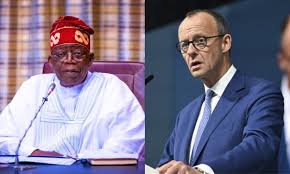
President Bola Tinubu has requested the supply of used helicopters from Germany to support security operations in the Sahel region, as Nigeria seeks to strengthen intelligence and reconnaissance efforts against rising threats in the area.
The request was made during a telephone conversation between Tinubu and the German Chancellor, Friedrich Merz, on Wednesday afternoon. The call, which lasted about 10 minutes, focused on security concerns in the Sahel, as well as cooperation in the power, railway and cultural sectors.
According to a statement issued by the President’s Special Adviser on Information and Strategy, Bayo Onanuga, both leaders agreed on the need to improve bilateral relations between Nigeria and Germany.
Tinubu reportedly told the German leader that the Sahel corridor remains unstable and requires urgent support.
“The Sahel corridor is bad and needs our support. Intelligence support reconnaissance is needed,” the President said during the conversation.
The statement did not confirm whether Germany agreed to provide the helicopters.
The Sahel region stretches across parts of West and Central Africa and has become a major hotspot for terrorism and armed groups. Countries such as Mali, Niger and Burkina Faso have witnessed frequent attacks by extremist groups in recent years. The insecurity has also affected neighbouring countries, including Nigeria, especially in the North-East and North-West regions.
Security experts say helicopters play a vital role in intelligence gathering, surveillance and rapid response. Used helicopters, if provided, could support Nigeria’s armed forces in monitoring remote and hard-to-reach areas along the borders.
Nigeria has been working with regional partners and international allies to tackle insecurity in the Sahel. The country has participated in joint military efforts and intelligence sharing to contain the spread of armed groups.
Beyond security, Tinubu and Merz also discussed economic cooperation, particularly in the power sector. The President highlighted Nigeria’s need for assistance in strengthening electricity transmission.
The talks brought renewed attention to the long-standing Siemens power project between Nigeria and Germany. The agreement, valued at about $2.3 billion, was signed in 2019 to improve electricity supply in Nigeria by modernising and expanding the national grid.
The project involves the German engineering company Siemens and aims to gradually increase Nigeria’s power transmission capacity. However, progress on the project has been slow.
In December 2021, the Federal Executive Council approved $1.9 million and €62.9 million for the first phase of the project. The first phase was designed to rehabilitate existing transmission infrastructure and improve grid stability.
Last November, President Tinubu acknowledged some progress on the project but said it had not met expectations. Many Nigerians continue to experience unstable power supply, despite years of reforms and investments in the electricity sector.
According to Onanuga’s statement, Chancellor Merz assured Nigeria that Siemens would continue to support the project. He also said Deutsche Bank would be willing to provide financing to help move the project forward.
Nigeria has long struggled with electricity challenges. Despite having an installed capacity of over 10,000 megawatts, actual power generation often falls far below demand due to transmission and distribution problems. Improving the national grid has been seen as a key step toward boosting economic growth and industrial development.
The leaders also discussed cooperation in the railway sector. Nigeria has in recent years invested heavily in rail transport as part of efforts to modernise infrastructure and ease pressure on roads. Partnerships with foreign companies have been central to these efforts.
In addition to security and infrastructure, the conversation touched on cultural ties. Chancellor Merz reportedly called for the establishment of a Great Museum of African Arts, reflecting Germany’s interest in supporting African cultural heritage.
The issue of cultural collaboration is important in Nigeria-Germany relations. In recent years, Germany has returned some Benin artefacts to Nigeria, strengthening diplomatic ties between the two nations.
Merz also said Germany is looking forward to receiving Nigeria’s new ambassador. Diplomatic representation is seen as crucial for deepening trade, investment and political cooperation.
Germany is one of Nigeria’s major European trading partners. The two countries cooperate in areas such as energy, security, migration and education. Germany has supported several development projects in Nigeria, particularly in renewable energy and vocational training.
Security in the Sahel remains a pressing issue. The withdrawal of some Western forces from parts of the region has raised concerns about a possible security gap. Nigeria, as the largest economy in West Africa, is expected to play a leading role in regional stability.
While it is not yet clear whether Germany will supply the requested helicopters, the discussion signals Nigeria’s readiness to explore various options to strengthen its defence capacity.