
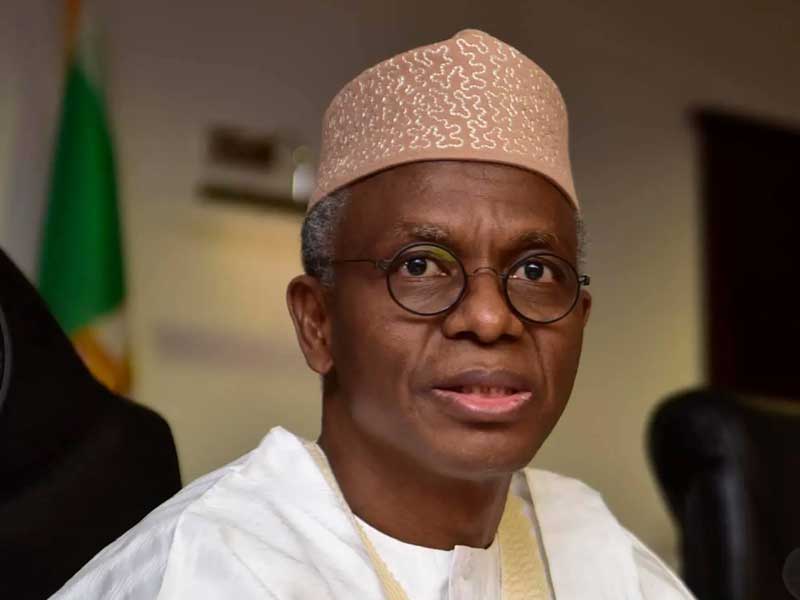
The Department of State Services (DSS) has fixed February 25 to arraign former Kaduna State Governor, Nasir El-Rufai, before the Federal High Court in Abuja over alleged cybercrime and breach of national security.
The case, marked FHC/ABJ/CR/99/2026, was assigned to Justice Joyce Abdulmalik by the Chief Judge of the Federal High Court, John Tsoho. The court has scheduled February 25 for El-Rufai’s formal arraignment.
Court documents show that the DSS filed a three-count criminal charge against the former governor on Monday. The agency accused him of unlawfully intercepting the telephone lines of the National Security Adviser (NSA), Nuhu Ribadu.
According to the DSS, El-Rufai’s alleged actions violate provisions of the Cybercrimes (Prohibition, Prevention, etc.) Amendment Act, 2024, as well as the Nigerian Communications Act, 2003.
In the first count, the DSS alleged that on February 13, 2026, while appearing as a guest on Arise TV’s Prime Time Programme in Abuja, El-Rufai admitted during a live interview that he and others unlawfully intercepted the phone communications of the NSA.
The security agency said this admission, if proven, is contrary to and punishable under Section 12(1) of the Cybercrimes Amendment Act, 2024.
In the second count, the DSS accused the former governor of stating during the same interview that he knew and related with a person who unlawfully intercepted the NSA’s phone communications but failed to report the individual to relevant security agencies.
The alleged offence is said to be punishable under Section 27(b) of the same Act.
Details of the third count were not fully disclosed at press time, but sources close to the matter said it relates to actions considered harmful to national security.
The charges stem from comments El-Rufai made during the live Arise TV interview. During the programme, he claimed that he overheard a conversation in which Ribadu allegedly directed security operatives to detain him.
He linked the alleged directive to what he described as an attempted arrest at the Nnamdi Azikiwe International Airport on February 12, shortly after he returned from Cairo, Egypt.
El-Rufai said he was surprised by the development and suggested that the situation was politically motivated. However, the DSS appears to have taken issue with his claim of intercepting or having access to the NSA’s telephone communications.
Phone interception without lawful authorisation is considered a serious offence under Nigerian law. The Cybercrimes Act criminalises unauthorised access to communication systems, including telephone conversations and digital messages.
El-Rufai’s legal troubles have deepened in recent days. Before the DSS charges, he had been detained by the Economic and Financial Crimes Commission (EFCC) for questioning over an alleged N432 billion fraud case.
He was reportedly granted administrative bail around 8 p.m. on Wednesday after several hours in custody.
However, shortly after his release from the EFCC, he was said to have been taken into custody by the Independent Corrupt Practices and Other Related Offences Commission (ICPC) over separate allegations.
As of the time of filing this report, it was not clear whether the ICPC investigation is directly related to the DSS charges.
Nasir El-Rufai served as Governor of Kaduna State from 2015 to 2023. Before that, he was Minister of the Federal Capital Territory from 2003 to 2007. He is known as a strong political voice and has remained active in national affairs since leaving office.
During his time as governor, El-Rufai carried out reforms in education, infrastructure and public service. However, his administration also faced criticism over security challenges and policy decisions in the state.
The DSS, as Nigeria’s secret police, is responsible for protecting the country against threats to national security, including terrorism, espionage and cybercrime.
The Federal High Court in Abuja has jurisdiction over matters relating to federal laws, including cybercrime and national security.
If he pleads not guilty, the case will proceed to trial, where the prosecution must present evidence to support the charges.
El-Rufai has not yet publicly responded to the DSS charges at the time of this report. His lawyers are expected to address the media before or after the court appearance.
The case has already generated debate among political commentators and civil society groups. Some believe the matter should be handled strictly according to the law without political interference. Others have called for transparency to ensure that justice is done and seen to be done.
Under Nigerian law, every accused person is presumed innocent until proven guilty by a court of competent jurisdiction.
As the February 25 date approaches, attention will be on the Federal High Court in Abuja, where one of Nigeria’s most prominent politicians will face fresh legal scrutiny over allegations touching on cybercrime and national security.