
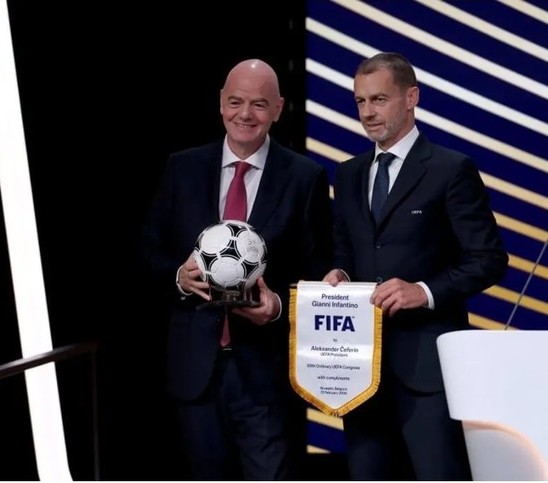
The presidents of world and European football governing bodies have been accused of “aiding war crimes” and “crimes against humanity” in a formal complaint submitted to the International Criminal Court.
The complaint targets Gianni Infantino, president of FIFA, and Aleksander Ceferin, president of UEFA.
The 120-page document was filed on February 16 at the ICC Office of the Prosecutor in The Hague, Netherlands. It was submitted by a coalition of advocacy groups, including Irish Sport for Palestine, Scottish Sport for Palestine, Just Peace Advocates, Euro-Med Human Rights Monitor, and Sport Scholars for Justice in Palestine. The complaint also includes Palestinian footballers, clubs, landowners and a human rights organisation based in Palestine.
At the centre of the complaint is the claim that FIFA and UEFA allow Israeli football clubs located in settlements in the occupied West Bank to compete in official leagues organised by the Israel Football Association. The advocacy groups argue that these settlements are built on land taken from Palestinians.
According to the joint statement released by the groups, FIFA and UEFA not only allow these clubs to play but also provide financial and structural support to them. Some of these clubs have reportedly taken part in competitions organised by UEFA.
The groups claim that by permitting such participation, the football bodies are helping to “normalise” life in settlements that are considered illegal under international law by many global institutions.
They further argue that these actions may contribute to what they describe as the transfer of civilian populations into occupied territories, which they say goes against provisions in the Rome Statute, the treaty that established the ICC.
The complaint also alleges discrimination, claiming that Palestinians are not allowed to attend matches in these settlements as spectators, nor can they play for or manage the clubs located there.
Israel has long rejected claims by the United Nations and the International Court of Justice that all settlements in the occupied West Bank violate international law. Israeli authorities argue that the status of the territories should be resolved through negotiations.
The issue of settlements has been one of the most disputed aspects of the Israeli-Palestinian conflict, which has lasted for decades. The conflict centres on competing claims to land and statehood between Israelis and Palestinians.
In a statement provided to The Athletic, UEFA strongly rejected the accusations against its president.
“The accusations against our president are as sensational as they are unsubstantiated,” UEFA said. “We stand for sport and humanity, not politics. Our actions speak louder than headlines.”
UEFA added that it would not comment further and insisted that such matters should be addressed in the proper institutions rather than in the media.
At the time of reporting, FIFA had not publicly responded to the complaint.
The ICC is an international court that investigates and prosecutes individuals accused of serious crimes such as genocide, war crimes, crimes against humanity and the crime of aggression. It does not try organisations, but individuals can be held responsible for their actions or decisions within those organisations.
The Office of the Prosecutor will now conduct a preliminary examination to determine whether there is enough legal basis to open a full investigation.
The complaint follows earlier pressure on football authorities. In October, Amnesty International wrote an open letter urging FIFA and UEFA to suspend the Israel Football Association until settlement clubs are removed from its leagues.
The letter argued that football cannot be separated from what it described as Israel’s unlawful occupation of Palestinian territory.
UEFA has also faced calls from some of its member associations to reconsider Israel’s participation in European competitions. In late September, the organisation reportedly considered holding a vote on the matter. However, the plan was shelved after a ceasefire between Israel and Hamas was brokered by the United States on September 29.
Earlier this month, in an interview with Sky News, Infantino said banning Israel from football competitions would be “a defeat.” He stated that national teams should not be punished for the actions of political leaders.
Infantino also said he would explore the possibility of changing FIFA’s statutes to prevent countries from being banned due to political conflicts.
His comments reflect a long-standing position by FIFA that football should remain neutral and separate from political disputes. However, critics argue that sports bodies cannot ignore human rights concerns.
The complaint has renewed debate about the role of sports organisations in global political issues. Over the years, international sports bodies have faced similar pressure in other conflicts, including calls to suspend countries over human rights concerns or military actions.
Supporters of the ICC complaint say sports bodies must ensure they do not indirectly support actions that may violate international law. They argue that allowing clubs based in disputed settlements to compete under official structures sends a political message.
On the other hand, defenders of FIFA and UEFA maintain that sports should unite people and avoid becoming a tool for political campaigns.
For now, the ICC’s preliminary examination will determine the next step. There is no guarantee that a full investigation will be launched. If it proceeds, it would mark a significant development, as it would involve top officials of global sports organisations.
The case highlights the growing scrutiny faced by international governing bodies, not only in sports but also in human rights matters.
As the ICC reviews the complaint, both supporters and critics of the action will be watching closely. The outcome could have wider implications for how global sports organisations handle political and human rights issues in the future.