
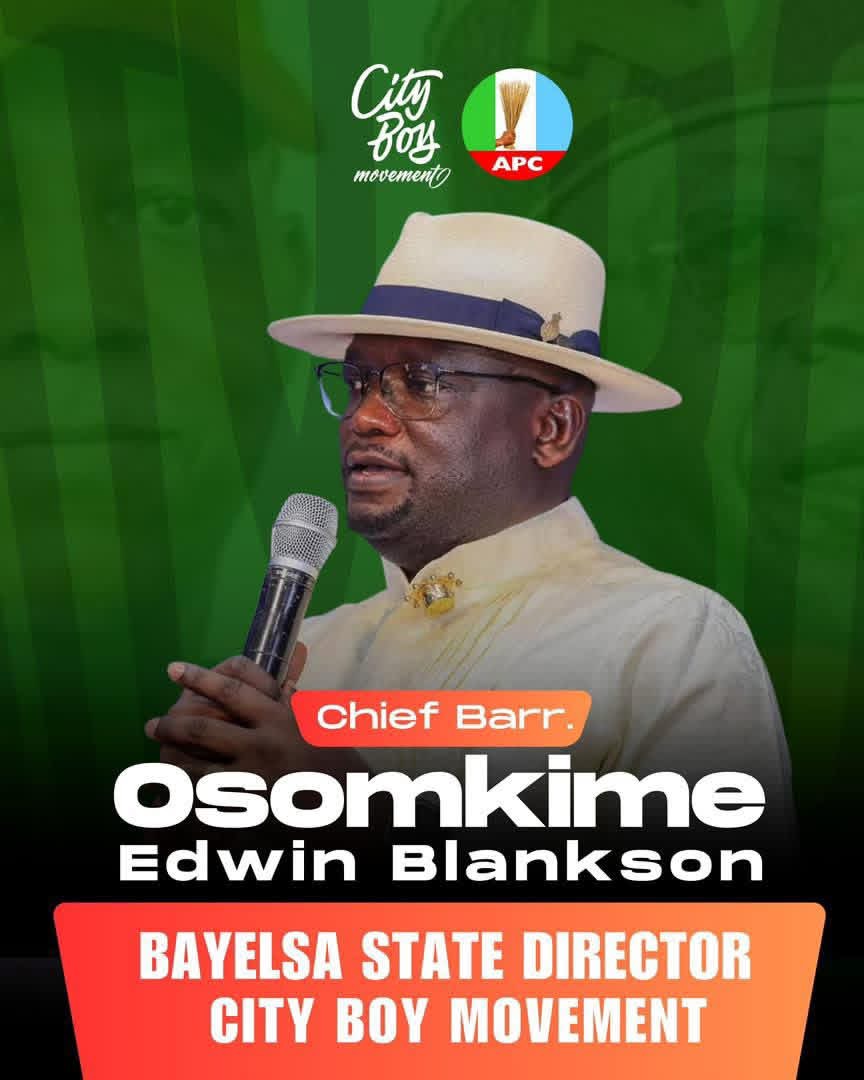
The City Boy Movement has appointed Bayelsa-based All Progressives Congress chieftain, Barrister Osomkime Blankson, as its State Director, in what observers describe as a strategic move to strengthen grassroots mobilisation ahead of future political engagements and the 2027 general elections.
The appointment, announced by the national leadership of the group, is part of broader efforts to expand its structure, deepen youth engagement, and consolidate political support in the South-South region.
According to a statement by the movement, the decision followed consultations and assessment of Osomkime’s political experience, organisational ability, and grassroots influence in Bayelsa State.
The group said his selection reflects confidence in his leadership and commitment to promoting its ideals and programmes.
The City Boy Movement is a political support group linked to President Bola Tinubu and operates under the grand patronage of his son, Seyi Tinubu.
It focuses on youth mobilisation, leadership development, and civic participation among young Nigerians.
The organisation has in recent months intensified efforts to build structures across states and regions, which many political observers see as part of early preparations for the next election cycle.
Confirming the development, the group noted that Osomkime would serve as its principal representative in Bayelsa State and coordinate activities in line with national objectives.
The movement said the appointment would help strengthen its presence and programmes across the eight local government areas of the state.
“The appointment is part of efforts to strengthen the Movement’s grassroots structures and expand programmes aimed at youth engagement and leadership development,” the statement said.
The group also described Osomkime as a dependable mobiliser with strong grassroots connections.
It added that his leadership would help galvanise young people and promote participation in civic and political processes.
Reacting to his appointment, Osomkime expressed appreciation to the national leadership for the confidence reposed in him.
He pledged to focus on youth empowerment, political awareness, and unity among members in the state.
“I am honoured by this appointment and fully committed to building a strong and inclusive platform in Bayelsa,” he said.
The development has attracted reactions from political stakeholders and supporters in Bayelsa, many of whom described the appointment as a step toward expanding political engagement among young people.
Political analysts say the growing activities of support groups such as the City Boy Movement highlight the importance of grassroots mobilisation in Nigeria’s political landscape.
They noted that political campaigns in the country increasingly rely on structured networks, youth engagement, and digital mobilisation.
The appointment also reflects the rising influence of youth-focused organisations in shaping political participation and leadership development.
Observers say such groups are playing a larger role in building political awareness and preparing future leaders.
Nigeria has one of the youngest populations in the world, with a large percentage of voters below the age of 35.
This demographic reality has made youth mobilisation a key priority for political actors and organisations.
The City Boy Movement has positioned itself as a platform to mentor young people and encourage their involvement in governance and public service.
It also promotes entrepreneurship, skills development, and community engagement.
The group has recently announced several state and zonal appointments as part of efforts to strengthen its nationwide structure.
In February, it appointed a North Central zonal youth coordinator to enhance political awareness and coordinated participation among young people in the region.
Analysts say these moves indicate early political preparation and long-term strategy.
The political environment in Nigeria has remained active since the 2023 elections, with parties and support groups already repositioning ahead of 2027.
Experts say early consultations and mobilisation are common, as political actors seek to build networks, identify candidates, and strengthen alliances.
Bayelsa State, located in the oil-rich Niger Delta, is considered politically strategic because of its economic importance and influence in national politics.
Although traditionally dominated by opposition parties, recent years have seen increasing competition and political realignments.
Observers say the expansion of support groups in the region reflects growing interest by national political actors.
The appointment of Osomkime may therefore signal an attempt to broaden political engagement and attract new supporters.
Political analysts also note that grassroots mobilisation remains one of the most effective tools in Nigerian elections.
They argue that while social media plays a growing role, physical presence and local structures remain critical in influencing voter behaviour.
This is particularly important in rural communities and among young voters.
The development comes amid national conversations about youth inclusion and leadership.
Many young Nigerians have called for greater participation in decision-making and governance.
In recent years, campaigns such as “Not Too Young To Run” have pushed for more youth involvement in politics.
However, challenges such as funding, political barriers, and limited opportunities remain.
Support groups and civic organisations are therefore seen as platforms to prepare young people for leadership roles.
Experts believe such structures could help improve political awareness, reduce voter apathy, and strengthen democracy.
They also say youth engagement can promote innovation and new ideas in governance.
As Nigeria moves closer to the next election cycle, political consultations and mobilisation are expected to increase across the country.
The coming months may witness more alliances, appointments, and strategic engagements among political actors.
For now, the appointment of Osomkime as Bayelsa State Director of the City Boy Movement highlights the growing role of youth-focused political organisations in Nigeria’s evolving democratic process.
It also underscores the importance of grassroots mobilisation and structured engagement in shaping the future of the country’s politics.

